The unit price on a quotation is not what you pay per bag. Between the sewing line and the container, a handful of packing decisions — polybag thickness, whether units ship flat or stuffed, how many go in a carton — decide how much freight is spent moving air and how many units arrive sellable. They get made late, by default, and surface on the first invoice.
From the line to the container
A finished bag passes through a short chain: inspection and trim, shape preparation, polybag, carton packing, sealing and shipping marks, then palletising or loose-loading. Trim is the cheapest step and the one most often squeezed — a shame, because a customer pulling a bag from a polybag covered in thread ends forms an opinion before looking at the stitching.
Flat, rolled, or stuffed
Flat-packing maximises density and suits e-commerce fulfilment, where the bag gets re-folded anyway. The risk is creasing: heavier coated fabrics and thick foam laminates can take a permanent set if folded the same way through a sea transit, worth revisiting when you review denier and coating specs.
Stuffing holds retail shape and costs volume — you pay freight for the air inside. Rolling suits soft duffels and bags with no rigid frame and avoids hard creases, though it is harder to keep consistent on a line. Decide by channel: flat-packing retail units to save freight and then wondering why they look tired on the shelf is a false economy.
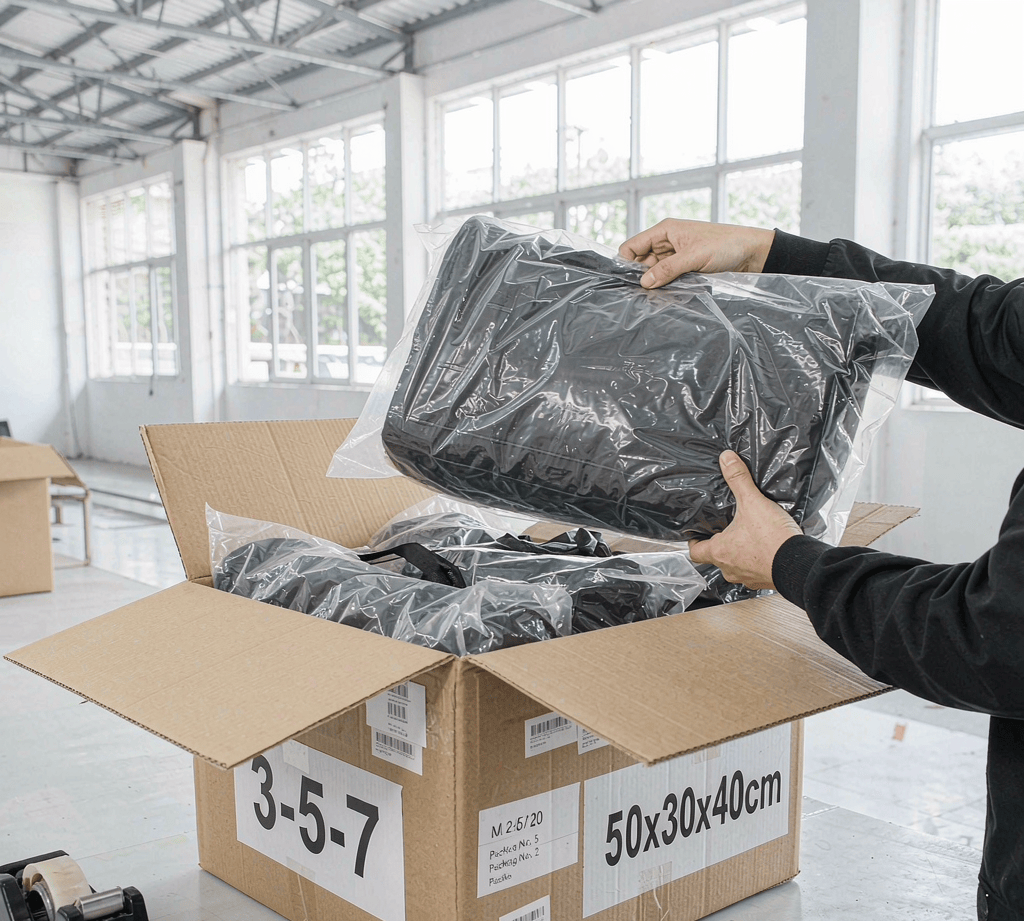
Polybags: thickness, vents, print
Material. PE is softer and quieter; PP is crisper and more transparent but creases audibly. Most bag orders run PE.
Thickness. Too thin and bags tear in transit or warehouse handling; too thick and you pay for material you don’t need, plus any plastic packaging levy the destination applies.
Venting and warnings. Suffocation warnings and vent holes are required on plastic bags above a certain size in several destination markets. Requirements vary by region and sometimes by language, so confirm per market instead of assuming one print works everywhere.
Closure and labelling. Adhesive flap, tape, heat seal, or resealable zip — resealable costs more but reduces damage when returns go back into stock. Decide now whether the barcode goes on the bag, the polybag, or only the carton; getting it wrong means relabelling at the destination warehouse.
If you’re specifying recycled content, sample it first — recycled PE is often less clear and can vary in seal strength between batches.
Carton spec: board, fit, closure
Single-wall board handles most bag orders; double-wall earns its cost for heavy loads, long transits, or cartons stacked several layers deep. Buyers typically specify strength as either a burst value or an edge-crush value, which measure different things — puncture resistance from inside versus stacking compression. Pick one and make sure the mill certificate matches it.
Fit matters both ways: an undersized carton bulges, splits at the seams, and crushes product, while an oversized one wastes freight and loses stacking strength. H-taping is standard; strapping helps heavy cartons, but over-tensioned strapping crushes corners and deforms structure — a slow, invisible version of the damage you meant to avoid.
Pack-out ratio and container math
This is where landed cost quietly moves. A carton measuring 60 × 40 × 50 cm is 0.12 cubic metres. A 40ft high-cube has a nominal internal volume around 68 cubic metres, so roughly 560 cartons fit in theory, a little fewer once you allow for stowage loss. At 10 units per carton, that is about 5,500 units per container.
Push one dimension to 65 × 40 × 50 cm and you are at 0.13 cubic metres: about 520 cartons, roughly 400 units of capacity lost on the same container. Freight per unit is the freight bill divided by units shipped, so density is a cost lever just as fabric yield is — the same arithmetic behind what drives the cost to manufacture a backpack.
Suppliers often prefer a fixed master carton because it grids cleanly into a container. That is legitimate, but ask to see the numbers rather than accepting “standard carton.”
What to agree before the PO
- Polybag material, thickness, venting, warning print, and any recycled content requirement
- Flat, rolled, or stuffed, plus stuffing material
- Carton board construction and which strength measure applies
- Units per carton and finished carton dimensions
- Shipping marks, carton numbering, label placement
- Palletised or loose-loaded, plus maximum stack height
- Photo evidence of packed cartons and container loading before departure
Packing sits at the very end of development, which is why it’s decided under time pressure. Building it into sampling and development milestones keeps it from becoming a last-minute compromise — particularly when quantities are negotiated at the same time, as they are with minimum order quantities on custom runs.
Carton decisions that drift past the PO stage tend to land back on the critical path, which is why packing belongs inside the wider production calendar rather than in a final-week email.
FAQ
Should bags ship flat or stuffed?
Match it to the channel. E-commerce fulfilment tolerates flat-packing; retail shelving generally does not, especially for structured bags. Mixed channels often justify two pack-out specs on one order.
Do polybags need vent holes?
In many markets, plastic bags above a minimum size require ventilation and a suffocation warning. Requirements vary by region and language, so confirm per market.
Who decides carton size?
Usually the factory proposes and the buyer approves. Treat it as a starting point — ask for carton dimensions and the container count, then check freight per unit yourself.
Can changing packing change the unit price?
Yes, both ways. Thicker polybags, double-wall cartons, stuffing, and palletising add cost per unit, while better density lowers freight per unit.
Related reading
For the wider sourcing context packing sits inside — supplier vetting, quotations, and shipping terms — see this guide to sourcing bags from China.
Buyers comparing suppliers can review our full bag catalog for OEM/ODM specs, materials, and MOQ.