Most bag factories quote a minimum order quantity between 300 and 500 pieces per style, per color. That floor exists to cover fixed setup costs — cutting dies, printing screens, and fabric-mill minimums — not to lock you out. Below that range, unit price rises sharply because the same setup cost spreads across fewer units, so knowing the math helps you plan a first order and a realistic budget.
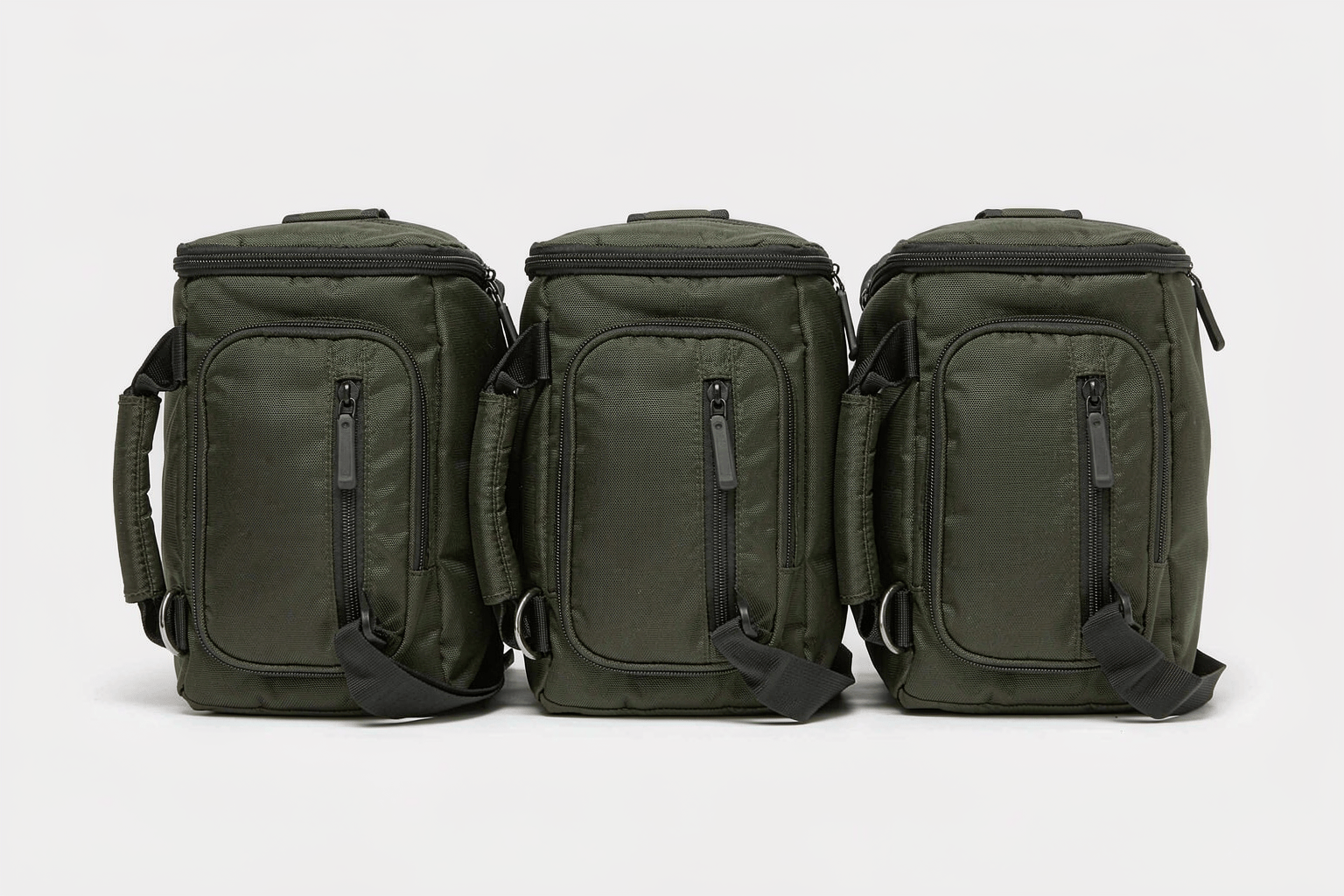
Why a factory quotes a minimum order quantity
A minimum order quantity (MOQ) is not an arbitrary gate. It is the volume at which a factory recovers the fixed costs of spinning up your specific product before variable sewing labor begins. Three components dominate the floor.
| Setup component | What it pays for | Typical one-time cost | Recovers at |
|---|---|---|---|
| Steel-rule cutting die | Laser-cut template for each panel size | $50–$200 per size | ~150–300 pcs |
| Screen / engraving setup | Per-color screen or embroidery digitizing | $30–$100 per color | ~200–400 pcs |
| Material mill minimum | Fabric, webbing, zipper ordered at mill floor | 500–3,000 m | Drives bulk MOQ |
A factory running a 600D polyester backpack cannot order 80 meters of a custom color from the mill — the mill’s minimum is usually 500–1,000 m per color. That single constraint, not the sewing line, often sets your true MOQ. When you understand which component is binding, you can decide whether to absorb setup, share a material lot, or accept a higher per-unit price on a smaller run.
Typical MOQ by bag category
Minimums vary by how many panels, how much hardware, and how complex the construction is. The ranges below reflect standard OEM/ODM quoting for a new style with one custom color.
| Bag category | Typical first-order MOQ | Why this range |
|---|---|---|
| Backpack | 300–500 pcs | Many panels, multiple dies, 7–9 SPI stitching |
| Tote / shopping bag | 200–400 pcs | Few panels, simple construction |
| Duffle / holdall | 300–600 pcs | Base reinforcement, webbing handles |
| Laptop / business bag | 300–500 pcs | Padding, suspended base, hardware |
| Golf / travel bag | 300–500 pcs | Structured frame, long zippers |
| Small pouch / accessory | 500–1,000 pcs | Material mill minimum dominates |
Accessories sit highest because a pouch uses little fabric per unit, so the mill’s 500–1,000 m floor translates into many more finished pieces before it is consumed. A backpack, by contrast, eats meters faster, so the sewing setup — not the fabric — becomes the binding constraint at 300–500 pcs.
How material and decoration method shift your MOQ
Two choices move the floor more than anything else: the fabric you specify and how you decorate it. Both pull against the mill minimums above.
| Choice | Effect on MOQ | Practical note |
|---|---|---|
| Custom-dyed fabric | +500–1,000 m order | Share a dye lot across 2–3 SKUs to soften it |
| Stock fabric, custom color | Often waived | Factory may hold base cloth inventory |
| Embroidery logo | 300+ pcs | Digitizing is cheap; fabric min still binds |
| Screen print (per color) | 300+ pcs | Each color adds a $30–$80 screen |
| Woven / printed label | 500+ pcs | Label mill minimum dominates |
| Heat transfer / digital | 200+ pcs | Needs coated substrate; lower floor, higher per-pc |
If your brand needs a unique color, ask the factory to reserve a dye lot you can split across a tote and a pouch — that turns one 800 m minimum into two sellable SKUs instead of one oversized order. Decoration method is the easier lever: a heat-transfer or digital run can start near 200 pcs, while a woven label alone can lift you to 500.
The MOQ–unit-price curve
Lower volume is not free — it simply costs more per piece. The mechanism is arithmetic, not margin stacking. Take a $120 cutting die and a $60 per-color screen on a 500-piece order: the setup totals $180, or $0.36 per bag. Cut the run to 150 pieces and that same $180 becomes $1.20 per bag before a single stitch is sewn.
In practice, moving from a 300-piece first order to a 1,000-piece reorder typically lowers the ex-works unit price by 15–30%, almost entirely from setup amortization and better material utilization. That is why a factory will happily quote a lower price at 1,000 pcs — they are not discounting to win the deal, they are passing back recovered fixed cost. Budget your launch at the 300–500 floor, then plan the reorder that unlocks the real margin.
What is negotiable, and what is not
Some parts of an MOQ are flexible; others are physics. Knowing the difference saves a wasted negotiation.
- Negotiable: tier pricing (e.g., $4.20 at 300 pcs, $3.60 at 1,000 pcs), a paid trial run at a premium, combining two colorways into one dye lot, or accepting stock fabric to drop the material floor.
- Rarely flexible: the fabric-mill minimum on a custom dye, zipper and webbing minimums from component suppliers, and certification batches (a REACH or OEKO-TEX Standard 100 test covers a material lot, not a piece count).
- Worth asking: whether the factory can carry your cutting die and screen for a future reorder — that removes setup from the second order entirely and is a strong signal of a partnership-minded supplier.
The realistic outcome is not “no MOQ” but “a floor you can plan around.” A factory that shows you the die cost, the screen cost, and the mill minimum is giving you a defensible quote; one that quotes a round number with no breakdown is asking you to trust the floor.
Red flags when a factory’s MOQ sounds wrong
MOQ is also a diagnostic. Two patterns deserve a second look before you send a tech pack.
- Suspiciously low with no setup fee. A quote of “50 pcs, any color, no tooling” usually means the supplier is trading, not manufacturing — they are pulling from a marketplace or a domestic warehouse. That is fine for a sample, but it will not scale to a protected custom design or a defensible cost structure.
- Suspiciously high for a simple item. A 2,000-piece floor on a basic tote suggests capacity is booked or the line is optimized only for bulk, which may not fit a launch-and-learn strategy.
- Vague certification claims. If REACH, California Prop 65, OEKO-TEX Standard 100, ISO 9001, BSCI, or Sedex are promised with no documentation path, the MOQ is the least of your risk.
A credible manufacturer states the floor, shows the components, and tells you which certs attach to the material lot versus the factory system. That transparency is the real qualification signal — more than the number itself.
How to brief a factory for a realistic MOQ quote
The fastest way to get a usable number is a complete tech pack, not a photo and a target price. Include these so the quote reflects your actual floor:
- Construction spec — panel list, fabric denier (600D / 840D / 1680D), foam thickness (8–12 mm EVA for laptop protection), and stitch density (7–10 SPI).
- Color and material plan — custom dye vs. stock, and whether colors can share a lot.
- Decoration — embroidery, screen print, woven label, or heat transfer, with color count.
- Compliance targets — REACH, Prop 65, OEKO-TEX Standard 100, plus system certs ISO 9001 / BSCI / Sedex if required for your market.
- Quality level — AQL 2.5 / 4.0 per ANSI/ASQ Z1.4, with inspection point.
- Lead-time window — standard production runs 35–55 days, plus 25–40 days ocean freight to a major port.
Send your tech pack for a manufacturability review and a costed quote that states the MOQ, the setup behind it, and the reorder price that recovers it: Request a quote →
A separate walkthrough of the full sourcing sequence — from tech pack to FOB — is useful reading before you brief a supplier: How to source bags from China: a buyer’s guide. For vetting the factory behind the number, see How to choose the right bag manufacturer.
The wider context sits in How to Start a Custom Bag Line with a Manufacturer.
The measurable thresholds behind that call are listed in Custom Bag Material Options: Canvas, Nylon, PU, Recycled.
Frequently asked questions
Q: What is a realistic MOQ for a first order with a new bag factory?
A: Plan on 300–500 pieces per style, per color for a structured bag like a backpack or duffle. Totes can start near 200, while small accessories often need 500–1,000 because the fabric-mill minimum dominates. Treat the first order as a launch run, not the volume order.
Q: Can I order 100 pieces for a market test?
A: Usually not from a cut-and-sew OEM, because the cutting die, screen setup, and fabric minimum are not recovered below ~150–300 pieces. A 100-piece test is better served by a trading supplier with stock, accepting that the design will not be protected or cost-optimized.
Q: Why does my MOQ go up when I add a second color?
A: A second color typically triggers another screen or embroidery setup and, if custom-dyed, another 500–1,000 m fabric minimum. Factories often quote per colorway, so two colors can mean two near-full minimums rather than one shared lot.
Q: Does a higher MOQ always mean a much lower unit price?
A: Not linearly. The biggest drop is from the first order to the first reorder, where setup is already absorbed — often 15–30% on a move from 300 to 1,000 pieces. Beyond that, savings flatten because variable sewing labor dominates. The MOQ floor, not the ceiling, is where price changes most.
Q: Which certifications add to MOQ or cost?
A: Certifications rarely raise piece count, but they add cost. REACH and Prop 65 are material-formulation checks; OEKO-TEX Standard 100 tests a material lot; ISO 9001, BSCI, and Sedex are factory-system audits. Budget the test or audit as a per-lot or per-year cost, not a per-piece MOQ.
Q: How long does a 300–500 MOQ order take from tech pack to FOB?
A: Standard production is 35–55 days once materials are in house, with another 25–40 days for ocean freight to a major destination port. Sampling adds 7–14 days before bulk cutting. Confirm the calendar at quotation, because material lead time — not sewing — is usually the critical path.
Buyers comparing suppliers can review our full bag catalog for OEM/ODM specs, materials, and MOQ.