A carry-on fails for one of two reasons: it is too big for the gauge at the gate, or it is heavy enough when empty that it eats the weight allowance before anything goes inside. Sort out the external dimensions first, then judge the shell, the wheels, and the handle.
The Size Rule Is Not One Number
There is no universal carry-on size. IATA publishes a suggested maximum of 55 × 40 × 20 cm, and that figure gets quoted everywhere, but it is a recommendation rather than a rule. Each airline sets its own limit.
- Major US carriers commonly allow around 22 × 14 × 9 in, roughly 56 × 36 × 23 cm.
- Several European budget carriers include only a much smaller personal item in the base fare, around 40 × 20 × 25 cm, and charge extra for anything larger.
- Asian carriers often publish a weight limit alongside the dimensions, sometimes as low as 7 kg for the cabin bag.
Two practical points follow. Measure the external dimensions including wheels and handles, because that is what the sizer at the gate measures. And treat a softside bag as more forgiving than a hardside one, since fabric can compress an inch into a frame where a rigid shell cannot.
Limits also move from year to year, which is worth checking against the travel bag trends for 2026 before a shell size is locked in.
Hardside or Softside
The choice is mostly about what you carry and where you check it.
- Polycarbonate shells are light for their strength and flex under impact instead of cracking. This is the common mid-to-upper tier.
- ABS is cheaper and stiffer, which means it is more likely to crack rather than dent when a handler drops it.
- Aluminium frames and shells are the most protective and the heaviest, and they show every scuff.
- Softside bags in ballistic nylon or heavy polyester weigh less empty, compress into tight sizers, and give you external pockets for the things you need mid-flight.
If you carry camera bodies, glass, or anything crushable, the hard shell earns its weight. If you routinely fly carriers with tight gauges, the softside saves you the gate-check fee.
The Wheels Decide How It Feels
Four-wheel spinners can be pushed upright beside you, which takes the load off your wrist and shoulder on a long terminal walk. The trade-off is that the wheels sit outside the shell, they count toward the external dimensions, and they are the part most likely to be snapped off by a baggage belt.
Two-wheel bags drag behind you. They pack smaller because the wheels recess into the body, and they handle kerbs and rough ground better. They put more strain on one arm over distance.
On either type, look at the wheel itself. Polyurethane wheels run quieter and last longer than hard plastic, and wheels held in with a bolt can be replaced, while riveted ones usually cannot.
Empty Weight Is a Real Cost
A 20-inch hardside typically weighs somewhere around 2.5 to 3.5 kg empty; a softside of the same size often lands nearer 2 to 2.5 kg. Against a 7 kg cabin allowance on some carriers, the shell alone can take a third of what you are allowed. Every kilogram saved on the bag is a kilogram you can spend on contents instead.
This is also why the lightest handle system matters: a telescoping handle with several height settings and very little wobble at full extension tends to survive longer than a cheaper two-stage one that rattles.
What Counts Inside
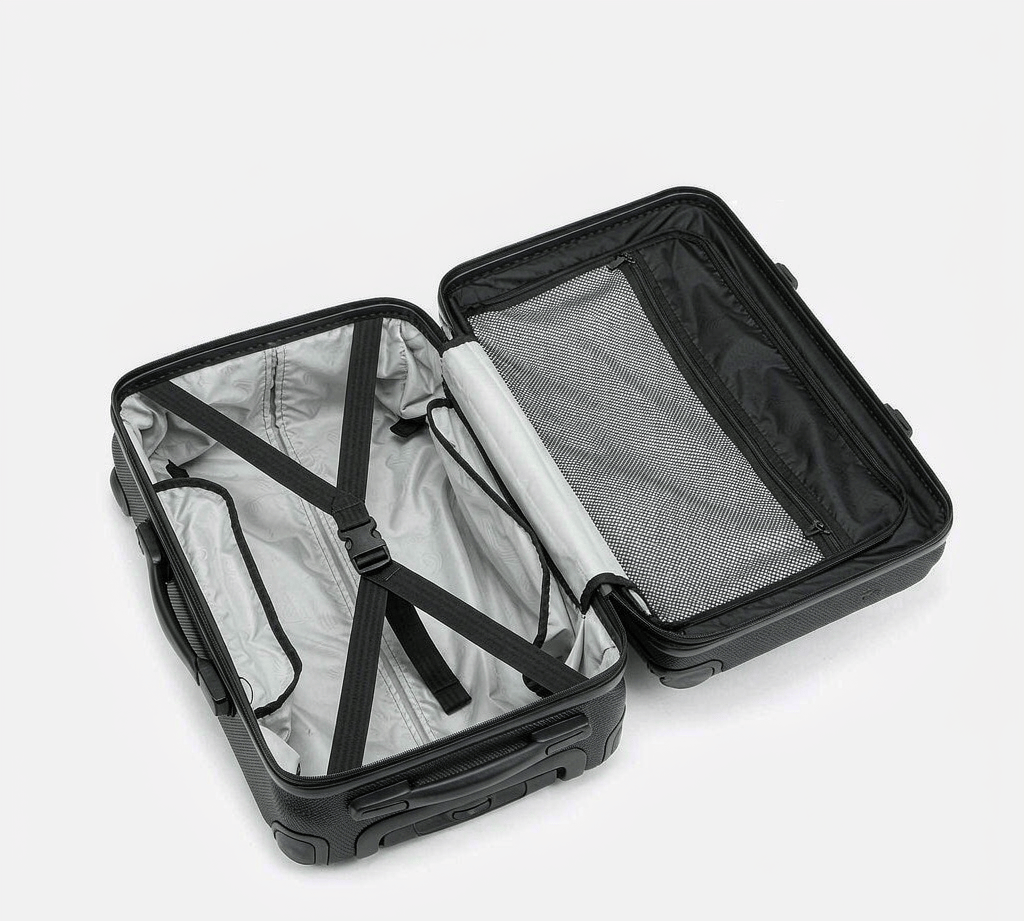
- Compression straps keep contents from shifting, which is what causes wrinkled clothes and broken zips.
- A laptop sleeve should sit against the back panel so the weight stays close to your body rather than pulling you backwards.
- Expansion zips are genuinely useful on the return leg of a trip, but an expanded bag often exceeds the gauge. Expand when you check, not when you board.
Quick Checklist
- External dimensions, wheels included, match your usual carriers.
- Shell material chosen for what you carry, not for looks.
- Wheel material and whether they can be replaced.
- Empty weight checked against the tightest allowance you fly.
- Compression straps and a back-panel laptop sleeve.
FAQ
Is the 55 × 40 × 20 cm carry-on size a rule? No. It is IATA’s suggested maximum and a useful design target, but the airline you fly sets the actual limit. Budget carriers in particular often allow far less than that in the base fare.
Are four wheels better than two? Four wheels are easier through a terminal and put less strain on your arm, but they sit outside the shell, count toward the size gauge, and are more exposed to damage. Two-wheel bags pack smaller and take rough ground better.
How much should an empty carry-on weigh? Roughly 2 to 2.5 kg for a softside and 2.5 to 3.5 kg for a 20-inch hardside. If you fly carriers with a 7 kg cabin limit, that difference matters more than the shell material does.
Buyers comparing suppliers can review our luggage and trolley bags for OEM/ODM specs, materials, and MOQ.