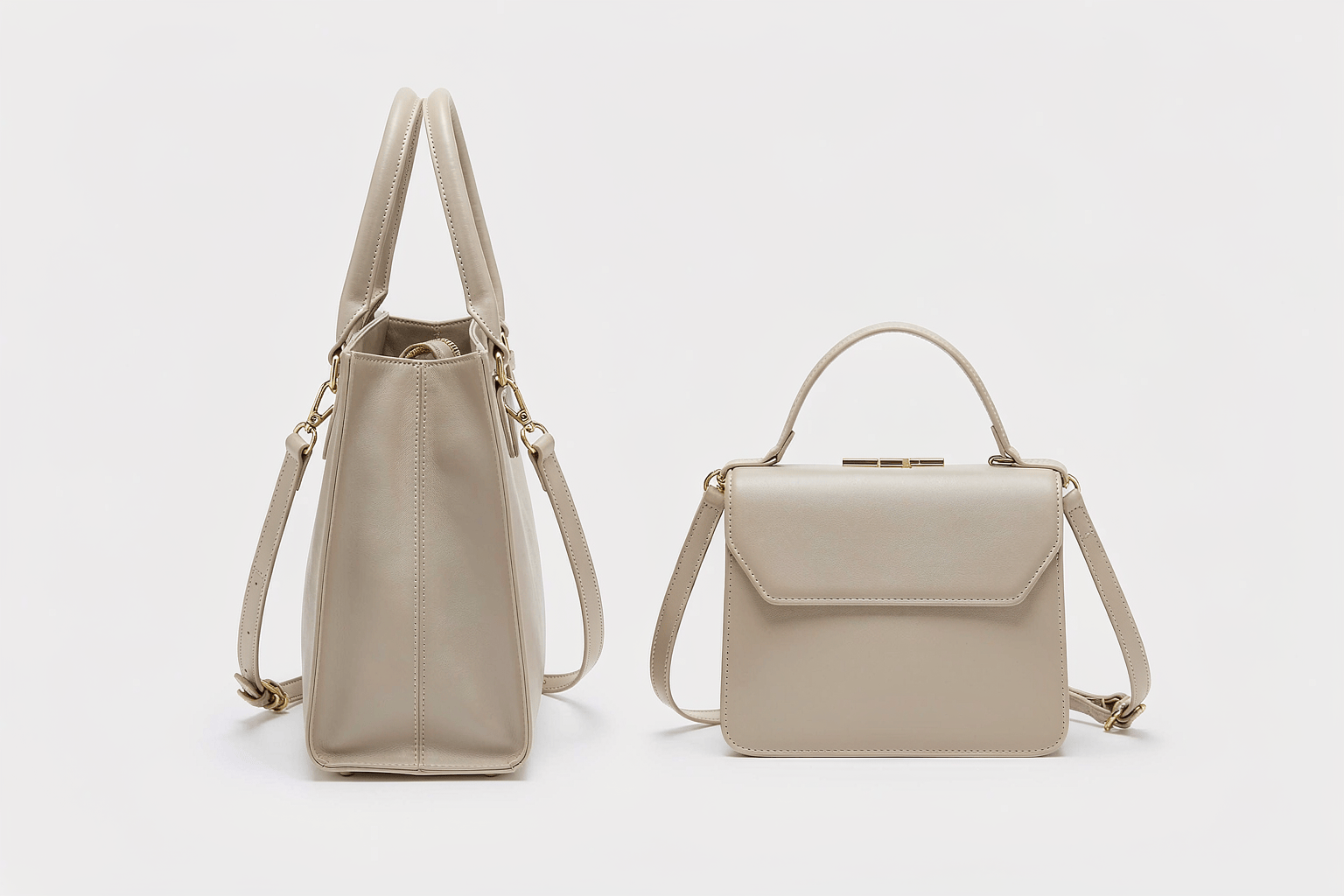
A tote bag vs crossbody decision for a private-label or retail line comes down to capacity versus control. A tote is a high-volume carry built around two short handles and an open or zip top, ideal for work and errands; a crossbody is a smaller, zip-closed bag on one long diagonal strap that keeps essentials secure and hands free. Choose the format from the end user’s mobility and risk, then spec the build around it.
What Each Format Is Built Around
From a factory view, the two shapes solve different problems. A tote is built around a roomy main compartment and two handle anchors; the open mouth is the feature, not a flaw. A crossbody is built around one adjustable strap and a secure zip, with more internal compartments because the user carries a tight set of essentials. The build complexity lands in different places.
- Tote: 2 handle anchors, 6–10 main seams, large panel cutting, lower labor.
- Crossbody: 1 long adjustable strap with sliders, more zip pockets, 12–18 seams.
- Shared: same shell fabrics, zips, and QC framework carry across both.
Side-by-Side: Tote vs Crossbody Spec Comparison
For a buyer weighing which SKU to add, the table below maps the two formats to the program facts that matter.
| Factor | Tote | Crossbody |
|---|---|---|
| Carry style | Two handles, shoulder or hand | One long strap, across body |
| Typical capacity | 12–28 L | 1–4 L |
| Shell denier | 600D–1200D or canvas | 600D–1200D nylon or polyester |
| Closure | Open, partial, or full zip | Zip or flap, always closed |
| Security | Open top easier to reach | Zip at front, hard to snatch |
| Hardware count | 2 handles, 1 zip | Strap sliders, zip, buckle |
| Typical MOQ | 300–1,000 per colorway | 300–1,000 per colorway |
| Best program | Work, retail everyday, promo | Travel, transit, evening, secure |
Use this as a first filter. If the end user hauls a laptop and lunch, a tote is the right SKU. If the end user moves through crowds with a passport and phone, a crossbody earns its place. Many buyers run both as a matched set.
Which Program Fits a Tote
Specify a tote when the use case is high-volume, polished carry: a corporate gift, a branded retail everyday bag, or a promo item. Define a suspended laptop sleeve only if the program targets work users; otherwise a single open well keeps cost down. A structured base and a zip or magnetic closure lift perceived quality with little added labor.
- Decide capacity first: 10–15 L for office, 18–28 L for travel or gym.
- Pick shell denier from weather risk: 900D–1200D polyester for most lines.
- Confirm handle webbing width at 25–30 mm for loads above 4 kg.
- Add one zip valuables pocket and an open phone slip.
Which Program Fits a Crossbody
Specify a crossbody when the user walks through crowds, travels, or wants both hands free with essentials secured. The build must include one adjustable webbing strap with a slider, a zip or flap closure, and 2–4 internal compartments sized to phone, cardholder, and keys. A strap drop that lands the bag at the hip, not the waist, is the detail that separates a comfortable crossbody from a bouncing one.
- Strap: 20–25 mm webbing, adjustable to 110–130 cm length.
- Closure: self-repairing coil zip, full length, plus an inner zip pocket.
- Shell: 600D–1200D nylon or polyester; 8–10 SPI at seams.
- Base: light reinforcement so the bag holds shape when set down.
Strap Engineering for Each Format
The strap is where the two formats diverge most in engineering. A tote needs two short handles anchored with bar-tacks and double stitch rows, rated to a 20 kg+ pull. A crossbody needs one long strap with an adjuster slider and a secure attachment point that sits flat against the back, not twisted. For both, specify webbing grade (700D–1000D) that holds shape under daily load, and a verified colorfast rating for programs shipped through hot, humid transit.
Materials and Hardware
Both formats draw from the same material library, so a buyer can run them as sister SKUs. For totes, 12–16 oz cotton canvas gives structure and a fashion read; for crossbodies, 900D–1200D nylon resists the abrasion of daily transit and reads technical. Across both, specify self-repairing coil zips, bar-tack reinforcement at every anchor, and 8–10 SPI stitch density at load-bearing seams. The crossbody simply applies those rules to more zip pockets.
Compliance and QC Differences
Compliance is identical in substance: EU programs need REACH conformance for dyes and coatings, with OEKO-TEX Standard 100 supporting audits; US retail triggers Prop 65 limits on specific phthalates and lead. The QC plan differs in focus points. A tote needs a 5,000+ zip-cycle test and a 20 kg+ handle-pull test. A crossbody adds a strap-pull test at the attachment point and a slider-adjust check, plus the same AQL 2.5 major / AQL 4.0 minor plan with inline checks at 20% and 80% production and a final audit.
MOQ, Lead Time, Packaging Contrast
Both formats share a MOQ of 300–1,000 units per colorway and a bulk lead time of 35–55 days after a 7–12 day sample. Packaging economics differ: totes flat-pack tightly, so carton density is high and freight per unit low; crossbodies are small but often structured, so confirm carton dimensions with your forwarder to keep palletisation efficient. Plan reorders with the first run: a 35–55 day window plus 25–40 days ocean transit puts restock two to three months out.
How to Decide for Your Line
Run this check before committing tooling:
- Weigh the end user’s daily load. Above 7 kg favors a tote; under 4 kg favors a crossbody.
- Count the risk. Passport, cards, phone in crowds favors a crossbody.
- Check the dress code. Office or client meeting leans tote; travel or evening leans crossbody.
- Model the margin. The tote’s lower labor usually yields a better entry price.
- Consider a two-SKU set: a tote for volume, a crossbody for security.
Get a Custom Bag Quote
With the format, materials, and QC defined, the next step is a manufacturability review. Send your tech pack for a costed quote and a realistic lead-time window: Request a quote →
For the practical sequence, see How to clean canvas tote.
We put the two formats side by side in Backpack vs tote bag.
Frequently Asked Questions
Is a tote or crossbody better for travel programs?
A crossbody is better for moving through airports, transit, and crowded streets because it stays zipped at the front and leaves both hands free. A tote works well as a carry-on personal item for bulk like a book and a scarf. Most travel programs offer both: a crossbody for the journey and a tote for the plane.
Can a crossbody replace a tote for work?
It can if the work load is light: a tablet or small laptop, a wallet, and a notebook. If the user carries a 15 inch laptop, papers, and lunch, a tote or a laptop bag is the safer spec. Many programs pair a crossbody for the commute with a tote at the desk.
Which bag is more secure to manufacture for?
The crossbody is more secure by design: worn across the body with a zip, it stays in front of the user and is hard to snatch. A tote’s open top is easy to reach on a crowded bus, so a tote program should offer at least a partial or full zip option for transit users.
Are crossbody bags easier on the shoulder than totes?
For lighter loads over long walks, yes. A crossbody spreads weight across the torso, while a tote hangs everything on one shoulder and can cause that side to ache past roughly 4.5 to 7 kg. For very heavy loads, a two-strap backpack is kinder than either.
What size tote or crossbody fits everyday use?
Choose by load. A daily crossbody of 1 to 3 liters fits phone, wallet, keys, and a few extras. A daily tote of 12 to 18 liters fits a laptop, lunch, and layers. Measure the end user’s actual carry before setting the spec.
Can a tote be worn as a crossbody?
Not usually. Totes are built with short handles for the shoulder or hand, not a long diagonal strap. Some tote programs add a removable crossbody strap as an option, but most do not. If that wear style is the goal, spec a bag designed for it rather than improvising with a tote.
Buyers comparing suppliers can review our travel and duffle bags for OEM/ODM specs, materials, and MOQ.