A golf bag and a golf travel bag solve different jobs, and a private-label or club program should decide which to develop from the transport mode of the end user. The bill of materials, tooling, padding, and QC plan differ enough that mixing the two into one SKU usually raises cost without satisfying either use case.
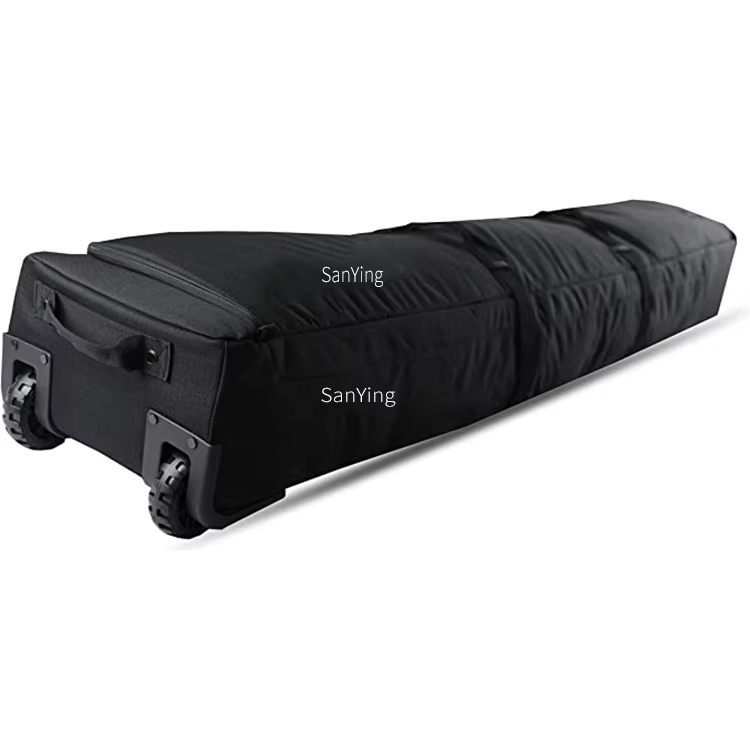
Two Products, Two Bills of Materials
The split is structural, not cosmetic. A course bag is built to give fast access to clubs during play; a travel case is built to protect those same clubs through handling, stacking, and drops. That difference drives nearly every spec choice below.
| Specification | Course golf bag | Golf travel bag |
|---|---|---|
| Primary purpose | On-course play | Transport and shipping |
| Padding | Light, for comfort | Heavy, for impact |
| Shell | 600–1680D soft shell | Soft, semi-rigid, or hard case |
| Structure | Molded top + legs | Stiff arm + reinforced base |
| Hardware | Zips, buckles | Wheels, locks, handles |
| Empty weight target | 2–12 lb | 8–20 lb |
| Tooling | Divider mold | Mold + wheel and base tooling |
Read the last row carefully. The travel case carries its own tooling for wheels, a stiff arm, and a rigid base, which is why it should be scoped as a separate development project rather than a padded version of the course bag.
Shell and Padding: Where Cost and Risk Concentrate
A course bag uses nylon or polyester over a light frame; the padding protects the bag’s shape and the player’s shoulder, not the clubs from a fall. A golf travel bag starts from the opposite premise: thicker walls, a reinforced base, and usually a stiff arm or internal rib that sits above the club heads so a dropped case lands on the arm instead of the graphite. Specifying the foam density matters: most soft covers run 15–25 mm of closed-cell foam on the walls, while hard cases rely on a 2–4 mm shell plus internal straps to immobilize the set. The right choice tracks flight frequency, not price.
- Soft padded cover: light, folds for storage, suits once-a-season flyers; specify 600D–1680D with 15–25 mm foam.
- Semi-rigid case: a molded base with padded walls; a balance of protection and weight, typically 6–9 lb empty.
- Hard case: ABS or polypropylene shell that spreads impact; heavier at 9–14 lb but best for frequent flyers.
- Internal straps: two to four compression straps keep the headcovers from shifting during a tumble in the hold.
Tooling and Structure: Molded Tops, Stiff Arms, Wheels
The course bag’s biggest tooling item is the injection-molded top, which runs 15–25 days of tooling and a per-cavity cost. The travel case adds at least two more tooled parts: a wheel assembly rated to sealed bearings and a base that resists stacking loads. Confirm these designs early, because changing them later means new tooling and a re-sampled batch. For small runs, a shared or stock top molding reduces cost but limits the layout you can offer.
Compliance and Lab Testing for Travel Cases
For EU-bound programs, REACH conformance for dyes and coatings is the baseline, with OEKO-TEX Standard 100 supporting retailer audits. US retail triggers Prop 65 limits on specific phthalates and lead in hardware and coatings. Because a travel case is handled roughly, add physical tests to the plan: a 1.2 m drop test onto a hard surface, a wheel-cycle test, and a handle-pull test at 20 kg+. These are the checks that separate a case that survives a season of flights from one that fails on the first trip.
MOQ and Lead Time: Why Travel Cases Run Longer
A golf travel bag program typically runs a MOQ of 200–600 units per colorway. Development samples take 15–20 days because of the extra tooling, and bulk lead time is about 40–60 days after approval. Cartons are bulky relative to weight, so confirm dimensions with your forwarder to keep freight and warehouse handling sane. Plan reorders with the first run: bulk lead time of 40–60 days plus ocean transit of 25–40 days puts a restock two to three months out.
Carton and Freight Planning
Travel cases are the least efficient product to ship per unit of sellable value, because the protective volume is mostly air. Specify a flat-pack or nestable structure where the design allows, and confirm carton dimensions with your forwarder before tooling so palletization stays efficient. A case that nests three-high instead of two can cut per-unit ocean freight by a meaningful margin on a full container.
Sourcing Decision: One SKU or Both
For a brand or club program, the practical question is whether to develop one product or two. A course bag and a travel case serve different moments in the same golfer’s year, so many programs end up offering both: a stand or cart bag for play and a padded case for the trip. The decision should follow the end user’s flight frequency. If fewer than one in five buyers flies with clubs, a single well-built course bag with an optional third-party cover is usually enough. If flying is routine, the travel case earns its own SKU and its own tooling budget, because bolting protection onto a course bag rarely meets a 1.2 m drop test.
- Build one: target golfers who play locally; keep the course bag and skip case tooling.
- Build both: target traveling programs; scope the case as a separate development with its own MOQ.
- Shared parts: a common divider top molding can reduce tooling cost across both SKUs where the geometry allows.
Get a Custom Bag Quote
With the product type, padding strategy, and tooling plan defined, the next step is a manufacturability review. Send your tech pack for a costed quote and a realistic lead-time window on a golf travel bag built for your target market: Request a quote →
Our detailed take is in best golf bag push cart.
Go deeper in How to Manage Production Across Multiple Factories.
Frequently Asked Questions
When should a program develop a travel case instead of a course bag?
Develop a golf travel bag when the end user flies or ships clubs regularly. The course bag optimizes for fast access during play; the travel case optimizes for survival in cargo. Building both as separate SKUs is usually cheaper than forcing one product to do both jobs poorly.
Which shell construction protects clubs best in transit?
For frequent flyers, a hard ABS or polypropylene case spreads impact across a rigid shell and survives stacked luggage. A soft padded cover is lighter, cheaper, and easier to store, which suits occasional travelers. Semi-rigid cases land between the two.
What tooling does a travel case require beyond a course bag?
At minimum, a wheel assembly with sealed bearings, a reinforced base, and a stiff arm or internal rib. Each is a tooled component with its own lead time of roughly 15–25 days, which is why travel-case development samples run longer than course-bag samples.
Which compliance and physical tests apply to travel cases?
For the EU, REACH conformance and OEKO-TEX Standard 100 support audits; for US retail, Prop 65 limits apply. Add a 1.2 m drop test, a wheel-cycle test, and a 20 kg+ handle-pull test to the QC plan because the case is handled roughly in transit.
What MOQ and lead time apply to a custom travel bag?
Most programs start at 200–600 units per colorway. Development samples take 15–20 days and bulk production runs about 40–60 days after approval, longer than a course bag because of the extra tooling.
How should cartons for travel cases be planned?
Travel cases are bulky relative to weight, so confirm carton dimensions with your forwarder before tooling and prefer a nestable or flat-pack structure where the design allows. Efficient palletization can cut per-unit ocean freight on a full container.
Buyers comparing suppliers can review our golf travel bags for OEM/ODM specs, materials, and MOQ.