A two-strap device pack is judged on load transfer, not appearance. The parts that decide whether a programme succeeds are the back panel construction, strap curvature and webbing grade, the suspended device cavity, and the fatigue testing that proves all three survive 3,000 loaded cycles. Specify those four and the rest is styling.
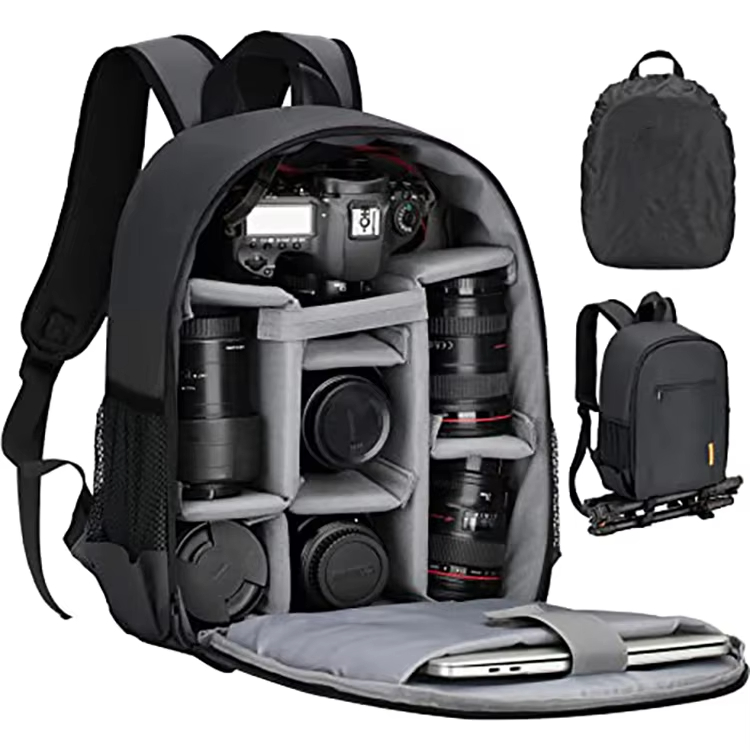
What Separates a Harness Product From a Shoulder-Carried Case?
Both share a padded cavity, but the harness adds a load path from the contents to the wearer’s shoulders and upper back. That path is engineered, not decorative: it involves a laminated back panel, curved strap geometry, load-lifter anchors and a reinforced yoke where the straps meet the body. Together those elements add 12–25 operations and 20–30 sewing minutes to the build.
The practical implication for a buyer is that you cannot evaluate this format from a flat photograph. A back panel photographs identically whether it contains 8 mm of 45 kg/m³ foam or 5 mm of 25 kg/m³ scrap. Fit and load transfer have to be assessed on a body, loaded to real weight, which is why these programmes typically need one more sample round than a simpler format.
How Is the Harness Engineered and Verified?
Strap geometry is where most low-cost builds give themselves away. A straight-cut strap sits fine when empty and digs into the trapezius under 5 kg. A curved strap follows the shoulder line, but curvature has a tolerance of 2–3 mm before the shape reads wrong on one side.
- Strap width: 70–90 mm at the shoulder, tapering to 25–38 mm webbing at the adjuster.
- Strap foam: 8–12 mm closed-cell EVA at 45–60 kg/m³, laminated rather than loose-inserted.
- Webbing: 25 mm and 38 mm polyester at 8–12 kN break load; state the break load in the tech pack.
- Yoke reinforcement: double bar-tack over a woven patch, 8–10 SPI, with the anchor seam caught into the back panel rather than surface-stitched.
- Load lifters: anchored 30–50 mm above the shoulder line, angled 30–45° to pull the load toward the body.
- Sternum strap: vertically adjustable across a 60–80 mm range so it clears different torso shapes.
Verify with loaded fatigue cycling rather than a static pull alone. A 15 kg load cycled 3,000 times on both straps exposes anchor slippage and foam collapse that a five-minute static test will never reveal.
What Back-Panel Constructions Are Available?
The back panel controls comfort, ventilation, cost and carton cube simultaneously, which makes it the single most consequential construction decision in this format.
| Construction | Build | Airflow | Added sewing minutes | Relative cost | Best fit |
|---|---|---|---|---|---|
| Flat laminated foam | 5–8 mm EVA + spacer mesh | Low | 4–7 | Baseline | Gifting, education |
| Contoured channel panel | 8–10 mm shaped foam, 2 channels | Medium | 8–14 | +8–14% | Branded commuter retail |
| Air-mesh pads | 4 discrete pads, 12 mm, 3D mesh | High | 12–20 | +15–22% | Specialist, outdoor |
| Framesheet + foam | 1.5–2.0 mm HDPE sheet, 8 mm foam | Medium | 10–16 | +12–18% | Heavy-load, travel |
The framesheet row deserves attention on programmes where packed weight exceeds 6 kg. A framesheet stops the panel from bowing into the wearer’s spine when the main compartment is over-packed, which is the most common comfort complaint on soft-back builds.
How Do You Specify the Suspended Device Cavity?
In this format the cavity sits against the back panel, which is both the safest position and the one most exposed to compression. Build it as a separate suspended pocket with its own foam walls rather than relying on the back panel to do double duty.
For a 15.6-inch device, specify 375 x 260 mm internal with 26–32 mm depth, ±5 mm on width and height. Use 5–6 mm closed-cell foam on all four walls and hold a 15–20 mm gap between the sleeve floor and the outer base panel. Line the cavity in brushed tricot at 90–140 g/m² so the lid does not pick up micro-scratches. Add a retention flap or elastic strap: in a pack that gets swung off one shoulder, a loose device slides and impacts the top edge.
Which Tests Belong in the Quality Plan?
- Loaded strap fatigue: 15 kg, 3,000 cycles on both straps, checking for anchor slippage and stitch failure.
- Back-panel compression set: 24 hours under load; above 15% recovery loss means foam density is too low.
- Six-face drop: 1.0–1.2 m onto concrete with a 2.0 kg weighted dummy board in the cavity.
- Haul-loop pull: 25 kg static, held 5 minutes, since this is how the piece gets lifted off a floor or an overhead bin.
- Zip cycling: 5,000 cycles on the main opening under normal carry load, using self-repairing coil.
- Water spray: shell tested with the cavity checked dry after 10 minutes; add a hydrostatic head figure if the claim goes on packaging.
- Final inspection: AQL 2.5 for major and AQL 4.0 for minor defects, with in-line checks at 20% and 80% output.
Documentation runs alongside: REACH conformance for dyes and coatings in the EU, Proposition 65 limits on phthalates and lead for US retail, OEKO-TEX Standard 100 or GRS where retailer audits require it, ISO 9001 evidence from the factory, and BSCI or SMETA reports for club-store and grocery channels. Freeze the bill of materials before third-party testing — a substituted buckle invalidates the report.
How Do You Judge Whether a Factory Can Actually Build It?
Not every competent cut-and-sew line can build a harness product to a consistent standard. Three checks separate capability from willingness.
First, ask how many bar-tack heads are on the line and whether a template is used for anchor placement. Manual placement drifts, and drift on a strap anchor is visible from two metres. Second, ask whether foam lamination is in-house. Subcontracted lamination adds 3–6 days and a second point where an approved 8 mm panel arrives at 6 mm. Third, request loaded fatigue test data from a previous harness programme. A factory that has run the test before will produce the report in a day; one that has not will offer a static pull result instead.
What Do MOQ, Sampling and Lead Time Look Like?
Minimums for this format typically run 300–500 units per colourway. The higher unit value makes a smaller run viable for the factory, but pattern complexity means development takes longer than a flat product.
Allow 15–20 days for a first proto from a complete tech pack, or 25–30 days if patterns must be drafted from a reference sample. Expect two to three proto rounds, since fit revisions are normal on a first harness. A pre-production sample against final materials adds 7–12 days, and bulk runs 35–60 days. Custom-colour moulded hardware is frequently the critical path at 15–25 days on its own, so freeze hardware colour at pre-production sample.
Plan freight early. A laminated harness product holds its three-dimensional shape and packs at roughly 5–8 units per 0.1 m³ carton, against 10–14 for a flat-packable case. On volumetric sea freight that halves the units per container, so confirm carton dimensions with your forwarder before the shipping mark is finalised.
Related: How to specify a device carry case for a sourcing programme
Get a Custom Bag Quote
Send your tech pack, a reference sample or even a sketch with a target landed cost, and we will return a construction proposal for the back panel and harness, a costed bill of materials, and a production calendar with carton figures: Request a quote →
If you are choosing between options, Bike bag vs backpack breaks down the trade-offs.
Sizing and fit are covered in Backpack buying guide for brands.
Frequently Asked Questions
What foam specification should the shoulder straps use?
Eight to twelve millimetres of closed-cell EVA at 45–60 kg/m³, laminated rather than loose-inserted, with the strap 70–90 mm wide at the shoulder tapering to 25–38 mm webbing at the adjuster.
Which back-panel construction is worth the extra cost?
For branded commuter retail, a contoured channel panel with 8–10 mm shaped foam adds 8–14 sewing minutes and 8–14% cost while measurably improving airflow. Add a 1.5–2.0 mm HDPE framesheet when packed weight regularly exceeds 6 kg.
How do you test load transfer rather than just strength?
Run 15 kg loaded fatigue cycling for 3,000 cycles on both straps, plus a 24-hour compression-set check on the back panel. Recovery loss above 15% indicates the foam density is too low for the weight class.
What MOQ applies to a harness format?
Typically 300–500 units per colourway. Below 300, fixed costs for marker-making, cutting and line changeover push the unit price up sharply and many factories will decline to quote.
How many sample rounds should I expect?
Two to three proto rounds, at 15–20 days each from a complete tech pack, because harness fit needs assessment on a loaded body. Add 7–12 days for a pre-production sample against final materials.
Why is freight higher for this format?
A laminated back panel holds its shape, so the piece packs at roughly 5–8 units per 0.1 m³ carton against 10–14 for a flat-packable case. Sea freight on carry goods is charged volumetrically, so units per container roughly halve.
Buyers comparing suppliers can review our backpacks and laptop bags for OEM/ODM specs, materials, and MOQ.