For a commuter-focused product line, the choice between a bike bag and a backpack comes down to where the load sits and how the rider travels. A pannier keeps weight on the bike and the back dry; a backpack keeps gear on the person for mixed-mode trips. For most daily programs, a rear pannier is the higher-volume core SKU, with a pack as the flexible add-on that needs no bike hardware.
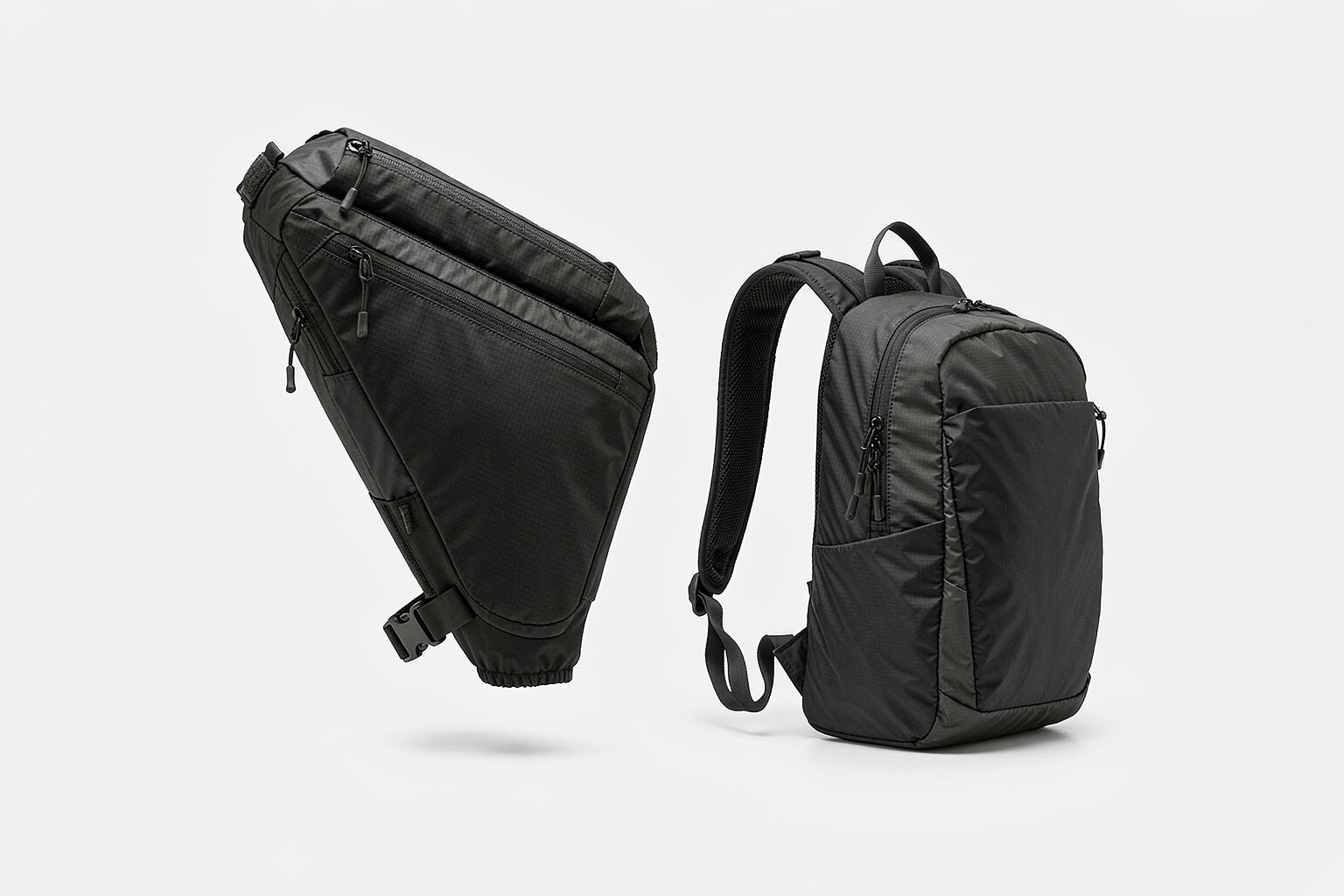
How the Two Products Are Built Differently
Although both carry the same cargo, the construction logic diverges at the first cut. A bike bag (usually a pannier) is built around a rack-mount system: hooks, a lower stabiliser, and a welded or rigid base. A commuter backpack is built around the body: a ventilated back panel, a sternum or hip strap, and a suspended laptop channel. The mount hardware is what a factory must tool for first, and it is where cost and QC differ most.
- Bike bag: rack hooks, stabiliser, reinforced base; load sits on the bike.
- Backpack: back panel, straps, frame sheet; load sits on the rider.
- Hybrid: a pannier with tuck-away straps, the most complex and the priciest to build.
Side-by-Side: Cost Drivers and Build
The table compares the two from a sourcing view so a buyer can choose where to invest tooling and margin.
| Factor | Bike bag (pannier) | Backpack |
|---|---|---|
| Core hardware | Rack hooks, stabiliser, base | Back panel, straps, frame sheet |
| Fabric denier | 600D–1680D polyester/nylon | 600D–1200D polyester/nylon |
| Waterproof method | Welded seams + roll top | Coated shell + rain cover |
| Typical capacity | 15–40 L per bag | 15–35 L in one pack |
| Key QC test | Seam-leak, mount-pull, zip-cycle | Strap-pull, foam-thickness, zip-cycle |
| MOQ per colorway | 300–1,000 units | 300–1,000 units |
| Best use | Long, daily, heavy commutes | Mixed riding and walking |
Both sit in the same MOQ band, but the pannier carries more per litre of tooling risk because of the mount, while the pack carries more per-unit sewing labour in the back panel and straps.
Which One to Manufacture First
For a new commuter program, start with the product that matches your customer’s dominant trip. If the channel is sporting-goods and bike shops, a rear pannier is the anchor SKU. If it is corporate gifting and mixed commuters, a ventilated backpack sells without requiring a rack. The anchor choice also sets your margin profile: panniers carry a higher perceived value because they solve a problem a backpack cannot, while backpacks win on volume and lower barrier to purchase.
- Phase one: one hero pannier (18–22 L waterproof) or one hero backpack (25–30 L).
- Phase two: add the counterpart so the range covers both rider types.
- Phase three: a convertible hybrid only if the channel proves demand.
Keep the first run tight. A single well-specified hero SKU lets the factory prove the QC plan and lets you test price elasticity before committing tooling to a full range. Buyers in this category respond to a clear hero product more than to a wide but shallow matrix.
Material and Hardware Specs for Each
Both use the same fabric logic: 600D polyester entry, 900D–1200D retail standard, 1680D ballistic nylon for heavy use, with a PU or TPU coating of 0.15–0.3 mm. The difference is in the stress points.
- Pannier: self-repairing coil zips, bar-tack at hook anchors, 20 kg+ mount pull, moulded base.
- Backpack: self-repairing coil zips, bar-tack at strap anchors, 8–10 mm closed-cell back foam, sternum strap above 5 kg loads.
- Shared: 8–10 SPI stitch density, reflective trim, and a suspended laptop sleeve where relevant.
Compliance for Both Categories
Both follow the same export rules. For the EU, REACH conformance for dyes and coatings is the baseline, with OEKO-TEX Standard 100 supporting retailer audits. US retail triggers Prop 65 limits on specific phthalates and lead. If either includes a USB pass-through or wiring, confirm electrical-safety documentation for the target market before mass production.
QC Checkpoints Compared
Use AQL 2.5 for major defects and AQL 4.0 for minor, with inline checks at 20% and 80% production plus a final audit for both. Then add the format-specific tests.
- Pannier: seam-leak submersion, 5,000+ zip-cycle, mount-pull at rack hooks.
- Backpack: strap-anchor pull at 20 kg+, foam-thickness check, zip-cycle test.
- Both: fabric denier and coating verification on arrival.
- Both: a final AQL inspection before carton sealing.
MOQ, Lead Time, and Freight
Both categories run a MOQ of 300–1,000 units per colorway, with a development sample in 7–12 days and bulk lead time of 35–55 days after approval. Panniers are bulky per kilo, so carton planning matters; backpacks pack denser, which lowers freight per unit but needs careful palletisation to avoid crushing the back panel.
Because bulk lead time of 35–55 days plus ocean transit of 25–40 days puts a restock two to three months out, plan reorders alongside the first run and keep the approved sample, test reports, and spec sheet on file.
How to Decide What Your Line Needs
Pick for your hardest day, not your easiest. If the channel’s riders do long, daily, sweaty commutes, the pannier wins on comfort and return rates. If trips mix riding with walking or transit, the backpack wins on flexibility. Many mature programs stock both and let the retailer bundle them as a commuter set, which lifts average order value without doubling your development effort.
Use a simple decision checklist when briefing the factory so the spec matches the channel rather than a generic ideal. Confirm the dominant trip length, the load weight, whether the rider walks after parking, and whether the target bike is likely to have a rack. Those four answers point straight at the anchor SKU and the capacity tier, and they prevent the common error of building a premium pannier for a market that mostly rides three blocks to the station.
- Long, daily, sweaty commute: lead with a waterproof rear pannier.
- Mixed riding and walking: lead with a ventilated backpack.
- Both present in the channel: stock a pannier plus a backpack and bundle.
- Uncertain demand: start with one hero SKU, prove the QC plan, then extend.
Get a Custom Bag Quote
With the product type, fabric, hardware, and QC plan defined, the next step is a manufacturability review. Send your tech pack for a costed quote and a realistic lead-time window: Request a quote →
Sizing and fit are covered in Backpack buying guide for brands.
If you need the baseline definitions first, What is a backpack covers them.
Frequently Asked Questions
Should a commuter line lead with a pannier or a backpack?
Lead with the product that matches the channel’s dominant trip. Bike and sporting-goods channels anchor on a rear pannier; corporate and mixed-commuter channels anchor on a ventilated backpack. Both sit in the same 300–1,000 unit MOQ band.
Which is cheaper to manufacture at volume?
Both use similar fabric and MOQ, but the pannier carries more tooling risk in the mount, while the backpack carries more sewing labour in the back panel and straps. Unit cost depends on which hardware and foam you specify.
What denier fabric works for both products?
900D–1200D polyester covers most programs, with 1680D ballistic nylon for heavy daily use and 600D for light versions. A PU or TPU coating of 0.15–0.3 mm provides water resistance for either build.
What compliance marks apply to EU and US commuter bags?
For the EU, REACH conformance for dyes and coatings is baseline, with OEKO-TEX Standard 100 supporting audits. For US retail, Prop 65 limits apply to certain phthalates and lead. GRS helps if you specify recycled content.
What QC plan prevents defects at scale?
Use AQL 2.5 for major defects and AQL 4.0 for minor, with inline checks at 20% and 80% production plus a final audit. Add a 5,000+ zip-cycle test, a seam-leak test on panniers, and a strap-pull test on backpacks.
How long does sampling and bulk production take?
A development sample usually takes 7–12 days. After approval, bulk production runs about 35–55 days, depending on order size, hardware sourcing, and compliance testing.
Buyers comparing suppliers can review our backpacks and laptop bags for OEM/ODM specs, materials, and MOQ.