The best gym bag for a private-label line keeps shoes, sweaty kit, and toiletries in separate compartments, carries comfortably, and survives weekly abuse without ripping or smelling. Spec the compartment layout, the ventilated shoe stall, and the coated base before colour, then confirm QC against the target retail channel. A clear spec prevents the odour and seam failures that drive returns and hurt a new program.
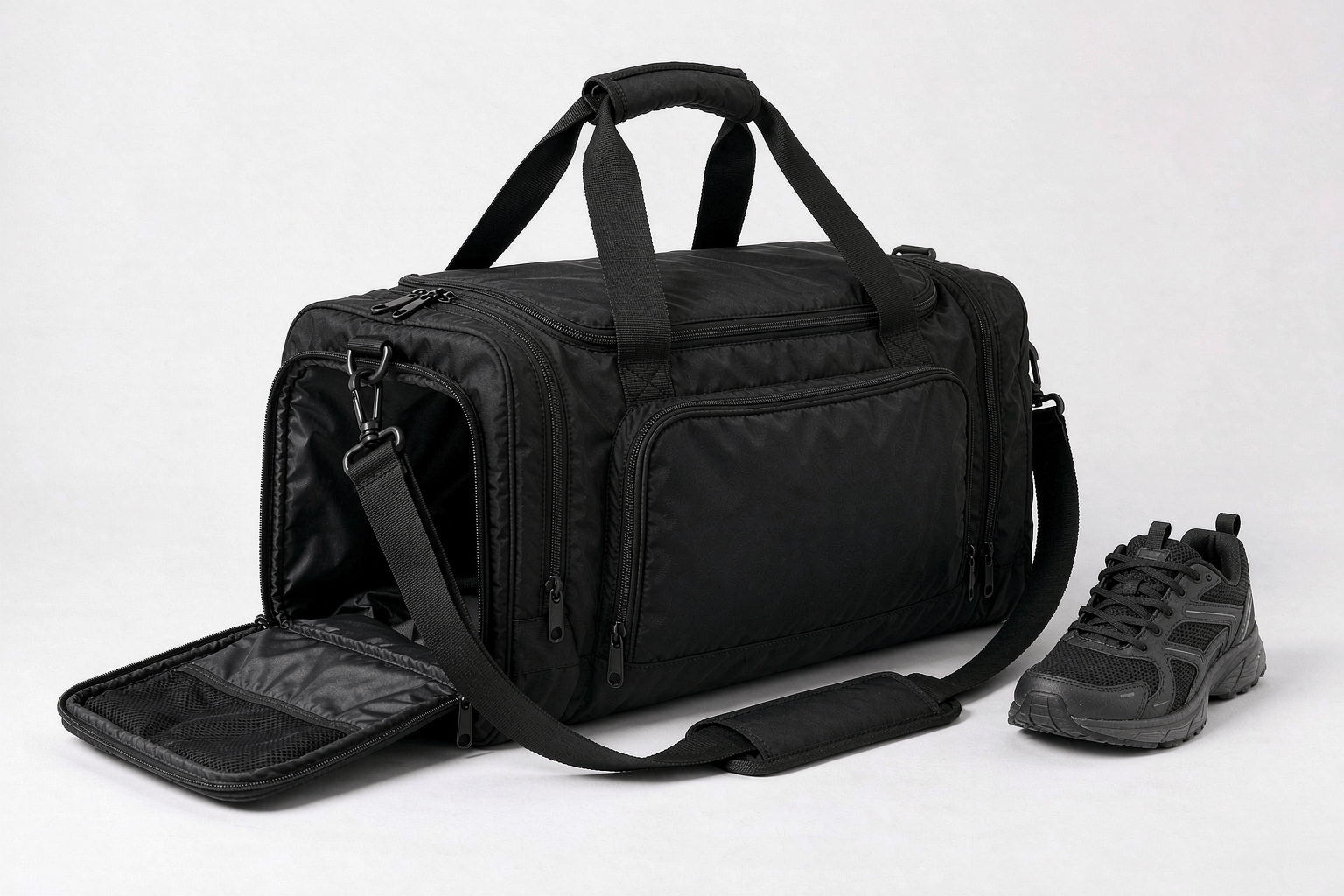
Define the Compartment Layout First
A gym bag’s job is to separate dirty from clean, carry without hurting the shoulder, and stay fresh after repeated use. The compartment plan does that work, so specify it before fabric or colour. A single open cavern forces the user to dig and lets damp shorts sit against a dry shirt, which is why compartments matter more than total volume.
- Ventilated shoe stall: a mesh-lined, externally accessed pocket that stops odour spreading.
- Wet pocket: a coated inner sleeve for a damp towel or swimsuit.
- Valuables pocket: a small zip near the top opening for keys, cards, earbuds.
- Main compartment: a wide U-zip opening so the user reaches the bottom without unloading.
Capacity Tiers for a Gym Range
Most adults do well with one 25–35 L bag for daily use and a second 50–70 L bag for trips. The table maps session type to a capacity and a build, giving a simple SKU ladder.
| Session type | Capacity | Best bag type |
|---|---|---|
| One class, light kit | 20–25 L | Compact tote or small backpack |
| Regular gym with shoes | 25–35 L | Ventilated duffel |
| Swim or racket sports | 35–45 L | Duffel with wet pocket |
| Team or multi-change | 45 L+ | Wheeled duffel |
If between sizes, go slightly larger only if the bag still compresses when empty; an oversized empty bag collects clutter and is awkward to carry.
Ventilation and Odour Control Specs
Odour is almost always a bag that never fully dries. Specify a mesh, gusseted shoe compartment that breathes, and a wipe-clean or antimicrobial lining on the interior. The lining is the part that touches sweaty clothes and the part that starts to smell first, so it is worth the small premium over a raw interior.
- Mesh shoe stall: externally accessed so muddy hands never open the main compartment.
- Antimicrobial lining: a coated, wipe-clean interior that resists bacterial growth.
- Coated base: lifts the bag off wet locker-room floors.
Shell Fabric and Coating Choices
Coated nylon and polyester shrug off sweat and spills and dry fast, which is why most modern workout bags use them. Canvas looks good but holds moisture, so reserve it for dry-condition, style-led lines. For the shell, 600D polyester is the entry workhorse, 900D–1200D the retail standard, and 1680D ballistic nylon the durable top end. Apply a PU or TPU coating of 0.15–0.3 mm.
- 600D polyester: cost-efficient for promotional and light-use programs.
- 900D–1200D: the common choice for branded retail lines.
- Recycled: rPET at 600D–900D meets many EU retailer sustainability asks.
- TPU laminate: excellent water resistance for swim and rowing programs.
For the EU, confirm REACH conformance for dyes and coatings; for US retail, Prop 65 limits apply to certain phthalates and lead. OEKO-TEX Standard 100 or GRS documentation supports both market access and buyer audits.
Hardware and Stress-Point Construction
Failures cluster at the strap anchors and the base. Specify self-repairing coil zips, bar-tack every strap anchor with double stitch rows, and a reinforced or moulded base panel. A padded, removable shoulder strap plus a top grab handle are now baseline expectations.
- Zips: coil #5–#10 by opening size; a recognised self-repairing coil.
- Stitch density: 8–10 SPI at load-bearing seams.
- Base: reinforced or moulded panel to survive being set on wet floors.
- Webbing: 700D–1000D webbing holds shape better than thin tape under daily load.
Customization and Branding Options
For corporate and promotional orders, decide the logo method early because it affects cost and lead time. Embroidery suits structured panels and reads premium; screen print is cost-efficient at volume; woven labels and metal badges add a durable mark. Confirm Pantone matching and a pre-production branding sample before the full run.
Compliance for EU and US Retail
Gym bags sold into the EU need REACH conformance for dyes and coatings, with OEKO-TEX Standard 100 supporting audits. US retail triggers Prop 65 limits on specific phthalates and lead. If the product includes a USB port or wiring, confirm electrical-safety documentation for the target market before mass production.
QC Checkpoints for Sports Bags
Write QC into the purchase order. Use AQL 2.5 for major defects and AQL 4.0 for minor, with inline checks at 20% and 80% production plus a final audit. Add a zip-cycle test of 5,000+ openings and a lining-wipe test for coating integrity.
- Confirm fabric denier and coating thickness on arrival.
- Check stitch density at three random seams per batch.
- Verify strap-anchor pull strength (target 20 kg+).
- Confirm the shoe stall and wet pocket seal correctly.
- Hold a final AQL inspection before carton sealing.
MOQ, Lead Time, and Carton Planning
A typical gym-bag program runs a MOQ of 300–1,000 units per colorway, with a development sample in 7–12 days and bulk lead time of 35–55 days after approval. Because the product is bulky, carton density is low, so confirm carton dimensions with your forwarder to keep freight per unit sensible.
Because bulk lead time of 35–55 days plus ocean transit of 25–40 days puts a restock two to three months out, plan reorders alongside the first run and keep the approved sample, test reports, and spec sheet on file.
How to Brief a Factory on a Gym Bag Line
Send a one-page spec: capacity tier, compartment layout, ventilated shoe stall spec, shell denier, coating thickness, hardware grade, branding method, compliance marks, QC plan, MOQ, and target landed cost. A technical drawing of the compartment layout removes the ambiguity that leads to wrong first samples.
Get a Custom Bag Quote
With the layout, fabric, hardware, and QC plan defined, the next step is a manufacturability review. Send your tech pack for a costed quote and a realistic lead-time window: Request a quote →
Related: for a sport-specific program, see our guide on how to choose a golf bag for dividers, base stability, and club-line sourcing.
For exact dimensions, Sports bag size guide has the measurements.
Sizing and fit are covered in Duffel bag buying guide bulk.
Frequently Asked Questions
What capacity suits most gym bags?
Most adults are happy with 25–35 litres, which covers shoes, a change of clothes, a towel, and a toiletry kit without overpacking. Swimmers and racket players step up to 35–45 L, and team programs need 45 L or more, often wheeled.
Why specify a ventilated shoe compartment?
A mesh, externally accessed shoe stall keeps dirty soles away from clean kit and lets air move, which is the main defence against odour. An antimicrobial lining on the interior adds a second layer of protection against bacterial growth.
What denier fabric works for a gym bag line?
900D–1200D polyester covers most programs, with 1680D ballistic nylon for heavy daily use and 600D for light promotional versions. rPET at 600D–900D meets many EU sustainability requirements.
What compliance marks apply to EU and US gym bags?
For the EU, REACH conformance for dyes and coatings is baseline, with OEKO-TEX Standard 100 supporting audits. For US retail, Prop 65 limits apply to certain phthalates and lead. GRS helps if you specify recycled content.
What MOQ is typical for custom sports bags?
Most cut-and-sew programs start at 300–1,000 units per colorway. Below that, tooling and setup costs push the unit price up and can extend lead time, so consolidate colorways where the buyer allows.
How long does sampling and bulk production take?
A development sample usually takes 7–12 days. After approval, bulk production runs about 35–55 days, depending on order size, branding method, and compliance testing.
Buyers comparing suppliers can review our travel and duffle bags for OEM/ODM specs, materials, and MOQ.