A private label tote program hinges on four decisions: material and fabric weight, construction and reinforcement, hardware grade, and compliance documentation. Set an MOQ of 300 to 1,000 units per style, plan 25 to 45 days of production after approved samples, and require REACH, OEKO-TEX, and Prop 65 test reports before shipment.
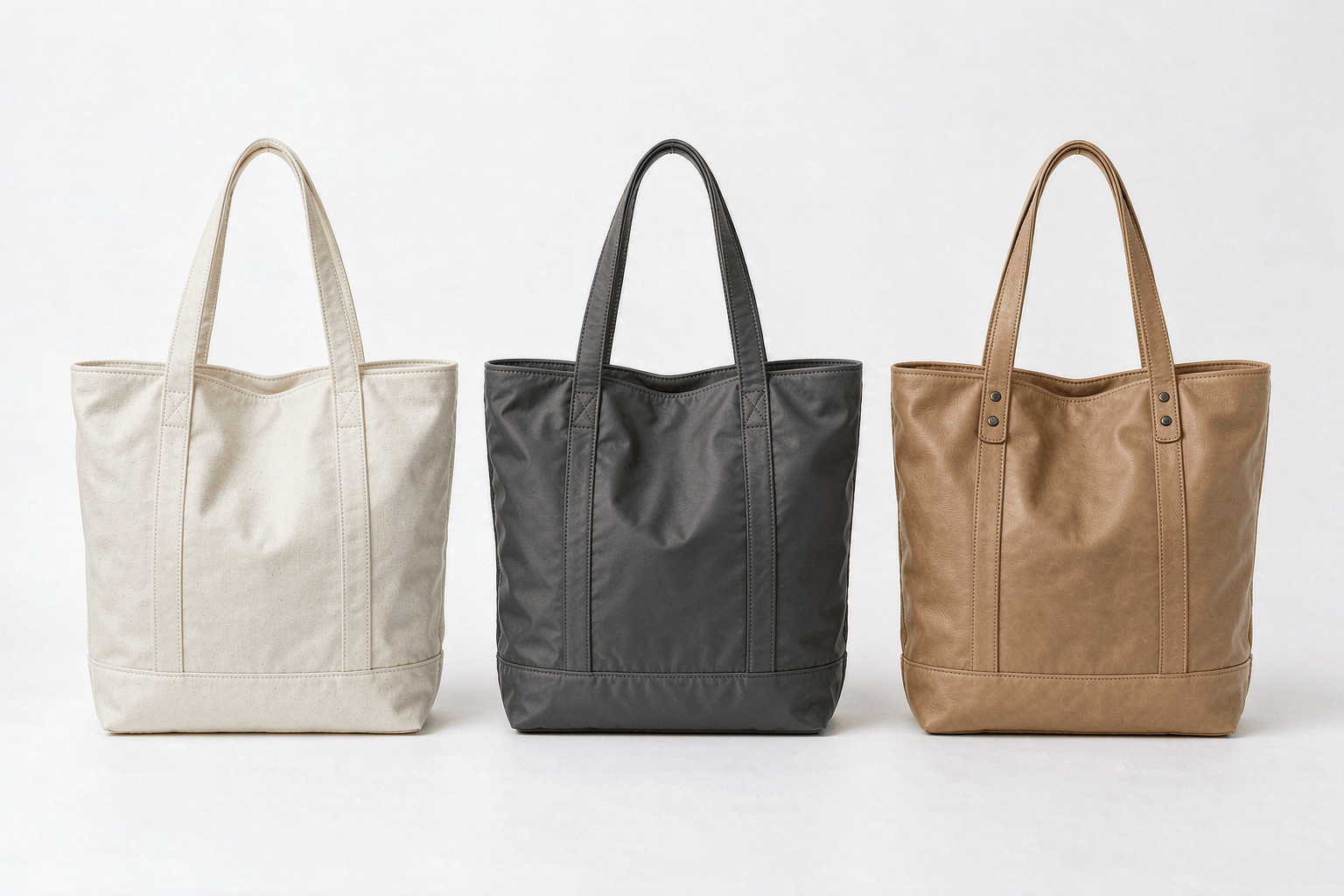
What Does a Tote Bag Buying Guide Private Label Program Cover?
A practical tote bag buying guide private label teams use starts by clarifying whether you need OEM or ODM support, because the two models shift responsibility for design, tooling, and testing onto different parties.
- OEM (Original Equipment Manufacturer): You own the design, tech pack, and material list. The factory executes cut, sew, and finish to your specification. You control the aesthetic and the risk.
- ODM (Original Design Manufacturer): The factory provides a developed silhouette that you rebrand, recolour, or lightly modify. Speed to market is faster, but differentiation is weaker and the base design may already be sold to competitors.
- Hybrid: You start from a factory’s existing block pattern and commission a custom print, hardware colour, and label. This is the most common entry point for first-time private label programs.
The model you choose dictates what you must supply. At minimum, a factory needs a tech pack, a confirmed material specification, a target FOB price, and a compliance target market (EU, US, UK, or combinations). Without those four inputs, any quote you receive is a guess.
How Do You Specify Material and Fabric Weight?
Fabric weight is the single biggest driver of both cost and perceived quality. In private label sourcing, never specify by feel — specify by a measurable unit.
- Cotton canvas: 8 oz (≈ 270 gsm) for lightweight promo totes; 12 oz (≈ 407 gsm) and 16 oz (≈ 542 gsm) for retail-grade structured totes; 20–24 oz (≈ 678–815 gsm) for heavy-duty, flat-bottom carryalls.
- Polyester: 300D–600D for linings and light totes; 900D–1200D for coated, wipe-clean outer shells. Denier measures filament weight per 9,000 metres, so 1200D is roughly twice as thick as 600D.
- Nylon: 210D for linings; 840D–1680D ballistic for abrasion-resistant outer panels.
- Jute or PP woven: 8–14 oz for low-cost, eco-positioned giveaway totes where structure is not the priority.
| Material | Typical weight | Best use | Relative FOB impact |
|---|---|---|---|
| Cotton canvas 12 oz | 407 gsm | Retail structured tote | Medium |
| Cotton canvas 16 oz | 542 gsm | Heavy-duty carryall | High |
| Polyester 600D | ~220 gsm | Coated everyday tote | Low–Medium |
| Nylon 1680D | ballistic | Abrasion-critical panel | High |
| Jute woven | 10 oz | Promotional giveaway | Low |
Request a Martindale abrasion result of at least 20,000 rubs (ISO 12947) for any tote expected to survive daily use, and a wash colourfastness of Grade 4 or better on the AATCC grayscale (AATCC 61, 5A) if the bag will be laundered.
Which Construction Details Decide How Long a Tote Lasts?
Two totes in the same fabric can fail three years apart based purely on how they were sewn. The specifications that matter are measurable.
- Stitch density: 8–10 SPI (stitches per inch) for standard seams; 10–12 SPI for reinforced stress seams. Below 8 SPI, the seam gaps under load.
- Bartacks: Require bar-tack stitching at every handle base, bottom corner, and stress junction. A bar-tack is a dense zig-zag knot, not a backstitch.
- Handle reinforcement: Webbing handles should be specified with a minimum tensile strength of 500 N and a working load rating of 10–15 kg. X-box stitching at the anchor point distributes load better than a simple line of stitches.
- Seam strength: Call out a minimum seam breaking strength of 110–160 N on a 50 mm seam, verified per ASTM D1683.
- Bottom structure: A flat, non-collapsing base needs either a sewn-in board channel, a thicker bottom lamination, or a boxed corner. Specify which, because each changes the sewing time and the FOB price.
Ask the factory for a pre-production sample pulled from the actual production line, not a hand-made showroom sample, and perform your own 1.2 m drop test five times per corner before approving.
What Hardware and Closure Grades Should You Put in the Spec?
Hardware is where cheap private label programs quietly fall apart. Specify by gauge and function, not by brand.
- Zippers: Size #3 for small interior pockets, #5 for main openings on light totes, #8–#10 for heavy or structured totes. Coil zippers resist corrosion better than metal for coastal or humid markets; specify a self-locking slider if the bag is carried open.
- Magnetic closures: Rate by pull force (typically 2–6 N for a single hidden magnet). Note that magnets interfere with cards, so avoid them on tech-oriented totes.
- Rivets and eyelets: Specify brass-plated or nickel-free if you ship to the EU (nickel release limit 0.2 µg/cm²/week under REACH Annex XVII).
- Webbing and webbing ends: Cut ends should be heat-sealed or folded to prevent fraying; specify the finish in the tech pack.
For any closure that bears load, ask for the supplier’s test certificate rather than a verbal assurance. A 5 N magnet that fails after 200 open-close cycles is a returned-goods problem, not a specification.
How Should You Customize a Tote for Your Brand?
Decoration is what makes a tote yours, but each method carries a different MOQ and setup cost. Choose the method before you negotiate price, because it changes the quote.
- Screen printing: Lowest cost at volume; water-based inks feel softer and pass stricter chemical rules than plastisol. Setup needs a screen per colour, so 1–2 colours is economical.
- Heat transfer / sublimation: Good for photographic or gradient artwork; works best on polyester. Durability is lower than screen print on heavy use.
- Embroidery: 4,000–12,000 stitches typical; reads as premium but adds 30–90 seconds of machine time per unit. Digitization is a one-time file cost.
- Woven label and hangtag: The cheapest brand signal; specify material, fold style, and attachment point.
- Debossed or printed leather patch: Highest perceived value; requires a custom die, so budget tooling time into the first order.
A common mistake is ordering 300 units with four-colour embroidery and a custom patch — the decoration cost then exceeds the bag cost, and the program is not scalable. Match the decoration to the retail price you can realistically command.
For dimension and tolerance planning on a structured tote, review our tote bag size guide before locking the spec.
What MOQ, Tooling, and Lead Time Are Realistic?
Private label minimums are driven by fabric lot sizes, printing screen setup, and sewing-line changeover, not by factory preference.
- MOQ: 300–500 units per style/colour for a simple cotton tote; 500–1,000 units when custom hardware, embroidery, or a unique fabric is involved. Below 300, most factories charge a small-order premium.
- Tooling: Cutting dies, screen preparation, embroidery digitization, and custom patches typically take 5–10 working days and may be a one-time charge or amortized across the first order.
- Sampling: A proto sample runs 7–14 days; an approved pre-production (PP) sample runs another 10–18 days once materials are confirmed.
- Production: 25–45 days after PP approval for orders in the 1,000–10,000 unit range; complex constructions sit at the upper end.
- Transit: 25–40 days by sea to a US or EU port; 5–10 days by air at roughly 4–6× the cost.
A realistic door-to-door timeline from tech pack to warehouse is 70–110 days. Brands that skip the PP sample to “save time” usually add two weeks of rework later, so the shortcut is false.
Which Compliance Documents Protect Your Shipment?
Compliance is not paperwork you add at the end — it is a spec you set at the start, because the required tests differ by market.
- EU — REACH (Regulation EC 1907/2006): Restricts substances such as azo dyes, phthalates, and nickel. Any SVHC (substance of very high concern) above 0.1% w/w by weight must be declared.
- US — California Prop 65: Requires a clear warning if the product exposes users to a listed chemical above the safe-harbor threshold. A missing warning on a non-compliant batch can trigger litigation, not just a recall.
- OEKO-TEX Standard 100: An independent test for harmful substances; Class II covers articles with direct skin contact, which fits most totes. Request the valid certificate number, not just a logo.
- ISO 9001:2015: Evidence of a documented quality management system at the factory. It does not guarantee your batch, but it shows process discipline.
- Social audit — amfori BSCI or Sedex SMETA: Verifies labour and workplace standards. Required by most EU retailers and many US distributors before they will place a PO.
Request third-party test reports issued within 12 months of shipment, and name the accredited lab. For the underlying standards, the OEKO-TEX Standard 100 and ISO 9001 pages explain scope in detail. For brand-owner due diligence on picking a manufacturing partner, see our guide to choosing a bag manufacturer.
What Should a Factory Tech Pack Contain?
A tech pack is the contract that prevents “that’s not what I ordered” disputes. A complete pack for a tote includes:
- A flat technical drawing with every dimension and a tolerance of ±3–5 mm.
- A bill of materials listing fabric, weight, colour code, and supplier reference.
- Hardware specifications by size, finish, and function.
- Colourways with Pantone or TPX references, not “navy blue.”
- Label and packaging instructions, including care label text per market.
- A clear statement of the compliance standard the finished bag must meet.
Send the tech pack as a layered PDF or a CAD file plus an Excel BOM. Avoid scattered email photos; they produce inconsistent samples and endless revision rounds.
What Does a Realistic Per-Unit Cost Breakdown Look Like?
FOB prices for a private label tote typically range from US$3 for a simple promotional cotton tote to US$12+ for a structured, hardware-heavy retail tote. The composition matters more than the headline number.
| Cost element | Share of FOB | What moves it |
|---|---|---|
| Material | 35–45% | Fabric weight, custom weave |
| Labour | 18–28% | Construction complexity |
| Hardware & trims | 8–15% | Zipper grade, magnets, rivets |
| Printing / decoration | 4–10% | Colours, embroidery stitch count |
| Overhead & margin | 10–15% | Order volume, payment terms |
Volume is the strongest lever: a 5,000-unit order of a 12 oz cotton tote typically prices 20–35% below a 300-unit order of the same bag, because screen setup and line changeover are fixed regardless of quantity. Ask for a full costed BOM, not just a single FOB figure, so you can see exactly where your money goes and where to negotiate.
Get a Custom Bag Quote
This tote bag buying guide private label checklist is meant to travel with your tech pack to the supplier. The fastest way to turn it into a priced program is to send a finished tech pack. A supplier can review manufacturability, flag spec conflicts (for example, a 24 oz canvas with a #3 zipper), and return a costed quote with a realistic lead time.
Send your tech pack for a manufacturability review and a costed quote: Request a quote
The step-by-step walkthrough lives in How to choose tote bag.
For model-by-model picks, see Best work tote bag.
Frequently Asked Questions
What is the minimum order quantity for private label totes?
Most factories set MOQ at 300–500 units per style and colour for a basic cotton tote, rising to 500–1,000 units when custom hardware, embroidery, or a unique fabric is involved. Orders below 300 usually carry a small-order premium.
How long does sampling take before production starts?
A proto sample typically takes 7–14 days, and an approved pre-production sample takes a further 10–18 days after materials are confirmed. Production itself runs 25–45 days after pre-production approval.
Which certifications do I need for the EU and US markets?
For the EU, plan for REACH compliance and an OEKO-TEX Standard 100 Class II certificate; for the US, California Prop 65 warning compliance is essential if applicable. ISO 9001 and a BSCI or Sedex audit support retailer onboarding.
Can I supply my own material, or must I use the factory’s?
Both are possible. Supplying your own fabric gives control but shifts quality risk to you and adds logistics; using the factory’s approved material is faster and lets the supplier own the compliance test. State your choice in the tech pack.
What file format should a tech pack use?
Send a layered PDF or CAD drawing for the construction, plus an Excel bill of materials. Avoid scattered photos, which produce inconsistent samples. Include Pantone or TPX colour references rather than named colours.
How does order volume affect the per-unit price?
Fixed costs like screen setup and line changeover spread across more units, so a 5,000-unit order of the same tote typically prices 20–35% below a 300-unit order. Request a full costed BOM to see where volume saves money.
Buyers comparing suppliers can review our travel and duffle bags for OEM/ODM specs, materials, and MOQ.