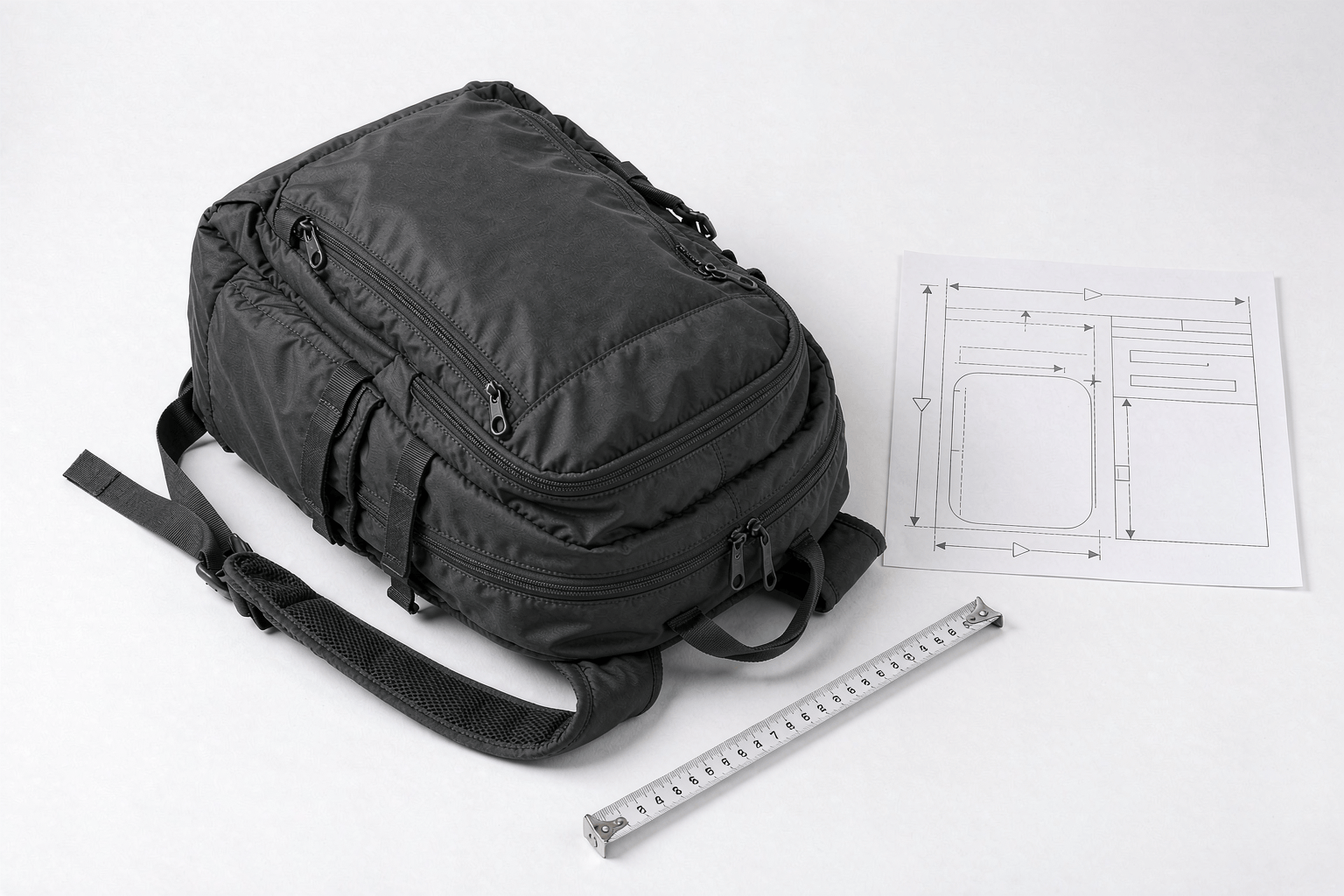
A tech pack is the specification package a brand sends to a factory before any quote or sample is cut. This bag tech pack guide shows what to include: materials by denier and coating, dimensions with ±3 mm tolerance, hardware grade, decoration method, target market compliance, and expected unit cost. A complete pack typically cuts sampling rounds from 3–4 to 1–2 and shortens the quote turnaround from 7–10 days to 2–3.
Why a complete tech pack changes your quote
A factory prices what you specify, not what you meant. When the shell fabric, foam thickness, or zipper grade is left open, the supplier fills the gap with the cheapest workable option or returns a clarifying question that stalls the quote. Either way you lose control of cost and lead time. A tech pack written before sourcing lets the factory return a costed quote from a single round instead of iterating through three or four physical samples, each costing USD 80–300 in sampling and 5–10 days in transit.
Brands that brief by PDF or scattered email threads also struggle to keep versions straight. One master tech pack file, version-controlled, becomes the single source of truth that the OEM or ODM partner signs against.
Step 1 — Write the product brief
Start with the commercial context, not the stitching. State the end use (commute, gym, trade show, corporate gift), the target retail price, the annual volume forecast, and the first order MOQ.
| Brief field | Example value | Why it matters |
|---|---|---|
| End use | Daily commute, 8 kg load | Drives fabric denier and reinforcement |
| Target retail | USD 39–59 | Sets the max viable unit cost |
| Annual volume | 20,000 units | Informs MOQ and tooling amortization |
| First MOQ | 500 pcs | Below 300 pcs, setup cost dominates |
The MOQ decides whether the factory runs stock molds or commits to custom tooling. A first order of 500 pieces typically rides existing hardware; 5,000+ pieces can justify a dedicated buckle or puller mold at USD 300–1,200 one-time tooling.
Step 2 — Specify materials line by line
Name every fabric and foam with a measurable property, never a feel. Use denier for woven fabric, millimetres for foam, and a coating type for water resistance.
| Component | Specification | Typical range | Decision note |
|---|---|---|---|
| Shell | 600D–1680D polyester | 600D light, 1680D ballistic | Higher denier = abrasion resistance, more weight |
| Liner | 210D–420D nylon | 210D standard | Lower denier saves cost inside the bag |
| Foam | 5–10 mm EVA | 5 mm soft, 8 mm structured | Laptop/commercial needs 8–12 mm |
| Coating | PU 300–500 mm | TPE for PVC-free | PU gives water repellency without plasticizer risk |
Requesting “rPET 600D” instead of “recycled fabric” lets the factory quote a certified post-consumer yarn (GRS 4.0) rather than a generic claim. Every material line should carry a test or cert name you can verify, not an adjective.
Step 3 — Define dimensions and construction
Give length, width, depth in millimetres with a ±3 mm tolerance, plus the empty and loaded weight target. Construction notes prevent the most common defects:
- Stitch density: 7–9 SPI (stitches per inch); below 7 SPI the seam weakens under 8 kg load.
- Stress points: bartack at handle base, strap anchor, and zipper end — minimum 8 mm x 10 mm bartack.
- Reinforced base: 600D with 5 mm EVA or a 12 mm webbing tunnel.
- Zipper: specify #5 for liners, #10 for main compartment on bags over 5 kg.
Tolerance tighter than ±2 mm raises reject rate on soft goods and pushes cost up without buyer-visible benefit. Keep ±3 mm unless the product seals against hardware.
Step 4 — Specify hardware and components
Hardware grade is where cost and durability diverge fastest. List the zipper brand class by performance tier rather than name, the slider type, the buckle material, and the puller finish.
| Hardware | Spec to write | Failure mode if omitted |
|---|---|---|
| Zipper | #10 coil, auto-lock slider | Slider walks open under load |
| Buckle | 25 mm side-release, 90 N pull | Cheap clip cracks at 40 N |
| Rivet | 8 mm steel, sealed back | Liner snag on exposed burr |
| Webbing | 25 mm, 1,200 N tensile | Strap stretches and frays |
A 5,000-cycle zipper test (ISO 105-X12 colourfastness grade 4 minimum for any printed webbing) is a standard incoming check the factory should run at AQL. State it in the pack so it is quoted, not assumed.
Step 5 — Document decoration and branding
Decoration is the part buyers notice, and the part most often mis-specified. For each logo or graphic, record the method, placement coordinates in mm, size in mm, and the colour standard.
- Screen print: Pantone spot or TCX; 1–4 colours; MOQ floor ~300 pcs; per-colour setup USD 30–80.
- Embroidery: 8,000–12,000 stitches for a 80 mm logo; thread TCX; MOQ floor ~200 pcs.
- Woven label: 40 x 20 mm; minimum 500 pcs for a custom loom; 10–14 day lead.
- Sublimation / DTF: full-panel print; needs white or light base fabric; colourfast to ISO 105-C06 class 4.
Colour matching to a Pantone TCX number avoids the “looks off” rejection that triggers a resample. Note that embroidery adds 2–4 g and changes the bag’s loaded weight, which feeds back into Step 3 tolerance.
Step 6 — State compliance and testing by market
Compliance is market-specific, and a missing cert can block customs. List the destination market and the standard the factory must meet.
| Market | Regulation | Typical test |
|---|---|---|
| EU | GPSR (EU 2023/988), REACH Annex XVII | Phthalate < 0.1%, Ni release EN 1811 |
| USA | CPSIA, CA Prop 65 | Lead < 100 ppm, kBbP warning |
| California | Prop 65 | Separate label if carcinogen present |
| Textile | OEKO-TEX 100 Class II | pH 4.0–7.5, formaldehyde < 75 ppm |
Set the incoming quality level: AQL 2.5 (major) / 4.0 (minor) per ANSI/ASQ Z1.4, with a sample size from the inspection level. The factory should run 1 m drop, 5,000-cycle zipper, and colourfastness checks before shipment. Writing the cert names in the pack means they are priced into the quote instead of surfacing as a surprise at the port.
Step 7 — Packaging, labeling, and the master file
Close the pack with what ships around the bag. A care label (ISO 3758 symbols), a hangtag with the SKU and barcode (EAN-13), and polybag thickness (≥ 0.04 mm in regions that ban thin single-use plastic) are all quote line items. Attach reference files: the CAD or vector artwork, the tech pack template checklist, and any approved swatch photo.
A usable bag tech pack template bundles these seven steps into one versioned PDF or spreadsheet. Brands that keep the master file updated avoid the silent drift where the running sample no longer matches the signed spec.
How the tech pack feeds your sourcing decision
A finished pack is also the document you send when comparing factories. Two suppliers quoting the same pack on the same denominators are finally comparable, because the variables are fixed. That is the point where OEM and ODM paths split: under OEM you own the pack and the factory executes it; under ODM the factory proposes the pack from your brief and you approve it. Either way, the pack—not the relationship—sets the cost and the lead time.
When the spec is tight, the quote comes back in 2–3 days and the first prototype is the production reference. When it is loose, every round reopens the same questions. The difference is usually one afternoon of spec writing.
Exact figures, tolerances, and test limits for this are in Recycled & Eco Materials in Bag Manufacturing.
FAQ
What is a tech pack for bag production?
A tech pack is a single specification file—materials, dimensions, hardware, decoration, compliance, and packaging—that a brand sends to a factory so it can quote and sample without assumptions. It is the contract of record for OEM and ODM bag programs.
How detailed should fabric specs be?
Name the fabric by denier and coating, not by feel: “600D polyester, PU 300 mm coating” beats “durable fabric.” Include foam thickness in mm and liner denier. Measurable specs let the factory quote a verifiable material instead of guessing.
What tolerance should I allow on dimensions?
Use ±3 mm on length, width, and depth for soft bags. Tighter than ±2 mm raises the reject rate on sewn goods without a visible benefit to the buyer. Loaded weight gets a ±15 g window unless the bag seals against rigid hardware.
Which compliance tests matter for EU and US shipments?
For the EU, REACH Annex XVII and GPSR (EU 2023/988) cover substance restrictions; for the US, CPSIA and CA Prop 65 apply. OEKO-TEX 100 Class II is the common textile safety cert. Set AQL 2.5/4.0 per ANSI/ASQ Z1.4 for incoming inspection.
Does a tech pack reduce sampling cost?
Yes. A complete pack typically cuts sampling from 3–4 physical rounds to 1–2, saving USD 80–300 per round plus 5–10 days transit each. It also shortens quote turnaround from 7–10 days to 2–3 because the factory is not waiting on clarifications.
Should I use OEM or ODM if I have a tech pack?
If you already own a detailed pack, OEM execution is usually cheaper because you are not paying for the factory’s design hours. If the pack is only a brief, ODM lets the factory propose the full spec for your approval. The pack’s completeness decides which path costs less.
Related: How to Source Bags from China: A Buyer’s Guide covers what to send a factory before quoting, and Custom Bag MOQ Guide: What to Expect from Factories explains how your spec sets the minimum order size.
Get a Custom Bag Quote
Send your tech pack for a manufacturability review and a costed quote: Request a quote →