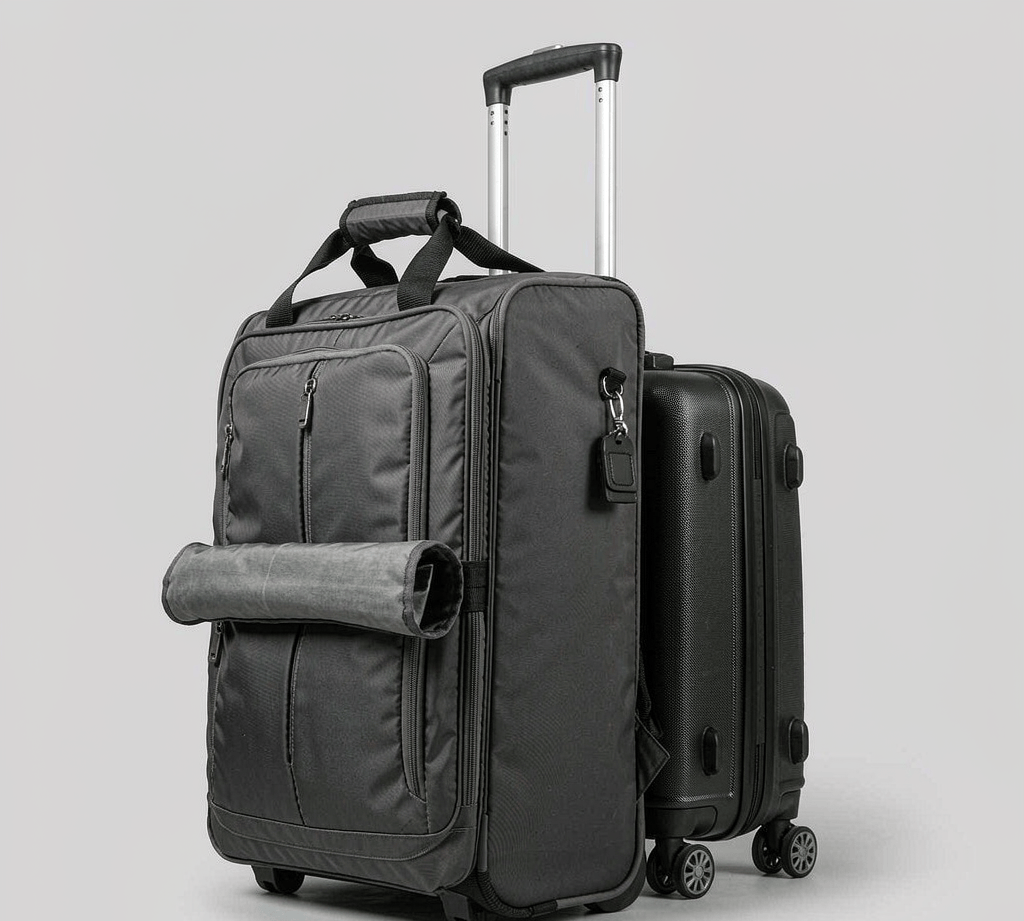
A bag trolley sleeve is the rear fabric channel that slides over a rolling suitcase handle, letting a backpack, tote, or briefcase ride on top of wheeled luggage. For brands building travel or commuter bags, it is one of the highest-leverage features you can add: it removes shoulder strain and frees both hands in terminals. The catch is that a poorly specced sleeve tears at the corners and drives returns. This guide covers the exact dimensions, placement, fabric, and stitching to put in your tech pack so the sleeve survives real travel.
When to include a trolley sleeve
Not every bag needs one. A sleeve earns its place on any product a customer will pair with wheeled luggage more than a few times a year: travel backpacks, work totes, weekender duffels, and business briefcases. If the bag is purely for short walks or desk-to-car commutes, skip it for a cleaner back panel. For the wider context of what to brief a factory on, see our carry-on travel bag guide.
Sleeve dimensions that actually fit handles
There is no universal standard, but field experience converges on a workable range. Make the opening 20–22 cm (about 8–8.6 in) wide so it clears wide double-rail handles from major luggage brands while staying snug on narrow carry-ons. The vertical pass-through height should be at least 15 cm (6 in) so the bag does not pivot on corners. Add roughly 2 mm of clearance for handle thickness. For a delicate women’s handbag use a smaller 18 × 12 cm sleeve; for a laptop tote or weekender, spec 21 × 15 cm.
Placement and center of gravity
Mount the sleeve at roughly 60% of the bag’s height, measured from the base. Too low and the stacked load becomes top-heavy and flips the suitcase backward; too high and the bag wobbles. The channel must run the full depth of the back panel and open at both top and bottom — a shallow single-loop strap only contacts one bar and rotates whenever you turn. This is the same load-transfer thinking behind how we reinforce stress points elsewhere on the bag.
Fabric and reinforcement
Use the bag’s own body fabric for the sleeve, not a thin lining cloth. Cheap mesh or light T-190 lining shreds under the shear force of a yanking handle, while self-fabric sleeves hold up far longer in the field. Add box-X stitching at the four corners and bar tacks at stress lines. Match the spec to your overall material plan — our guide to fabric denier and coating explains why a 600D body pairs naturally with a self-fabric sleeve. Some premium builds add a rubberized anti-slip print inside the sleeve so it grips the aluminum handle. Those stress lines are exactly where a rivet can back up the stitching, so read our bag rivets guide before you finalize the reinforcement spec.
That self-fabric back panel also leans on the interfacing layer inside it, which is worth naming in the same material plan.
Stitch and thread spec
Aim for 8–10 stitches per inch (SPI) with bonded nylon thread (around #69 weight) at the sleeve seams. After assembly, pull the sleeve hard: if the stitch holes widen (the “grin” effect), the construction is weak. This is the same seam discipline covered in our sewing thread and stitch spec guide, and the same box-X reinforcement used in handle construction.
Fixed vs removable
A built-in sleeve is always ready and never lost, which is why dedicated travel bags use it. A detachable strap loops around the back panel and clips to the handle but holds the bag at only one point, so it rotates more. Build it in if the customer flies regularly; make it removable only if a clean back panel matters for non-travel days.
FAQ
Q: What is a trolley sleeve and how does it work?
A: It is a closed fabric tunnel stitched into the rear panel. You extend the suitcase handle and slide the sleeve over it; the wheels carry the combined weight and your shoulders stay free. It relies on a snug fit, not a lock.
Q: What dimensions should a universal trolley sleeve be?
A: About 20–22 cm wide and at least 15 cm tall, with ~2 mm clearance for handle thickness. Smaller 18 × 12 cm suits light handbags; 21 × 15 cm suits laptop totes and weekenders.
Q: Can you add a trolley sleeve to a bag that does not have one?
A: Only with an aftermarket luggage strap, which clips to the handle and holds the bag at one point. It is less stable than a built-in sleeve and cannot supply the stiffened back panel a real sleeve relies on.
Q: Does a trolley sleeve make a backpack less comfortable to wear?
A: Slightly. It needs a stiffened back panel to stay flat, which adds a little weight and sits less softly against the spine. If you never travel with wheeled luggage, you can skip the feature.
Conclusion
A trolley sleeve is cheap to add and expensive to get wrong. Put 20–22 × 15 cm dimensions, ~60% height placement, self-fabric construction, and 8–10 SPI box-X stitching into your tech pack, and the feature will outlast the rest of the bag. Pair it with the right carry hardware and your travel line will feel considered rather than cobbled together.