A care label (often called a content or wash label) is the small tag sewn into a bag’s interior that tells the end user what the product is made of and how to look after it. For a buyer placing a custom or OEM order, it is also a quiet compliance and quality-control checkpoint: get the label wrong and an entire shipment can be flagged at the border or returned by a retailer. Specifying it in the tech pack — not leaving it to the factory — keeps every unit consistent.
What belongs on a bag care label
Most buyers include four pieces of information:
- Fiber content — the material breakdown by percentage (for example, “Body: 100% polyester; Lining: 100% polyester”).
- Care instructions — wiping, spot-clean, or wash guidance, usually shown as symbols.
- Country of origin — required on imports into many markets.
- Supplier or style identifier — an RN/LN number (U.S.), a manufacturer code, or at minimum the style and lot number for traceability.
Some orders also add a QR code or a short compliance line (such as a children’s-product statement), but those are market-specific and should be confirmed with the destination regulator rather than assumed.
Where the label goes and how it is attached
Placement is a spec, not an afterthought. The usual choices are inside the main compartment, under a zippered pocket, or on the base of the lining. The label must be reachable without destroying the bag but clear of seams that take load.
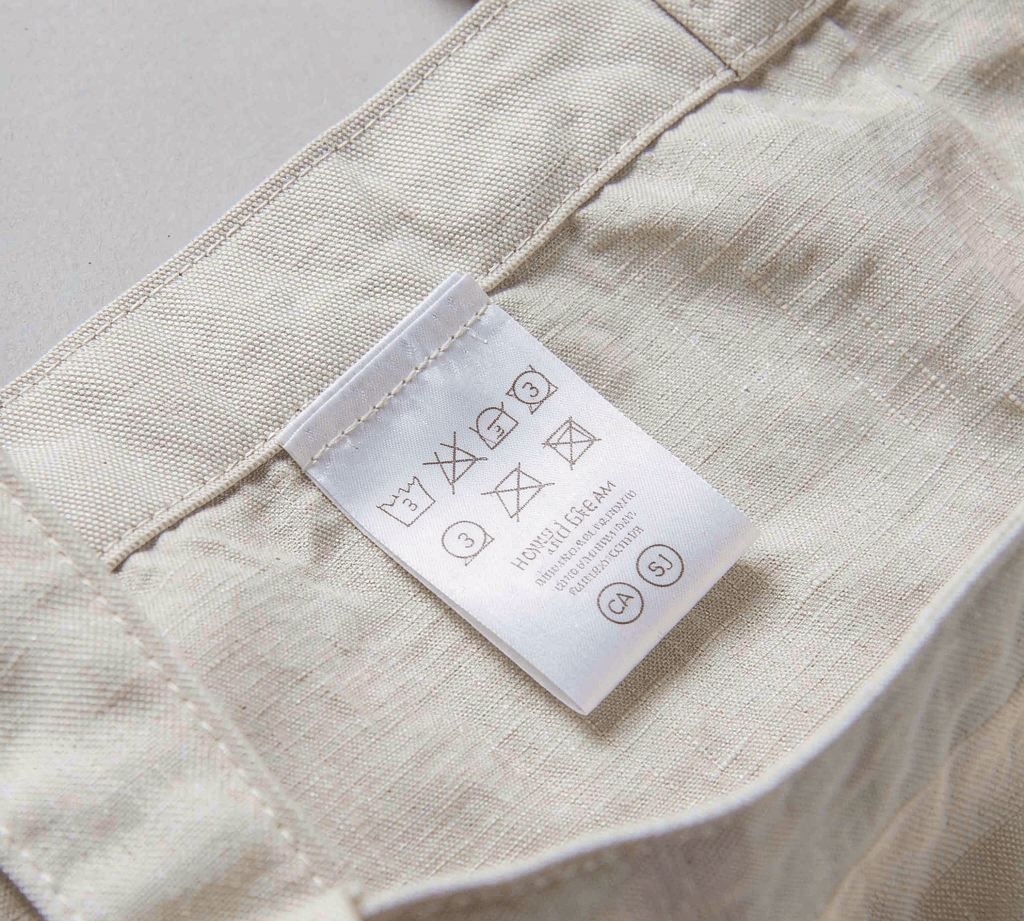
Attachment methods vary by volume and budget:
- Folded satin ribbon — the most common; heat-cut ends, folded, and top-stitched. Cheap and durable.
- Woven label — a single woven patch with the care text built in; feels more premium, higher setup cost.
- Heat-seal or screen-printed — printed directly on the lining for very lightweight or promotional runs, but wears faster.
Care symbols and fiber content
Care symbols follow a recognized standard (ISO 3758 is the one most factories reference), so a wipe icon or a do-not-tumble-dry symbol means the same across suppliers. The key for a buyer is simply to decide the symbols rather than let the factory guess. If the bag is spot-clean only, say so; if it is machine-washable, specify temperature.
Fiber content must match the actual build. A common defect is a label that lists “cotton” on a bag that is mostly synthetic — retailers and market inspectors check this, and a mismatch is a recall risk, not a typo.
Making the print last
A label is only useful if it survives the product’s life. Buyers should ask for a wash and rub-fastness check on the printed or woven text, especially on bags that will be cleaned often (gym, kids, medical). A simple rub test with a damp cloth should not smear the ink after a few passes. For woven labels this is rarely an issue; for printed satin it is worth a line in the QA checklist. Tie it to your broader finishing and QC steps so the factory treats the label as a measured item, not a verbal note.
Export compliance: a short checklist
Compliance is market-driven, so treat the following as a starting list to confirm against your own requirements:
- Children’s bags may fall under small-parts and labeling rules (for example CPSIA in the U.S.); a permanent tracking label is often expected.
- California Prop 65 applies when certain listed chemicals are present in components; a warning line may be required.
- REACH matters for the EU when specific substances appear in hardware or coatings.
None of these are universal “one label fits all” rules — the point is to tell the factory exactly which market the order targets so the correct statements are sewn in. For the full production flow, see our guide to the bag manufacturing process.
What to write in your tech pack
To avoid ambiguity, put the label spec in the tech pack as its own line item: placement, size, attachment method, the exact text or symbols, and the fastness requirement. Related interior details are specified the same way — as explicit, testable callouts rather than verbal notes — including a clear PVC window, edge painting, and seam taping.
FAQ
Do all custom bags need a care label?
Not legally in every market, but most retailers and many import rules expect at least fiber content and country of origin. Specifying one protects you if a buyer audits the shipment.
What is the difference between a care label and a woven label?
A woven label is a physical patch with text built in; a care label is the informational tag (which can itself be woven, satin, or printed). Many bags use a woven brand label plus a separate care label.
How do I stop the printed text from rubbing off?
Ask for a rub-fastness check on the label, and prefer woven or heat-cut satin for bags that get cleaned often. Put the requirement in the tech pack so it is inspected, not assumed.
Can one label cover multiple markets?
Only if every statement on it is true for all of them. A safer approach is a base label (fiber, care, origin) plus market-specific compliance lines added per destination.
Conclusion
A care label is small, but it is one of the few parts of a bag a buyer or inspector actually reads. Writing it into the tech pack — with placement, attachment, exact text, and a fastness check — turns a recurring defect source into a non-event. Treat it like any other spec: explicit, testable, and verified at QC.