A padded hip belt is the part of a load-bearing bag that takes weight off the shoulders and puts it on the hips, where the body carries load far more comfortably. On packs above roughly 7–8 kg (15–18 lb) of packed weight, a well-built hip belt is the difference between a bag people finish the day in and one they abandon. If you are briefing a factory for a trekking, hiking, bike-touring, or heavy everyday pack, the hip belt should be one of the first things written into the tech pack — not added as an afterthought. Above the hip belt, the load-lifter straps finish load control by pulling the upper pack toward the shoulders.
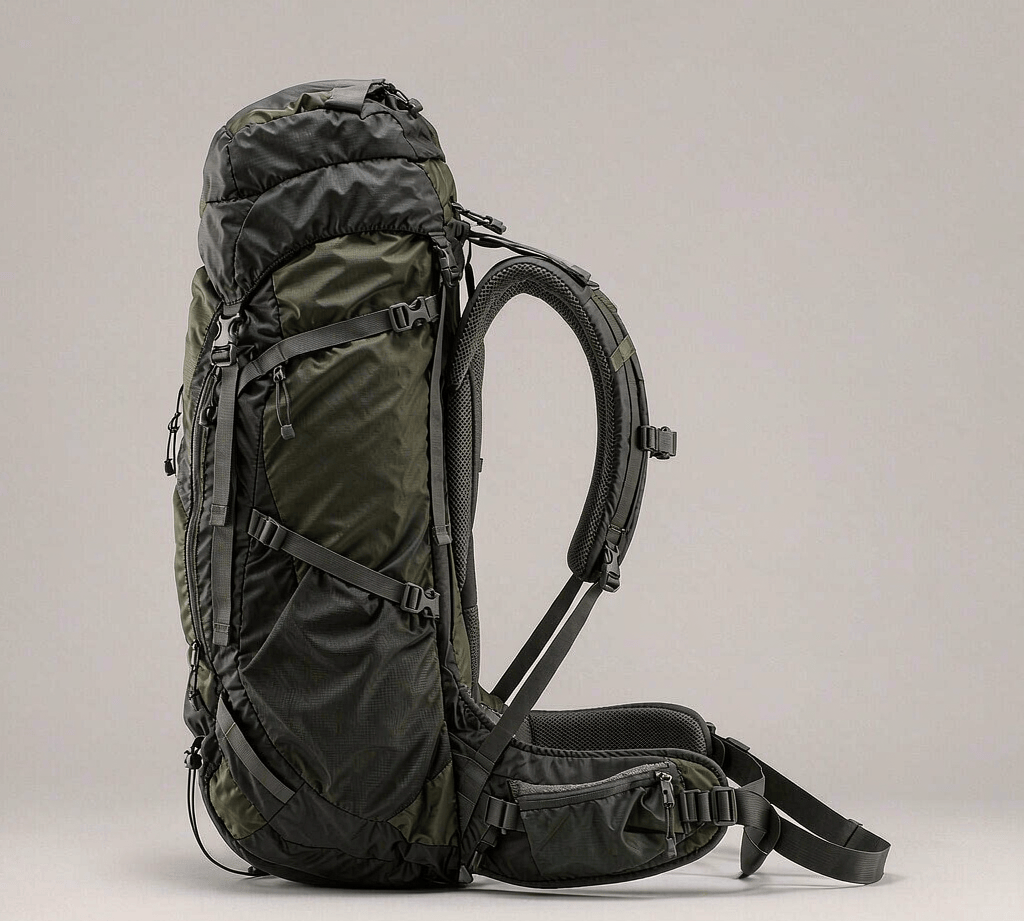
What a hip belt actually does
The shoulder straps hold the pack against the back; the hip belt does the load transfer. A padded belt wraps the iliac crest and, through a frame or a stiffened channel, routes pack weight down to the pelvis. Without it, every kilogram pulls on the trapezius and the lower back. That is why the belt’s width, foam density, and how it connects to the pack body matter more than its appearance.
When you actually need one
Below about 5 kg packed, a hip belt is mostly decoration and can be skipped to save cost and weight. Between 5 and 8 kg it becomes useful. Above 8–10 kg it is essential, and the belt should connect to some form of structure — a frame sheet, a PE board, or a stiffened spine channel — so the load reaches the hips instead of just cinching the waist. The spec on frame sheets and stiffeners explains how that structure is built, and the webbing spec sets the load-rated tape the belt is sewn from.
Specifying the belt itself
Three numbers define the belt: width, foam thickness, and wrap length.
- Width: 50–70 mm is the normal range for adult packs. Narrower belts concentrate pressure; wider than 80 mm starts to hit the ribs.
- Foam: an 8–12 mm closed-cell EVA, often laminated to a softer brushed face, is the standard. The foam padding spec guide covers density and why a dual-layer build (firm core, soft skin) holds shape better than one thick slab.
- Wrap: the two ends should overlap by at least 80–100 mm at the buckle so the belt fits a range of waist sizes without the ends running out.
The buckle and redirect hardware
The belt closes with a side-release buckle sized to the load — 25 mm or 38 mm webbing needs a matching buckle. A small pull-tab and an audible click help field use. Most belts also use a pair of strap hardware connectors (tri-glides or ladder locks) at the attachment points so the webbing can be tensioned and the belt angle set. Specify the buckle’s release strength if the pack will be used with gloves or in cold conditions.
Mounting and stitching
A hip belt fails at the seam, not the foam. The belt must be box-stitched or bar-tacked through the pack’s load channels, not just top-stitched to the shell. High-stress seams should follow a thread and stitch-density spec of bonded polyester at 8–10 stitches per inch, with bar-tacks at every load point. Where the belt meets the pack, a stress-point reinforcement — an internal patch or webbing loop — keeps the seam from spreading under repeated cinching.
What goes wrong in production
The common failures are a belt that is too narrow for the pack’s weight class, foam that is too soft and bottoms out, a buckle that is under-rated for the webbing, and mounting that is sewn to the liner instead of the structure. All four are caught by writing the numbers into the tech pack and checking the first sample against them.
FAQ
How wide should a bag hip belt be?
For adult load-bearing packs, 50–70 mm is the safe range. Under 50 mm concentrates pressure on the hip bones; over 80 mm tends to ride up into the ribs. Kids’ packs scale down to 30–40 mm.
Do small daypacks need a hip belt?
Only if they will carry more than about 5 kg. Below that, a hip belt adds cost and weight without real benefit, and many users leave it unbuckled. For campus or commute packs under 15 L, skip it or make it removable.
Above the hip belt, a padded shoulder strap does most of the daily carrying, so its foam and width deserve equal attention.
What foam works best for a hip belt?
A dual-layer EVA: a firm 6–8 mm core for support plus a softer 2–4 mm brushed face for comfort. Single thick slabs feel plush in the hand but compress and bottom out under load. Core density is usually 35–55 kg/m³.
Can a hip belt be removable?
Yes. A webbing loop or male/female buckle at each hip lets the belt detach for travel or laundry. Note that a removable belt cannot transfer load as reliably as a sewn-in one, so reserve removable belts for lighter packs.
Conclusion
A hip belt is a structural component, not trim. Specify its width, foam, buckle, and mounting in the tech pack, tie it to the pack’s frame, and verify the first sample against those numbers. For a broader view of how load transfer fits into pack design, see our guide to ergonomic backpack features.