When a bag’s job is to protect something — a driver, a board, a camera, a tool — the padding does the work. The shell keeps water and scrapes off; the foam absorbs the impact. Yet foam is often the least specified part of a custom bag, left to the factory’s default. For buyers, a few numbers on the spec sheet decide whether the bag actually protects or just feels padded.
The same closed-cell foam also lines a well-padded shoulder strap, where 10-12 mm of EVA is the comfort sweet spot.
When that same foam has to wrap a body, as in a padded hip belt, the dual-layer build stops the belt from bottoming out under load.
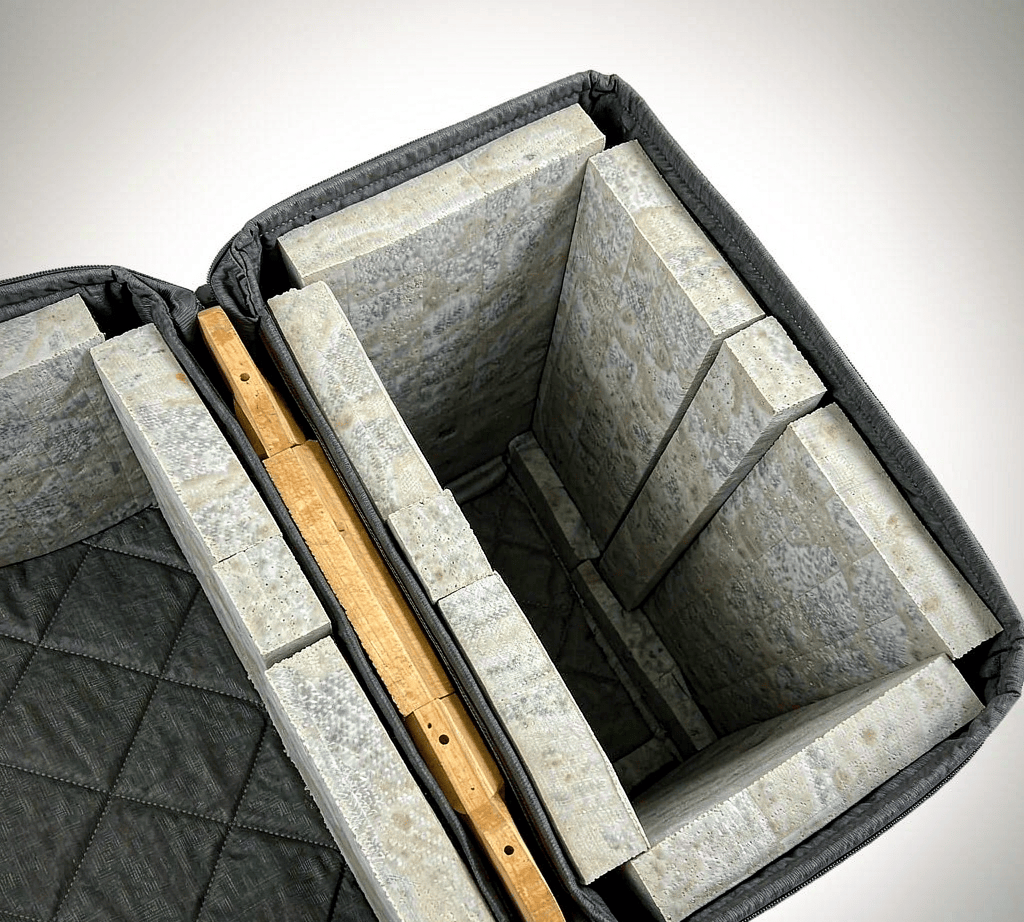
The main foam types
- EVA (ethylene-vinyl acetate): the standard for protective bags. It is closed-cell, holds its shape, and comes in densities from about 30 to 80 kg/m³. Higher density means firmer protection and more cost.
- PE (polyethylene) foam: cheaper and softer, often used as a filler layer. It compresses more easily, so it is less suited to heavy impact.
- PU (polyurethane) foam: light and cushiony, common in laptop sleeves. It breaks down faster under repeated load and heat.
- Cross-linked vs non-cross-linked: cross-linked EVA has a finer, more uniform cell and better compression recovery — worth the small premium on bags that get dropped often.
Thickness and density, not just “padded”
A 5 mm layer of 30 kg/m³ EVA feels padded but stops almost nothing. Protection comes from combining thickness with density: a 10 mm, 60 kg/m³ EVA panel absorbs far more. When you ask for “padded,” pin down both numbers, or the factory will pick the cheapest combo that still feels soft to the hand. This is the same discipline behind bag stress point reinforcement — both are about where the bag actually takes the hit.
When the padding also has to hold a three-dimensional curve, flat sheet stops working and the spec moves to molded EVA shells.
Where padding matters most
In a golf bag, the top cuff and divider walls need firm foam so club heads do not knock together; the materials angle is covered in our notes on golf bag materials and construction. A ski or snowboard bag needs edge protection along the length, not just a flat bottom — see ski and snowboard bag basics for the layout. Bike panniers and frame bags benefit from thinner, shaped foam that pads without bulking. The padding plan should follow the contents, not a uniform wrap.
Where a panel also has to stay flat under load, foam is usually paired with a semi-rigid insert; frame sheets, PE boards and stiffeners covers that layer and how to specify it.
Specifying for production
Two checks keep foam honest. First, compression set: after a weighted load, good EVA recovers most of its thickness; cheap foam stays flat. Second, lamination: the foam must stay bonded to the shell and lining through heat and flex. A delaminated panel is a warranty call waiting to happen, and it pairs badly with a welded, waterproof shell that otherwise keeps the interior dry. Tie both checks to your inspection step so production matches the approved sample.
Thickness is one of the dimensions that drifts most between sample and bulk, so it helps to settle dimensional tolerances before material is booked.
Where the goal is airflow rather than cushioning, a spacer knit panel is specified by a different set of numbers: thickness under load and compression recovery rather than density.
For a deeper look at protective features across sports bags, see sports bag features buyers should know.
Freezing foam spec before material is booked is what keeps a late change from re-entering the queue, the pattern described in this breakdown of production lead time.
FAQ
Q: Is EVA or PE foam better for a protective bag?
A: EVA is the better choice for impact protection — it is firmer, holds shape, and recovers after compression. PE is fine as a cheaper filler but compresses more easily.
Q: How thick should foam padding be?
A: It depends on what you are protecting, but thickness alone is not enough. Pair 8–12 mm of 50–70 kg/m³ EVA for gear that takes real knocks; thinner panels work for light cushioning.
Q: Does foam add much to unit cost?
A: It can. Higher density and thicker panels raise material and die-cutting cost, but they are usually a small part of the total. Spec them explicitly so quotes are comparable.
Q: Can foam be waterproof or washable?
A: Closed-cell EVA resists water on its own, and pairing it with a sealed shell keeps the interior dry. The foam itself is not washable, so the shell and lining do the cleaning job.
Buyers comparing suppliers can review our full bag catalog for OEM/ODM specs, materials, and MOQ.
For the padded build itself, our guide to [Quilted Bag Construction](https://imarobag.com/bag-quilted-construction-spec/) explains the stitch and loft specs that matter.