The approval sample arrived at 45.5 cm wide. The first bulk cartons measured 46.8 cm across the same seam. Nobody had done anything wrong — nobody had agreed what 45.5 cm meant, either.
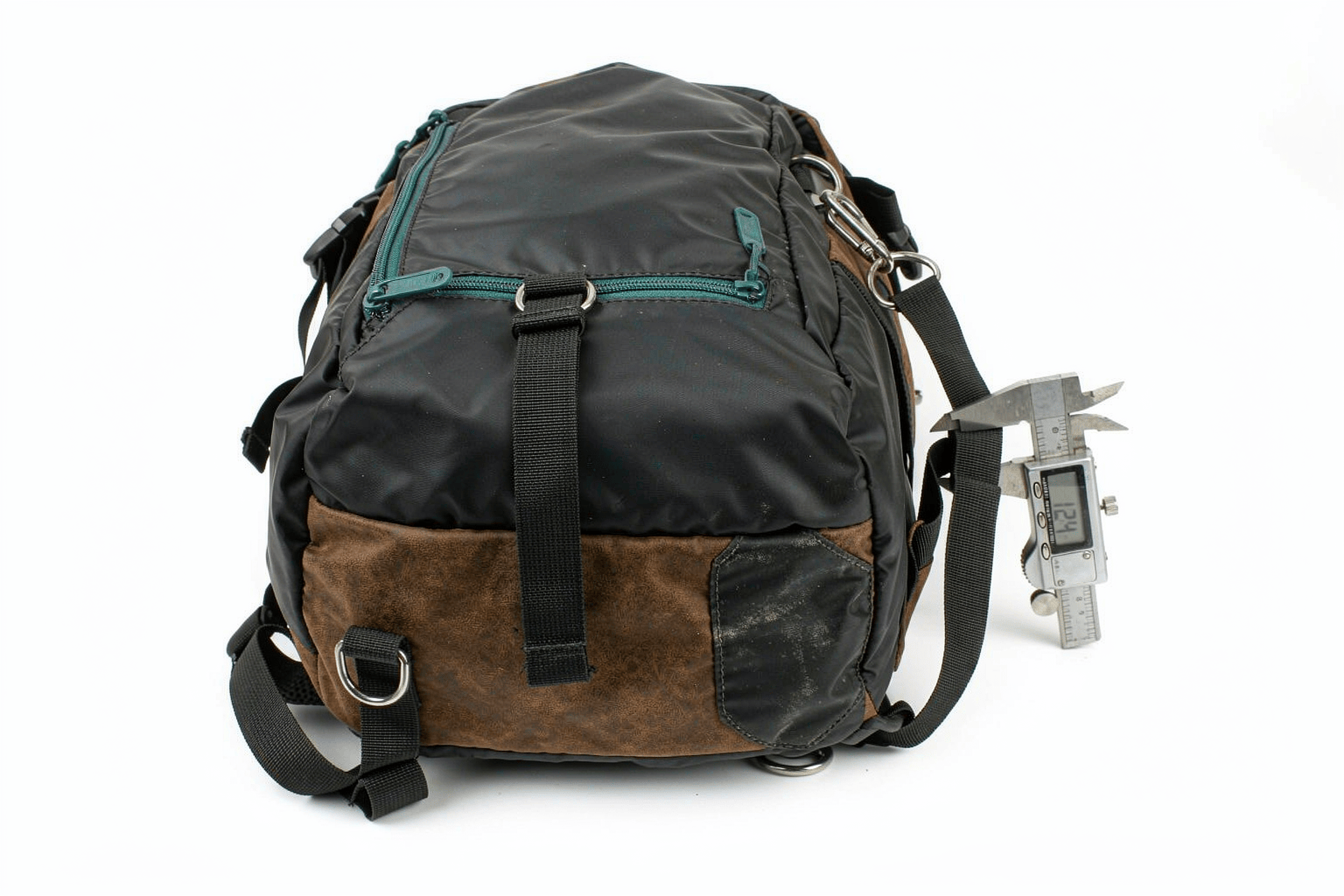
Disputes like that are common in soft goods. A bag is not a machined part; it is flexible layers joined by thread, and each one has its own opinion about where the edge should sit. Settling tolerance before cutting is cheaper than arguing after shipping.
The base panel length and width sit in the same tolerance table, and a reinforced bottom earns its own line in the tech pack — see how a reinforced bag base is specified.
Where the millimetres come from
Variation enters in four places, and they compound.
Cutting. Die-cut panels are repeatable because the tool fixes the outline, but the fabric underneath still moves. Knitted and stretch-woven shells relax after they leave the roll, and a stack of plies cut in a single pass is rarely identical from top ply to bottom. Cutting method matters too — die cutting, laser and oscillating-knife tables each leave a different edge signature.
Seam allowance. A 10 mm allowance taken at 9 mm instead of 11 mm moves a finished panel by 2 mm, and one bag body has many seams. Operators tend to be consistent within a shift and less consistent across shifts.
Padding. Foam is bought by nominal thickness, but it compresses under the presser foot and rebounds slowly, and laminated foam behaves differently from loose sheet. When the padding spec is vague, the finished silhouette is what drifts. The thickness and density variables behind that are covered in foam padding specifications.
The state of the bag when measured. An empty bag lies flat and reads small; the same bag stuffed and standing reads larger. Webbing under load creeps slightly, and a strap cut and sealed hot can sit a few millimetres off nominal length once it cools.
Writing a tolerance a factory can hold
The most useful thing a buyer can do is define how a dimension is taken, not just the number.
- Name the measurement points. “Width” is ambiguous on a tapered body. Say base seam to base seam, or widest point excluding pockets.
- Fix the condition. Flat, unstuffed, hardware relaxed, measured a day after unpacking so creases fall out.
- Separate critical from cosmetic. Internal clearance on a laptop sleeve and the outer envelope of a carry-on are critical. Pocket depth and webbing tail length usually are not.
- Use one-sided tolerances where fit demands it. A sleeve that has to swallow a 15.6-inch laptop wants +3/-0, not ±1.5. Symmetric numbers are easy to write and wrong for anything that must accept another object.
- Match the tolerance to the process. Asking a cut-and-sew panel to hold what a moulded shell holds is a request no factory can meet. Asking for looser than the process allows just gives away consistency you already paid for.
It also helps to say what happens outside tolerance. “±5 mm, reject beyond” tells a line supervisor something different from “±5 mm target, flag at 8 mm”. The second version gets you a conversation; the first gets you a rejected container.
Volume deserves a note. Buyers specify external dimensions and then market a litre figure derived from them, which is one way a capacity rating drifts between sample and bulk. Rate volume the same way every time.
Label placement deserves a callout too; the retail labeling guide covers what to specify for barcodes and care labels.
Checking bulk against the reference
Keep the approved sample. Not a photo and not a spec sheet — the physical unit, stored flat and out of sunlight, because foam and coated fabrics both change over months.
When pre-shipment inspection runs, the same person should measure the reference and the samples with the same tool, in the same state, on the same day. A steel rule and a soft tape disagree by a millimetre or two across a curved panel, and that alone can look like a process failure.
Most inspection regimes sample rather than measure every unit, so agree the sampling plan and the measurement sheet in one document. If dimensional checks are not on that sheet, they will not happen. The moment to settle it is the pre-production meeting, before fabric is cut — the sample development timeline has a slot for it right after approval.
FAQ
What tolerance is realistic on a sewn bag body?
A few millimetres across a 400–500 mm panel is normal for cut-and-sew construction. If a product genuinely needs tighter, the fix is usually a change of construction — a moulded shell, a bound frame, or a panel trimmed after assembly — rather than a smaller number on the same drawing.
Why does the same bag measure differently at two factories?
Because the measurement method differs. One lays the bag flat, one measures it standing; one pulls the tape taut, one does not. Ask both to measure your reference sample and report the number before you compare quotes.
Should carry-on luggage be held to tighter tolerances?
The outer envelope should be. Airlines publish dimension limits and gate sizers are physical objects, so a case that reads 56 cm in the spec and 58 cm at the gate is a real problem. Treat height, width and depth including wheels and handles as critical dimensions.
Do moulded shells hold tolerance better than sewn panels?
Generally yes, once the tool is proven, because the outline is fixed by steel rather than by an operator. The trade-off is that early shots off a new tool can drift while shrink rates settle, so dimensional checks on first articles matter more, not less.
Related reading: How to evaluate a bag supplier’s capabilities