The barcode is the smallest thing on a bag and the one part you cannot fix after production. A crooked stitch can be re-sewn and a shade can be re-dipped. A symbol that scans at a failing grade, or a care label missing its fiber percentage, gets a finished shipment refused at the warehouse door — not because the product failed, but because the information printed on it did. Most first programs hand labels over late, as artwork. The choices that decide whether a barcode scans are locked in before bulk cutting starts, so they belong in the tech pack.
Three labels, three rulebooks
Retail barcodes, content labels, and carton shipping marks all look like “the label” on a purchase order. Different parties govern them, and they fail at different points in the chain.
- Retail barcode (GTIN, UPC, EAN). The number belongs to the brand, the print quality belongs to the factory, and the scan happens at a register you will never see.
- Content and care label. Fiber composition, origin, care instructions, manufacturer identity. Regulated by your market, not by the retailer.
- Carton label or shipping mark. What the distribution center reads to receive the carton, often a different number entirely, such as an SSCC-18 container code.
Conflating them is the most common early mistake, and a supplier will print the carton number on the polybag if nobody says which number goes where. The carton side is its own spec — see the export carton packaging guide.
Who owns the number
UPC and EAN numbers are built from a GS1 company prefix licensed to one legal entity, and the GTIN resolves back to that entity in the GS1 registry. Numbers sold cheaply by resellers are usually recycled from lapsed prefixes, and that mismatch is what marketplaces check: Amazon expects the brand on the listing to line up with the registrant of the GTIN.
The clean split: the brand buys its own prefix, maps each GTIN to a SKU, and supplies the number; the factory prints it. Write that division on the PO, because “who prints it” and “who owns it” get confused constantly.
Print method decides whether it scans
A barcode is a pattern of module widths. Anything that softens the edge between a dark bar and a light space lowers the grade, so the method matters more than the file.
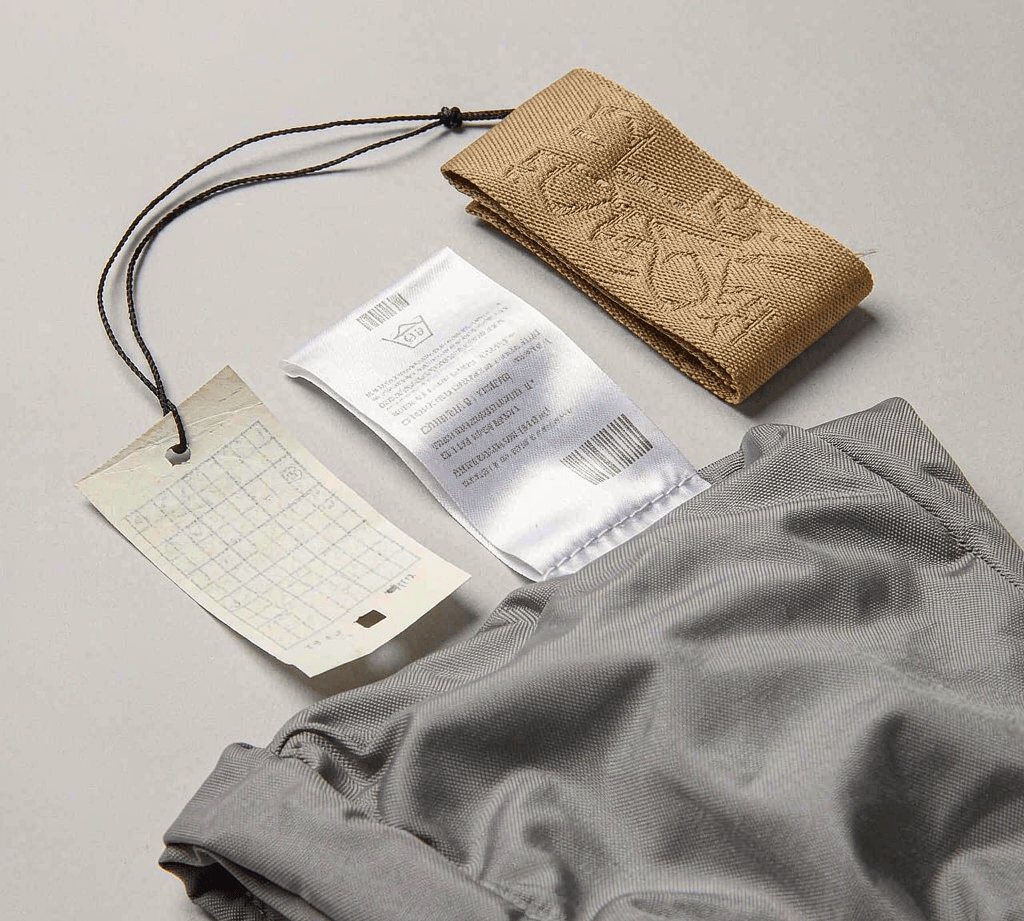
- Woven label — excellent for a brand mark, weak for a symbol. Thread edges blur module boundaries and polyester sheen drops contrast.
- Heat transfer or thermal print on satin — crisp modules, the default for care labels for good reason.
- Screen printing — fine for graphics, risky for fine modules straight onto textured fabric.
- PVC or rubber patch — durable, but the barcode wants a flat print rather than molded relief.
- Self-adhesive sticker — practical for FBA prep and short runs, with the usual caveat about adhesive on coated nylon.
Placement finishes the job: keep the light quiet zone at both ends, keep the symbol off seam allowances and rolled edges, avoid anywhere a strap or zipper pull rests across it, and never fold it over a binding. Labels also rub against lining, so they need to survive what color fastness testing covers.
Verify, do not eyeball
A phone app answers “does this decode at all under good light”, not “will this survive a conveyor scanner at an angle”. ISO/IEC 15416 grades linear symbol print quality from A down to F on parameters such as edge determination and modulation, using a calibrated verifier.
Retailers set their own minimum grade. Ask the buyer for theirs rather than guessing. If a symbol passes at 100% magnification, shrinking it to fit a smaller label is a fresh risk.
Market-specific content
The fiber and care block is regulated in most major markets, and the rules do not transfer. In the United States, a textile product generally needs fiber content by weight under the Textile Fiber Products Identification Act, care instructions under the FTC Care Labeling Rule (16 CFR Part 423), country of origin, and a manufacturer or RN identity. In the European Union, fiber names and percentages fall under Regulation (EU) No 1007/2011; California Prop 65 warnings and a CPSIA tracking label for children’s products add further lines.
One universal label satisfies nobody, so freeze the copy per destination and date it. A revised fiber blend after a material swap invalidates the text, and so does any claim beside it — including capacity, which should match the capacity rating method you actually used.
What goes in the tech pack
One label panel prevents more rework than any other page. For every label, specify artwork, finished dimensions, print method, substrate, placement measured from a fixed reference point, magnification, quiet zone, and the verification requirement. Name who supplies the GTIN, then treat the label as a component with its own approval sample — a printed proof on production fabric, not a PDF. Brand marks follow the logic of other logo application methods.
FAQ
Why does it scan on the sample but fail in bulk?
Usually the substrate changed. Coated ripstop or heavy mesh behaves differently from the satin used on the approval sample, and absorption shifts the module edges.
Do we need a different label per country?
The fiber and care block must match each market’s rules. Many brands run one multi-language label for the EU and a separate one for the US.
Where should the barcode sit on a backpack?
Somewhere flat and reachable: interior seam tape, the lower back panel, or the hangtag. Avoid curved gussets.
Related reading
For the wider picture of where labeling sits in a custom program, see OEM vs ODM bag manufacturing.