If you want a custom bag that can carry more than what fits inside, this attachment grid is the answer buyers keep coming back to. A row of spaced webbing loops — the MOLLE/PALS grid — lets users clip pouches, holsters, and straps onto the outside of a pack without sewing anything permanent. For an OEM order, the difference between a grid that lasts and one that tears off is almost entirely in the spec sheet.
Beyond sewn webbing loops, many packs add stretch mesh pockets for bottles and quick-access gear. Those same sewn webbing loops can also form the tab that catches a toggle closure on a drawcord opening.; our mesh pocket spec guide covers mesh grade, pocket size, and edge finishing.
What modular webbing actually is
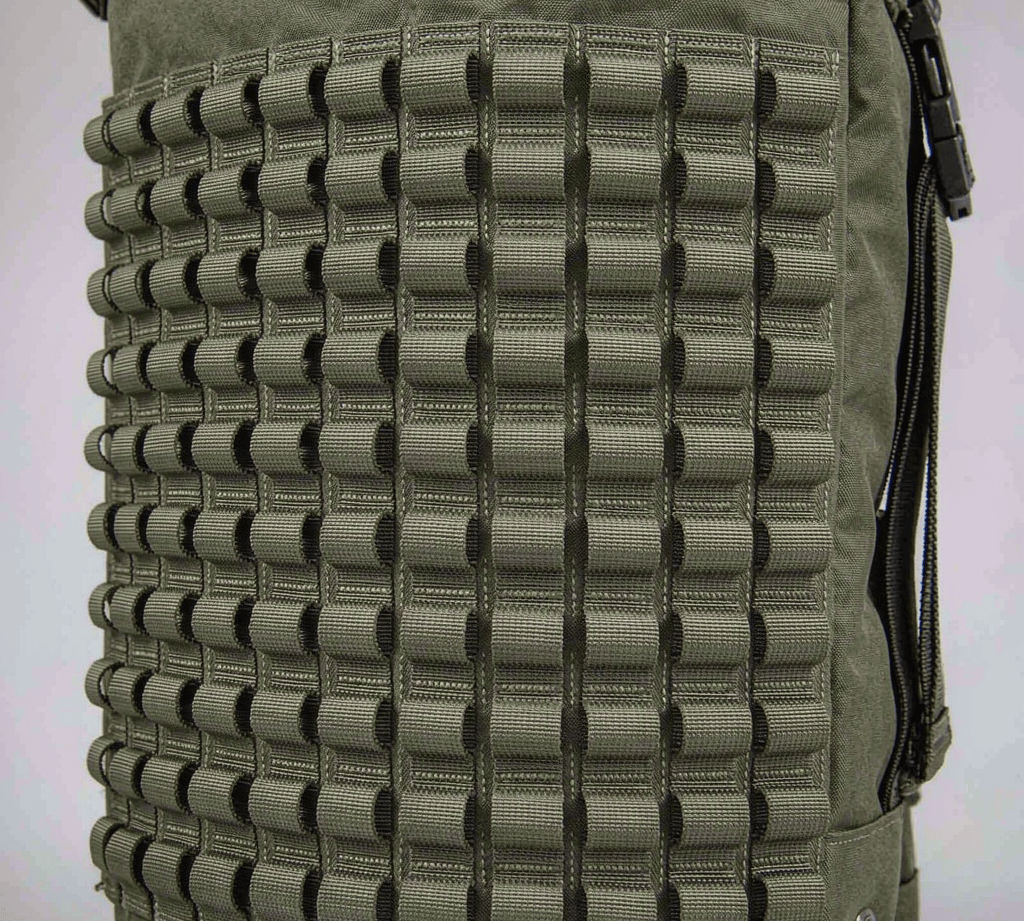
Modular webbing is a grid of 1-inch (25 mm) nylon webbing sewn onto the bag face in evenly spaced rows. The spacing follows the PALS standard: loops sit 0.5 inch (12.7 mm) apart, with each row 1 inch (25 mm) tall. That fixed pitch is what lets third-party pouches from any maker snap on. If your factory drifts from the standard pitch, off-the-shelf accessories will not lock in. Spell out the pitch in millimeters in the tech pack and ask for a row-count tolerance of ±1 mm.
Choosing the webbing grade
The grid is only as strong as the webbing it is cut from. Most buyers specify 17337-type nylon webbing at 1 inch width, with a break strength around 600–1,200 lbf depending on the weight class. Heavier tactical or dive bags may move to 2-inch webbing for the primary rows. Match the webbing width to the pouches you expect to mount; a 1-inch grid will not accept a 2-inch pouch cleanly. The webbing and strap spec guide covers the widths and break ratings you should cite.
How the grid is sewn on
A reliable modular grid is box-stitched or bar-tacked at every intersection, not just edge-tacked. Each loop should be a continuous pass that wraps the bag panel so the load spreads into the backing fabric. Skipping stitches to save time is the most common reason a grid rips away after a few months of use. The strap hardware guide explains the D-rings and triglides that usually pair with these loops, and a daisy-chain attachment point is a lighter variant when you only need a few lashing points rather than a full grid.
Where modular webbing belongs — and where it doesn’t
It shines on tactical, hiking, cycling, and camera bags where users reconfigure loads daily. It adds weight and cost, so it is a poor fit for slim commuter or fashion totes. If a buyer wants adaptability without a full grid, a few reinforced loops at the base or lid do the job for less. Before committing, read how a purpose-built sports bag for the gym uses external mounting without overloading the design.
Common failures to spec against
The two failures we see most: webbing that frays at the cut ends because it was not heat-sealed or folded, and grids that peel because the backing panel was too thin to take the load. Specify folded-and-stitched ends, a backing fabric of at least 500D, and a sample pull test at the quoted load before signing off the order.
FAQ
How many rows of modular webbing do I need?
That depends on the tallest pouch you expect. Most buyers run 3–6 rows on a panel; each row adds about 1 inch of height. Sketch the accessories first, then size the grid to fit them with one spare row.
Can modular webbing go on any bag material?
It works best over a stiff panel — EVA-foam-backed or PE-board inserts hold the grid square. On a floppy fabric panel the loops sag and pouches sit crooked, so build in a backing layer where the grid sits.
Is MOLLE the same as PALS?
PALS is the webbing spacing standard; MOLLE is the original military system that uses it. In custom manufacturing the terms are used interchangeably to mean the 1-inch spaced grid. Ask for “PALS pitch” in the tech pack to be precise.
Does modular webbing add much weight?
A full grid on a panel adds roughly 30–80 grams depending on row count and webbing weight. It is noticeable on ultralight builds, which is why many brands limit it to one panel rather than wrapping the whole bag.