How to source bags from China comes down to eight checkpoints you control before the deposit moves: a complete tech pack, a verified factory, quotes on one Incoterm, an approved pre-production sample, a written AQL standard, compliance documents matched to your import market, a schedule built backwards, and a landed-cost calculation. Skip one and a cheap unit price becomes rework, delay, or a customs hold.
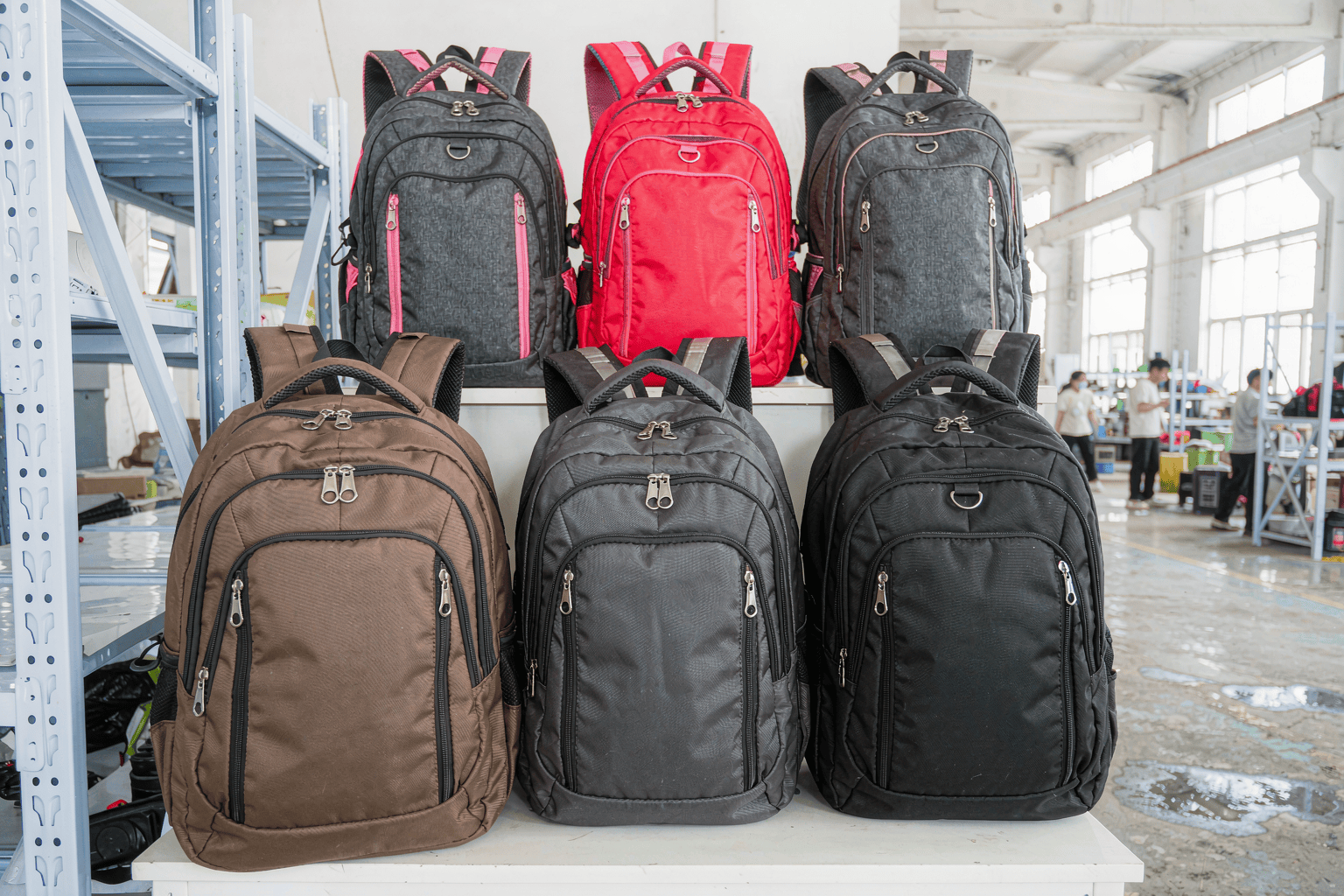
How to source bags from China: the eight checkpoints
- Spec the product in writing — a tech pack with dimensions, materials, hardware, and tolerances.
- Verify the factory — licence, quality system, social audit, and in-house processes.
- Compare quotes apples-to-apples — same Incoterm, same currency, same validity window.
- Approve two sample rounds — a prototype for design, a pre-production sample for bulk.
- Fix the quality standard — AQL levels plus lab tests named in the contract.
- Collect compliance documents — test reports that reference your actual bill of materials.
- Build the schedule backwards — from the date goods must be in your warehouse.
- Cost the landed price — freight, duty, and destination charges on top of FOB.
Step 1: Write the tech pack before you contact a factory
A quotation without a tech pack is an estimate: the same design can come back 20–30% apart from two competent factories because each guessed a different lining, foam thickness, or zipper grade. One file removes the guessing. It should contain:
- Dimensions and tolerances — panel sizes at ±3 mm on cut parts, finished outer dimensions, and a target weight at ±5%.
- Bill of materials — shell fabric with denier and coating, lining denier, foam type and thickness (EVA at 8–12 mm for structured panels), webbing width, zipper gauge and type, and hardware finish.
- Colour references — Pantone or TPX codes for every component, with lab dips approved under a D65 light box. Fabric, webbing, zipper tape, thread, and lining rarely match on the first dip; approve each to ΔE ≤ 1.5.
- Construction detail — stitch density in stitches per inch (7–9 SPI for load-bearing seams), seam type, bartack positions at every handle and strap junction, and edge finishing.
- Decoration and packaging — logo method, placement, panel size, labels, hangtag, and carton pack-out.
- The test standards you will hold — naming them here means the factory prices for compliance instead of against it.
For a backpack programme, the spec checklist in our backpack buying guide for brands covers the same fields with category-specific numbers you can drop straight into the pack.
Step 2: Verify the factory, not just the sales contact
The person answering your email may be a trading company, an agent, or the factory’s export desk. All three can produce good bags, but you cannot verify what you have not identified. Ask for, then check:
- Business licence — the 18-character Unified Social Credit Code identifies the legal entity. Confirm the registered scope covers manufacturing, not only trading.
- Quality system certificate — ISO 9001 with a scope covering bags or luggage. Verify the certificate number on the issuing body’s register; certificates lapse and change scope.
- Social audit — amfori BSCI or Sedex SMETA, offered as a 2-pillar audit (labour plus health and safety) or a 4-pillar audit adding environment and business ethics. Request the report, not the certificate page.
- Process map — which operations are in-house; name anything outsourced.
- Two or three export references in your own market, because EU and US documentary expectations differ.
Treat these as risk signals: refusing a live video walk-through of the line, quoting a firm price before reading the tech pack, no sample room, or declining to name the fabric mill. The reasoning behind each check is set out in our guide on how to choose a bag manufacturer for your brand.
Step 3: Compare quotes on the same Incoterm and the same spec
Quotes arrive as EXW, FOB, CIF, DAP, or DDP. Comparing $7.80 EXW against $9.40 DDP is not a comparison: roughly 40–60% of the gap is freight, insurance, duty, and destination charges rather than the bag. The Incoterms® 2020 rules from the International Chamber of Commerce define where cost and risk transfer for each term.
| Term | Export clearance and inland haulage | Main freight | Import duty and clearance | Best used when |
|---|---|---|---|---|
| EXW | Buyer | Buyer | Buyer | You have your own China-side consolidator |
| FOB | Seller | Buyer | Buyer | Standard for most first orders |
| CIF | Seller | Seller (to destination port) | Buyer | You control clearance but want freight handled |
| DAP | Seller | Seller | Buyer | You have a broker and want door delivery |
| DDP | Seller | Seller | Seller | You want one number and a bonded importer of record |
Ask every factory for the same thing: FOB in USD, valid for 30 days, priced at three volume tiers (500 / 1,000 / 3,000 units), with tooling and sampling as separate line items. Separation matters because those one-off costs distort the first order:
- Custom zipper-pull or logo-badge mould: roughly $300–1,500, 15–20 days to cut.
- Custom woven label: $50–150 setup, MOQ 500–1,000 pieces.
- Prototype: $50–200 per sample, plus $40–80 courier.
- Custom-dyed fabric: 15–25 days of material lead time, with a dye-lot minimum.
On payment, 30% deposit with the balance against a copy of the bill of lading is the common structure for a first order; a letter of credit at sight works for larger programmes. Decline full prepayment before you have seen a pre-production sample.
Step 4: Sample in two rounds — prototype, then pre-production
Two rounds, with different jobs.
Round one, the prototype (7–10 days). This sample answers “does the design work?” Check proportion, pocket access, and strap geometry. Expect to pay for it and to revise it.
Round two, the pre-production sample (5–7 days). This one must be built on the bulk line from bulk materials and confirmed trims, not assembled in the sample room. It is the physical reference for the order: sign and date one, keep it, and have the factory keep a sealed counterpart.
Before signing it off, run the checks that catch most field failures:
- Load the bag to 1.5× rated capacity for 30 minutes; check strap anchors and seam creep.
- Drop test from 1 m with a 2 kg load, on the base and each corner.
- Cycle every zipper 200 times by hand; watch for slider spread or tape separation.
- Weigh the sample against the tech pack target within ±5%.
Any change after sign-off — a different fabric mill, a swapped zipper grade, a relocated logo — needs a new pre-production sample. Bulk built against an unapproved change is where most order-level defects are born.
Step 5: Put the quality standard in writing: AQL plus lab tests
“Good quality” is not a specification. Two documents are.
The AQL standard. Agree an Acceptable Quality Limit under ANSI/ASQ Z1.4, single sampling, General Inspection Level II, with AQL 2.5 for major defects and 4.0 for minor. On a 1,200-unit lot that means a sample of 125 pieces: accept 7 / reject 8 for major defects, accept 10 / reject 11 for minor. Critical defects — sharp points, non-functioning closures, missing required markings — carry an accept number of zero.
The test protocol. Name the standard, the method, and the pass threshold:
| Test | Standard | Commonly specified threshold | Failure mode it prevents |
|---|---|---|---|
| Colourfastness to rubbing | ISO 105-X12 | Grade 4 dry / 3–4 wet | Dye transfer onto clothing |
| Abrasion resistance | ISO 12947-2 (Martindale) | 10,000 cycles at 600 D; 30,000+ at 1680 D | Pilling and holes in high-wear zones |
| Zipper durability | QB/T 2171 or BS 3084 | 5,000 open-and-close cycles | The most common field failure in bags |
| Seam strength | ISO 13935-2 | 150–200 N per 50 mm shell seam | Straps and handles pulling out |
| Handle and strap load | Internal method | 1.5× rated load for 30 min | Anchor failure under real use |
| Water repellency (if claimed) | ISO 4920 spray test | Grade 80 or better | Unsupported marketing claims |
Book three inspection points, not one: an initial production check at 10–20% output, when setup errors are still cheap; a during-production check at 40–60%; and a pre-shipment inspection at 80–100% packed. Third-party inspection runs $250–400 per man-day with agencies such as SGS, Intertek, TÜV Rheinland, Bureau Veritas, or QIMA. Require a needle-control policy: needles issued and collected against a count, and metal detection at ferrous sensitivity around 1.0–1.2 mm.
Step 6: Match compliance documents to your import market
Compliance is documentary. If a claim is not on a test report that matches your bill of materials, it does not exist at the border.
For the EU:
- REACH (EC 1907/2006) — substances of very high concern below 0.1% w/w per article, plus Annex XVII restrictions on azo dyes, nickel release, and PAHs. Ask for the current PFAS position, not last year’s declaration.
- General Product Safety Regulation (EU) 2023/988 — applicable from 13 December 2024, requiring product traceability, an identified economic operator for non-EU sellers, and instructions and safety information.
- OEKO-TEX Standard 100, Class II — the usual evidence for skin-contact textiles.
- Global Recycled Standard (GRS) — needed for any recycled-content claim, evidenced by a transaction certificate tracing the recycled input through each stage.
For the US:
- CPSIA — lead limits of 100 ppm in substrates and 0.1% for specified phthalates, tested by a CPSC-accepted laboratory where required.
- California Proposition 65 — either a compliant warning or formulation below the safe-harbour levels; get the position in writing.
- Country-of-origin marking under 19 U.S.C. 1304 — “Made in China” permanently affixed and legible at the point of sale.
- Duty exposure — bags generally classify under HTS heading 4202, but the rate depends on the subheading and material, and Section 301 duties have applied to many Chinese-origin 4202 subheadings at up to 25%. Verify the current position with your broker.
Request test reports from an ISO/IEC 17025-accredited laboratory, dated within 12 months, listing the components actually used. A generic “REACH compliant” statement issued against a different bill of materials is a common gap at this stage.
Step 7: Build the timeline backwards from your in-hands date
Work from the warehouse date, not from “production takes 30 days.”
| Stage | Duration | Notes |
|---|---|---|
| Tech pack review and quotation | 3–7 days | Longer if tooling is quoted |
| Prototype | 7–10 days | Plus 3–5 days courier each way |
| Pre-production approval | 5–7 days | Per revision round |
| Bulk production | 25–35 days | 1,000–5,000 units at typical line load |
| Inspection and corrective work | 3–7 days | Add a round if it fails |
| Ocean freight and clearance | 28–40 days | Air is 5–7 days at roughly 4–6× the cost |
That is about 45–55 days by air and 70–90 days by sea from an approved tech pack. Three calendar hazards break it: Chinese New Year, when shutdowns run two to four weeks; the National Day holiday on 1–7 October, which absorbs September slots; and the August-to-October peak, when slots fill and ocean rates can rise 30–100%.
The bottleneck is almost never sewing — it is material lead time: custom-dyed fabric at 15–25 days, a custom hardware mould at 15–20 days, a custom woven label at 10–15 days. Confirm those dates before committing to a delivery date.
Step 8: Cost the landed price, not the FOB price
FOB is a component of cost, not the cost. Below is an illustrative 1,000-unit order at $8.00 FOB.
| Component | Amount | Per unit |
|---|---|---|
| Goods, FOB | $8,000 | $8.00 |
| Tooling and samples | $600 | $0.60 |
| Ocean freight plus origin charges | $1,100 | $1.10 |
| Marine insurance (0.3–0.5% of CIF) | $40 | $0.04 |
| Import duty (at your verified HTS rate; 20% used here as an illustration) | $1,828 | $1.83 |
| Brokerage, clearance, and final delivery | $450 | $0.45 |
| Landed total | $12,018 | $12.02 |
The uplift over FOB is about 50% — the number your margin depends on: a supplier at $8.30 FOB can cost more than one at $9.10 once packaging, freight terms, and duty classification differ. First orders add fixed costs (inspection $250–400 per man-day, lab testing $150–600 per material package), so amortise them over annual volume.
Frequently asked questions
What is a realistic minimum order quantity for custom bags in China?
Standard MOQ is 300–500 units per colourway, set by cutting efficiency and decoration setup. Custom components raise the effective floor: a woven label typically starts at 500–1,000 pieces and a moulded metal badge at 1,000–3,000.
Should I use a sourcing agent or work directly with a factory?
Direct works when you have a complete tech pack, your own inspection arrangement, and roughly 3,000 units or more per order. An agent earns its fee on small or multi-category programmes, where coordination and re-inspection cost more than the commission.
How do I check whether a Chinese factory’s certificates are genuine?
Ask for the certificate number and issuing body, then verify on that body’s online register. Request the full audit report rather than the certificate page, check the audit date is within 12–24 months, and confirm the scope covers bags.
Which Incoterm should a first-time buyer choose?
FOB: the factory handles export clearance and loading while you control the forwarder, insurance, and import clearance. Move to DDP only when you have a reliable importer of record and want one delivered number.
How much should I budget for tooling on a first custom bag order?
Typically $500–2,500, covering any custom mould, printing screens or embroidery digitising, and label setup. Ask for these as separate line items so recurring and one-off costs stay visible.
What is the single most common cause of a failed first order?
An incomplete tech pack, or a material change after the pre-production sample was approved. Both let the factory make reasonable decisions that miss your expectation, and both surface only at pre-shipment inspection, when the goods are already made.
Get a Custom Bag Quote
How to source bags from China is mostly a documentation problem: write the spec, verify the factory, fix the quality standard, and cost the landed price before the deposit moves. Send your tech pack for a manufacturability review and a costed quote that confirms materials, tooling, certification, and lead time: Request a quote
Buyers comparing suppliers can review our full bag catalog for OEM/ODM specs, materials, and MOQ.