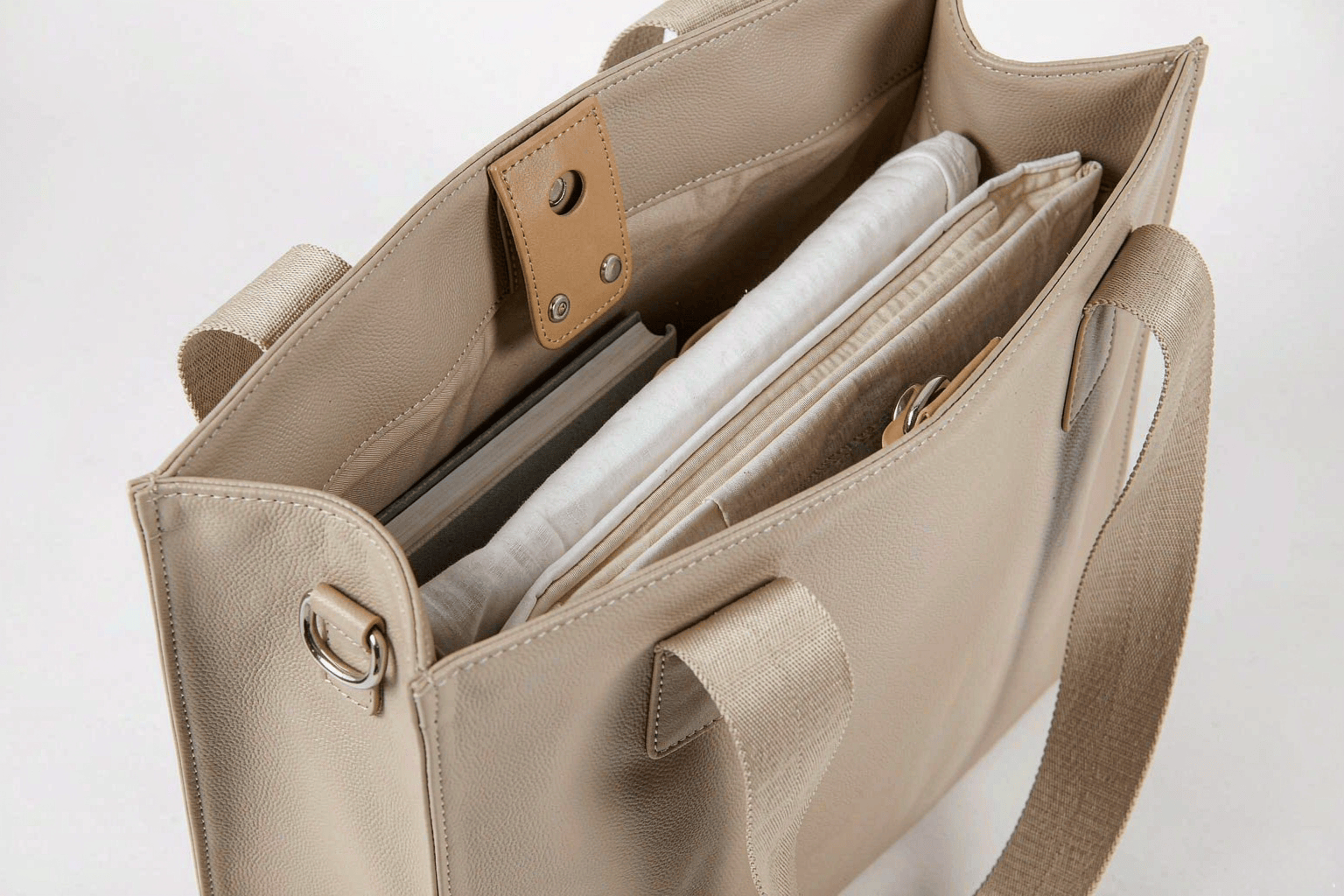
How to pack a tote bag well is decided long before the end user fills it, at the specification stage. A buyer should map compartments to use frequency, set a structured base and a suspended sleeve where needed, and confirm webbing grade and closure type with the factory. Those layout decisions, not afterthought pockets, determine whether the finished tote stays organized under daily load.
Why Internal Layout Drives the Whole Program
A tote lives close to the body for hours, so how its load is arranged shapes comfort, access speed, and returns. An open bucket tote turns into a black hole by week two; a tote with compartments spec’d to real use stays a tool the buyer trusts. For a B2B program, the layout is a spec line, not a decoration, and it should be locked in the tech pack before sampling.
- Heavy items: belong low and centered, near the body, to protect posture.
- Frequent items: phone, transit card, keys need fixed, fast-access homes.
- Loose items: pens, cables, receipts need one contained zip pouch.
- Tech: a suspended sleeve with foam where the program targets work users.
Map Compartments to Use Frequency
The most useful totes give every function one home. The table below maps common end-user items to the pocket spec a buyer should request, so the factory builds organization in rather than bolting it on.
| Item type | Spec’d pocket | Build detail |
|---|---|---|
| Phone, transit card | Quick-access slip | Front or rear, 1–2 mm foam, open top |
| Keys | D-ring or leash | Clips inside, never loose in lining |
| Wallet, passport | Zip valuables pocket | Top position, 18–22 cm opening |
| Laptop, tablet | Suspended sleeve | 8–10 mm foam, false bottom |
| Water bottle | Interior or side sleeve | Wipe-clean, 7–9 cm diameter |
| Cables, chargers | One zip pouch | Moves as a unit, 12 x 18 cm |
Keep the rule simple in the brief: one of each function, sized to the bag, nothing duplicated. A tote holding three half-empty bottles is a spec failure, not a user failure.
Build the Core Pocket Set Into the Spec
For most everyday and work totes, request at least one zippered interior pocket for valuables, one slip pocket for the phone, and a key clip or leash. A structured base helps the bag stand and keeps the load from collapsing into a lump. These features are cheap to add at the cutting stage and impossible to retrofit cleanly after bulk.
- Define pocket count and position from the end user’s routine, not the factory’s leftover patterns.
- Spec the zip gauge per pocket: #3 for slips, #5 for the main valuables zip.
- Confirm the key leash anchor is bar-tacked to the body panel, not the lining.
- Set the base as reinforced or moulded so the tote stands upright when set down.
- Request a wipe-clean lining so a pen leak or snack break does not end the bag.
Foam, Base, and Weight Balance
Weight balance is engineered, not hoped for. For a work tote, specify a suspended laptop sleeve with closed-cell foam of 8–10 mm on the walls and a false bottom so a drop does not transfer to the device. Keep the base reinforced so the load sits low and centered. Handle webbing of 25–30 mm spreads the load and avoids the single-line cut that strains one shoulder past roughly 4.5–7 kg.
Fabric and Lining Choices That Survive Daily Use
Fabric decides how the tote reads and how it cleans. For most lines, 900D–1200D polyester or 12–16 oz cotton canvas covers the everyday case; coated nylon at 420D–840D wins on water resistance for commuters. Pair the shell with a PU or TPU coating of 0.15–0.3 mm and a wipe-clean lining. Specify self-repairing coil zips and 8–10 SPI stitch density at load-bearing seams so the organization features outlast the season.
QC Checks for Organization Features
Write the pocket and closure checks into the purchase order. A standard plan uses AQL 2.5 for major defects and AQL 4.0 for minor, with inline checks at 20% and 80% production and a final audit. Add these organization-specific points:
- Zip cycle: 5,000+ openings on the main and valuables zips.
- Key leash pull: target 10 kg+ before seam shift.
- Sleeve fit: compartment checked against the spec’d device footprint.
- Base flatness: verified on a hard surface before carton sealing.
Compliance Notes for Cross-Border Programs
For the EU, confirm REACH conformance for dyes and coatings, with OEKO-TEX Standard 100 supporting buyer audits. US retail triggers Prop 65 limits on specific phthalates and lead, which matters for zips, webbing, and coating. If the tote includes a USB pass-through or wiring, add electrical-safety documentation for the target market before mass production.
Production Basics: MOQ, Lead Time, Packaging
A typical tote program runs a MOQ of 300–1,000 units per colorway, with a development sample in 7–12 days and bulk lead time of 35–55 days after approval. Because totes flat-pack tightly, carton density is high and freight per unit stays low—but confirm carton dimensions with your forwarder so palletisation stays efficient. Plan reorders with the first run: a 35–55 day window plus 25–40 days ocean transit puts restock two to three months out.
How to Brief a Factory in One Page
Send a one-page spec: target use case, capacity in liters, shell material and denier, coating thickness, pocket map with positions, closure types, hardware grade, compliance marks, QC plan, MOQ, and target landed cost. A technical drawing of the pocket layout removes the ambiguity that leads to wrong first samples more often than any other error.
Get a Custom Bag Quote
With the layout, materials, and QC defined, the next step is a manufacturability review. Send your tech pack for a costed quote and a realistic lead-time window: Request a quote →
For day-to-day handling, see Waterproof tote bag.
We put the two formats side by side in Tote bag vs crossbody.
Frequently Asked Questions
How should a buyer spec tote compartments?
Map each function to one pocket: a quick-access slip for the phone, a zip valuables pocket at the top, a key leash, and a suspended laptop sleeve where the program targets work users. Define positions in the tech pack so the factory builds organization in rather than adding it later.
What foam thickness protects items in a tote?
For a work tote, closed-cell foam of 8 to 10 mm on the sleeve walls plus a false bottom gives the best device protection. The base should be reinforced or moulded so the load sits low and centered against the body.
Which fabric suits an everyday tote?
900D to 1200D polyester or 12 to 16 oz cotton canvas covers most everyday lines; coated nylon at 420D to 840D wins on water resistance for commuters. Pair any shell with a wipe-clean lining for daily abuse.
What MOQ should I expect for a custom tote?
Most cut-and-sew programs start at 300 to 1,000 units per colorway. Below that, tooling and setup costs push unit price up and can extend lead time.
How long does sampling and bulk production take?
A development sample usually takes 7 to 12 days. After approval, bulk production runs about 35 to 55 days, depending on order size, hardware sourcing, and compliance testing.
What QC plan prevents defects at scale?
Use AQL 2.5 for major defects and AQL 4.0 for minor, with inline checks at 20% and 80% production plus a final audit. Add a 5,000+ zip-cycle test, a 10 kg+ leash-pull test, and a sleeve-fit check against the target device.
Buyers comparing suppliers can review our travel and duffle bags for OEM/ODM specs, materials, and MOQ.