A tote bag size guide for a private-label or retail program starts with capacity tiers, not style. Most everyday totes run 10–20 L and 13–18 inches wide; a work tote needs 15–18 L to fit a laptop with clearance, and a travel tote targets the 20–26 L personal-item window. Lock dimensions, strap drop, and base structure with the factory before sampling.
Start With Capacity Tiers, Not Style
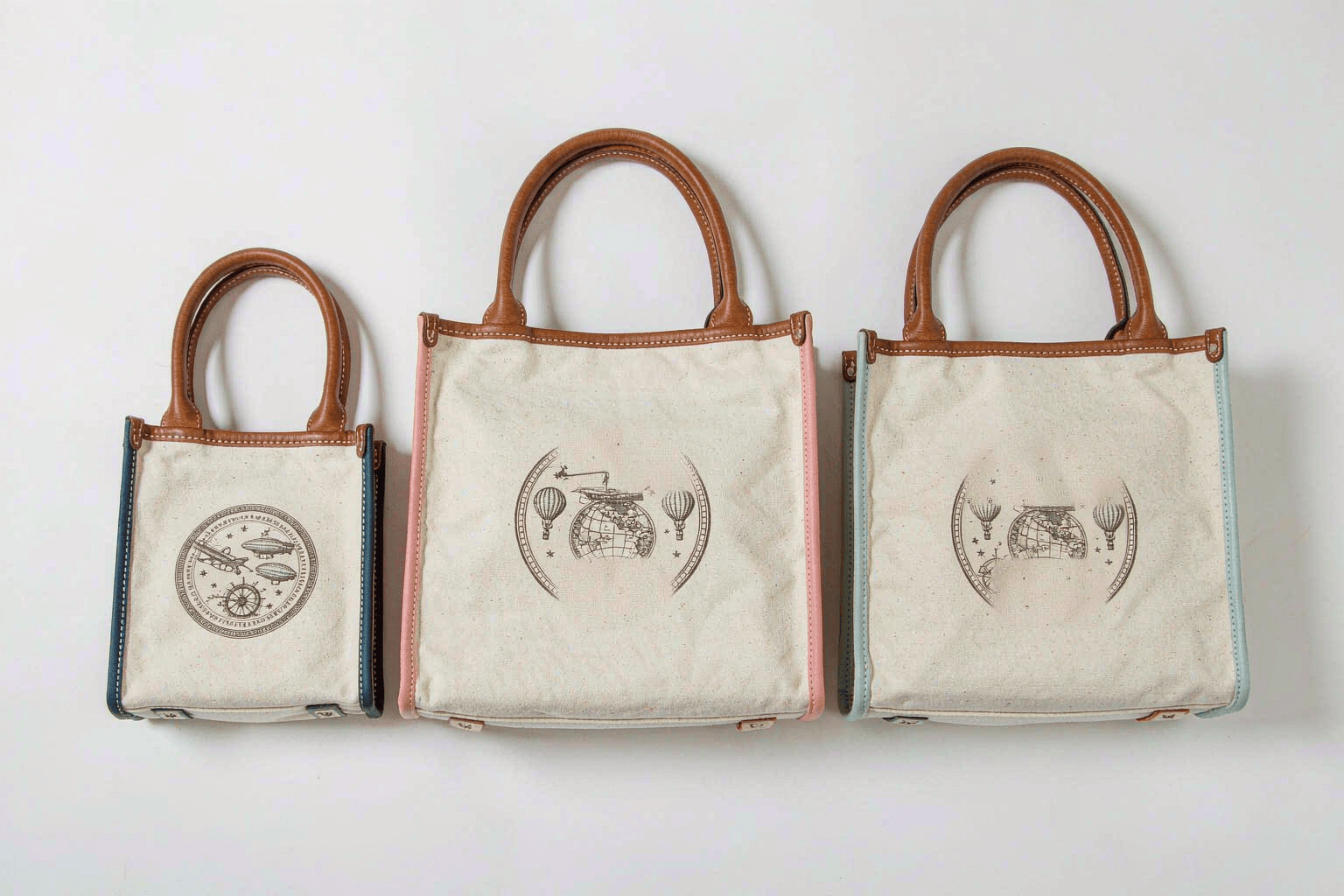
A factory can build the same silhouette in three sizes, and each serves a different buyer and margin. Before requesting samples, decide which tier the program leads with, then set the rest as sister SKUs. Capacity in liters tells the buyer more than width alone, because depth and height vary so much between constructions.
- Small (8–12 L): daily essentials, phone, wallet, small book; lightest carry.
- Medium (13–18 L): work commute, 13–14 inch laptop, lunch, pouch.
- Large (19–28 L): weekend, gym, beach, grocery; reserve for heavy days.
Standard Size Bands for a Tote Line
The table below is the quick reference a buyer can hand to a factory. Soft totes flex, so treat the numbers as typical ranges rather than hard limits, and confirm the flat measurement on the approved sample.
| Size band | Width x Height x Depth | Capacity | Best program fit |
|---|---|---|---|
| Small | 11–13 x 10–12 x 4–5 in | 8–12 L | Daily essentials, promo |
| Medium | 13–16 x 12–14 x 5–6 in | 13–18 L | Work commute, retail everyday |
| Large | 16–20 x 14–16 x 6–8 in | 19–28 L | Weekend, travel, beach |
Medium totes are the most versatile and suit most adults for everyday life. Large totes are useful but get heavy fast once filled, so reserve them for programs where the end user expects the space. If a buyer is torn between two sizes, lead with the smaller everyday size and keep a larger travel SKU in the line.
Sizing the Compartment to the Device
For a work tote, interior width and height decide the program’s fate. The laptop should lie flat with at least half an inch of clearance on each side so the closure does not press the screen. Spec the compartment 0.2–0.5 inches larger than the device footprint in each direction.
- A 13 inch laptop fits a 14 inch wide tote with a suspended sleeve.
- A 15 inch laptop needs about 16 inches of width plus a false bottom.
- A 16–17 inch device pushes into the large band or a structured device tote.
- Confirm depth at 5–6 inches so chargers and a notebook distribute instead of bulging.
Depth and Base That Hold Shape
Depth matters more than buyers expect. A tote only 4 inches deep bulges awkwardly once a charger brick and notebook go in. Specify 5–6 inches of depth for a work tote so the load distributes and the bag stands on its base. A reinforced or moulded base panel keeps the structure and takes floor contact; an open-bottom tote flops and reads cheap by week two.
Strap Drop and Handle Placement
Strap drop is the gap from the handle top to the bag opening, and it decides whether the tote rides the shoulder or dangles from the hand. Spec a drop of 7–9 inches so the tote rests on the shoulder for most adults; under 6 inches is effectively a hand carry. For winter markets, add an inch or two of slack so the tote fits over a coat sleeve. Handle placement also affects usable width: anchors set close to the side walls keep the mouth wide for laptop access, while inward-set handles narrow the opening.
- Handle webbing: 25–30 mm to spread load above 4 kg.
- Drop: 7–9 in shoulder, 10 in plus for forearm carry.
- Crossbody option: a removable adjustable strap for hands-free use.
Travel and Personal-Item Dimensions
When a tote becomes a travel SKU, prioritize a base that holds shape and a depth that swallows a pair of shoes or a rolled towel. A large tote in the 22–26 L range handles a one or two night trip if packed light. For flying, the tote must meet the airline personal-item limit, often near 18 x 14 x 8 inches on major carriers; a soft-sided build compresses to fit under the seat. A wipe-clean lining beats a pretty one that stains on the first outing for beach and pool programs.
Materials and Hardware by Size
Shell choice scales with size. Small promo totes run on 600D polyester; medium retail lines use 900D–1200D polyester or 12–16 oz cotton canvas; large travel totes benefit from coated nylon at 420D–840D for water resistance. Across all bands, specify self-repairing coil zips (#3 slips, #5 main), bar-tack reinforcement at every handle anchor, and 8–10 SPI stitch density at load-bearing seams. Larger totes need a wider base panel and stronger handles because the filled weight climbs fastest there.
Compliance and QC for a Size Range
For the EU, confirm REACH conformance for dyes and coatings, with OEKO-TEX Standard 100 supporting audits. US retail triggers Prop 65 limits on specific phthalates and lead in zips, webbing, and coating. Write QC into the purchase order: AQL 2.5 major / AQL 4.0 minor, inline at 20% and 80% production, final audit, plus a 5,000+ zip-cycle test and a 20 kg+ handle-pull test scaled to the largest band in the range.
Production Basics: MOQ, Lead Time, Packaging
A tote program runs a MOQ of 300–1,000 units per colorway, with a development sample in 7–12 days and bulk lead time of 35–55 days after approval. Sibling sizes from shared tooling can sometimes share a MOQ band, but confirm with the factory. Totes flat-pack tightly, so carton density is high and freight per unit is low—verify carton dimensions with your forwarder. A 35–55 day window plus 25–40 days ocean transit puts restock two to three months out, so plan reorders with the first run.
How to Brief a Factory in One Page
Send a one-page spec per size band: capacity in liters, flat dimensions, compartment target, depth, strap drop, base spec, shell denier, coating thickness, hardware grade, compliance marks, QC plan, MOQ, and target landed cost. A technical drawing of the flat dimension with the handle anchor points removes the sampling errors that cost the most time.
Get a Custom Bag Quote
With the size bands, materials, and QC defined, the next step is a manufacturability review. Send your tech pack for a costed quote and a realistic lead-time window: Request a quote →
We cover this in more detail in Custom Bag Sampling Process: Mockup to Pre-Production.
Exact figures, tolerances, and test limits for this are in Bag Cost Breakdown: What Drives the Price.
Frequently Asked Questions
What is a normal tote bag size for a line?
A normal everyday tote is about 13 to 16 inches wide, 12 to 14 inches tall, and 5 to 6 inches deep, holding roughly 13 to 18 liters. That size carries a laptop, a water bottle, and daily essentials while staying comfortable on the shoulder, which is why it leads most retail programs.
How many liters is a standard tote bag?
A standard tote holds 10 to 20 liters. Small totes sit near 8 to 12 liters, medium totes around 13 to 18 liters, and large totes reach 19 to 28 liters. Choose the band from whether the end user carries a laptop, gym gear, or travel items.
Is a 14 inch tote big enough for a 15 inch laptop?
Usually not. A 15 inch laptop needs a tote at least 16 inches wide so the screen lies flat with clearance on each side. A 14 inch wide tote will pinch the corners and strain the closure, so size the compartment up for any laptop 14 inches or larger.
What size tote bag is best for work?
The best work tote is 15 to 18 liters with a width of about 16 inches, which fits a 15 inch laptop, a charger, and a few personal items. A depth of 5 to 6 inches keeps the bag standing and protects your devices.
How do I confirm a tote fits under an airplane seat?
Measure the tote flat and compare it to the airline personal-item limit, often near 18 x 14 x 8 inches. A soft-sided large tote in the 20 to 26 liter range usually qualifies and compresses to slide under the seat in front of you.
What strap drop should a shoulder tote have?
A shoulder tote should have a strap drop of about 7 to 9 inches for most adults, which lets the bag rest on the shoulder without dragging on the elbow. Under 6 inches means the tote is really a hand carry rather than a shoulder bag.
Buyers comparing suppliers can review our travel and duffle bags for OEM/ODM specs, materials, and MOQ.