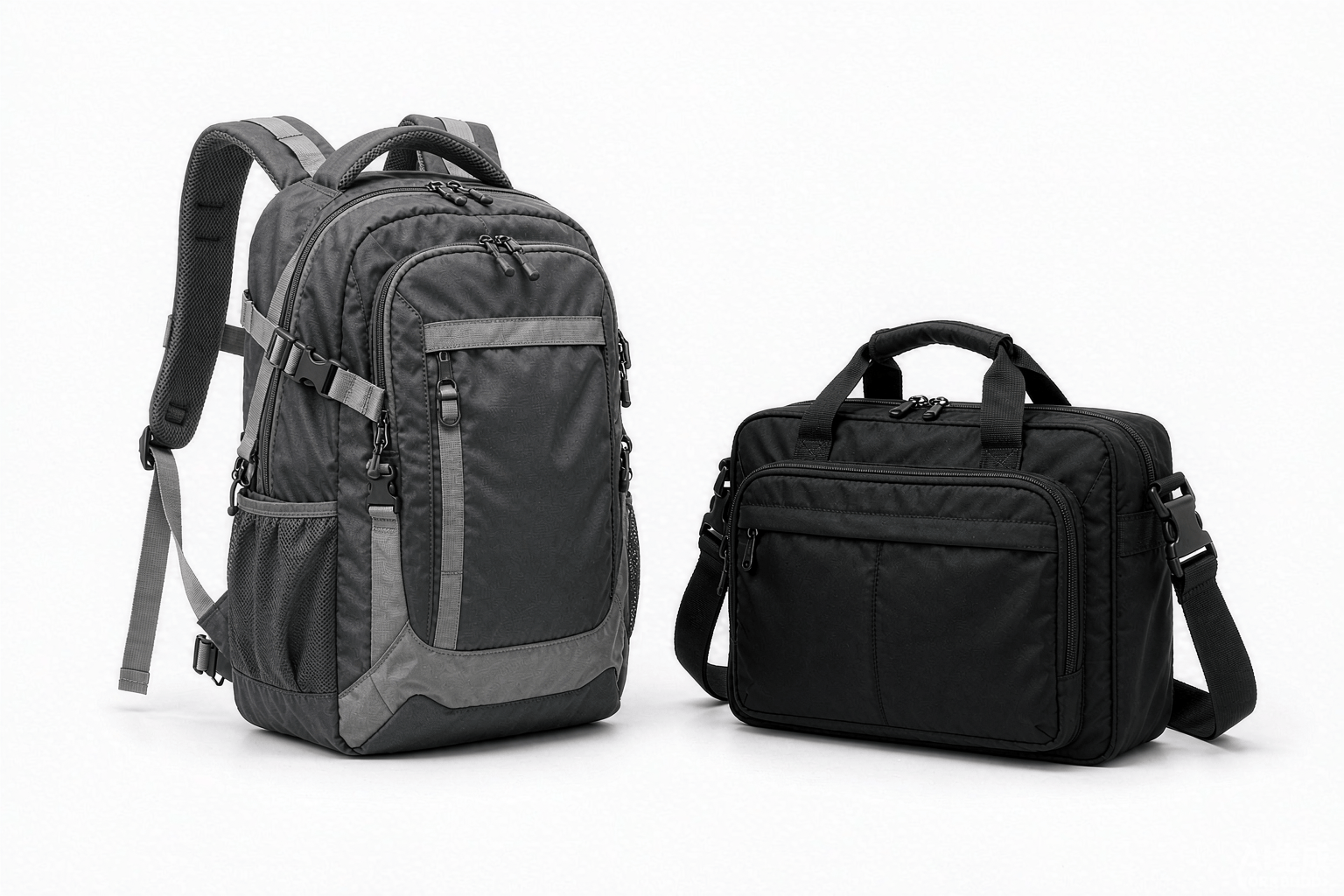
Choosing between a backpack and a messenger bag for a private-label line comes down to how the end user carries weight and how fast they reach their things. A backpack spreads load across both shoulders for commuting and travel; a messenger slings over one shoulder for quick city access and a sharper look. Spec each to its strength.
Load Physics: Two Straps vs One Strap
The biggest difference is load distribution, and it decides which build a buyer’s QA team will accept for daily use. A backpack uses two straps and often a sternum or hip belt, so heavy contents ride close to the spine and spread across the strongest muscles. A messenger bag concentrates the same weight on one shoulder, which feels light at first but tires the neck and upper back over long carries. For loads above about 5 kg (11 lb) or all-day wear, the backpack is the healthier choice.
| Feature | Backpack | Messenger Bag |
|---|---|---|
| Carry style | Two shoulder straps, close to back | One crossbody strap, rests on hip |
| Weight distribution | Even across both shoulders | Concentrated on one shoulder |
| Best load | 5 kg and up, bulky items | Under 5 kg, flat items |
| Laptop protection | Padded sleeve against back | Suspended sleeve, more swing |
| Access speed | Slower, must swing around | Faster, flip lid from front |
| Capacity range | 10–40 L common | 8–20 L common |
| Style signal | Casual, travel-ready | Urban, professional, sleek |
Capacity and Internal Organization
Most messenger bags top out near 20 L, while backpacks commonly reach 30–40 L. If the program packs a change of clothes, shoes, or gym gear, a backpack wins on raw capacity; a messenger bag is best for a laptop, a few files, and daily essentials. For either build, specify a suspended laptop sleeve, a false bottom, and 8–10 mm closed-cell foam on the walls. The messenger’s swing risk means the sleeve should float away from the bag floor so a set-down drop does not transfer to the device.
Laptop Protection Differences
Both builds can shield a laptop, but differently. A backpack cradles the device in a sleeve pressed against the back panel, the side least likely to meet a hard surface in a fall, and the even weight means the bag does not swing into doorframes. A messenger bag often uses a suspended sleeve that floats away from the floor, excellent when set down, but the single strap lets the whole bag rotate, raising drop risk when hurried. For electronics-heavy programs, the backpack is the safer default.
Access Speed and Commuter Reality
A messenger bag wins on grab-and-go: the strap stays on the shoulder, so the user rotates the bag to the chest, lifts the flap, and reaches inside while standing or walking. That matters on crowded transit and at bike stops. A backpack asks the user to shrug a strap off or spin the pack to open the main zip. For riders who open the bag dozens of times a day, the messenger’s speed is hard to beat, but keep its load light to protect the shoulder.
Professional Look for Work Programs
Style is where the messenger bag pulls ahead for office settings. Its flat profile and crossbody line read as deliberate and urban, pairing with a blazer or smart jacket, and a leather or waxed-canvas version can look as sharp as a briefcase without the stiffness. A clean technical or leather backpack now fits many workplaces, yet in a conservative meeting the messenger still signals “professional” faster. Choose the build that matches the room the customer walks into most often.
Material, Hardware, and Stitch Specs
Both builds start from the same fabric library. Specify 600D–1680D polyester or nylon with a PU or TPU coating of 0.15–0.3 mm; 900D–1200D covers most programs, 1680D for heavy daily use. For a backpack, bar-tack every strap anchor at 8–10 SPI and use self-repairing coil zips #5–#10. For a messenger, double-stitch and bar-tack the single shoulder mount, add a wide padded strap, and use a secure flap buckle or clip; hardware pull strength should reach 20 kg+ at anchors on either style. rPET at 600D–900D meets EU sustainability asks with a GRS file.
Compliance and QC for Both Builds
Compliance scope is identical. For the EU, REACH conformance for dyes and coatings is the baseline, with OEKO-TEX Standard 100 supporting audits; for US retail, Prop 65 limits apply to specific phthalates and lead. Write QC into the PO: AQL 2.5 for major defects and AQL 4.0 for minor, with inline checks at 20% and 80% production plus a final audit. Add a zip-cycle test of 5,000+ openings and a hardware pull test at anchors. An ISO 9001-certified factory and a BSCI or SMETA audit report satisfy most onboarding questionnaires.
MOQ, Lead Time, and Carton Planning
Both programs run a MOQ of 300–1,000 units per colorway, with a development sample in 7–12 days and bulk lead time of 35–55 days after approval. Messenger bags are lighter and flatter, so carton density is high and freight per unit stays low; backpacks are bulkier, so confirm carton dimensions with your forwarder to keep palletisation efficient. A 35–55 day bulk window plus ocean transit of 25–40 days puts a restock two to three months out, so plan reorders with the first run.
Get a Custom Bag Quote
With carry style, capacity, and compliance defined, the next step is a manufacturability review. Send your tech pack for a costed quote and a realistic lead-time window: Request a quote →
If you are choosing between options, Laptop bag vs backpack breaks down the trade-offs.
Related reading: Laptop backpack.
Frequently Asked Questions
Is a backpack or messenger bag better for a laptop?
A backpack usually protects a laptop better because the padded sleeve sits against the back, away from impact, and the weight is balanced. A well-built messenger bag can protect a laptop too, especially with a suspended sleeve, but the single strap lets the bag swing, raising drop risk when set down fast.
Can a messenger bag hold as much as a backpack?
Most messenger bags top out near 20 L, while backpacks commonly reach 30–40 L. If the program packs a change of clothes, shoes, or gym gear, a backpack wins on raw capacity. A messenger bag is best for a laptop, a few files, and daily essentials.
Which bag is better for biking to work?
A backpack is the safer pick for cycling because it stays centered on the back and will not swing into traffic. A messenger bag gives fast access at stops and reads sharp, but the single strap shifts weight as the rider leans, so keep the load light.
Are messenger bags bad for the shoulder?
Carrying a heavy messenger bag on one shoulder every day can strain that side over time. A padded, wide strap helps, and tightening the strap to keep the bag high reduces pull. For heavy daily loads, a backpack remains the healthier choice.
What MOQ is typical for a backpack or messenger line?
Most cut-and-sew programs start at 300–1,000 units per colorway for either build. The MOQ floor is set by tooling and setup, not by style, though the messenger uses less fabric and hardware, which can lower unit cost.
Which compliance marks apply to both builds?
For the EU, REACH conformance for dyes and coatings is baseline, with OEKO-TEX Standard 100 supporting audits. For US retail, Prop 65 limits apply to specific phthalates and lead in hardware and coatings. An ISO 9001 or BSCI audit report supports buyer onboarding.
Buyers comparing suppliers can review our backpacks and laptop bags for OEM/ODM specs, materials, and MOQ.