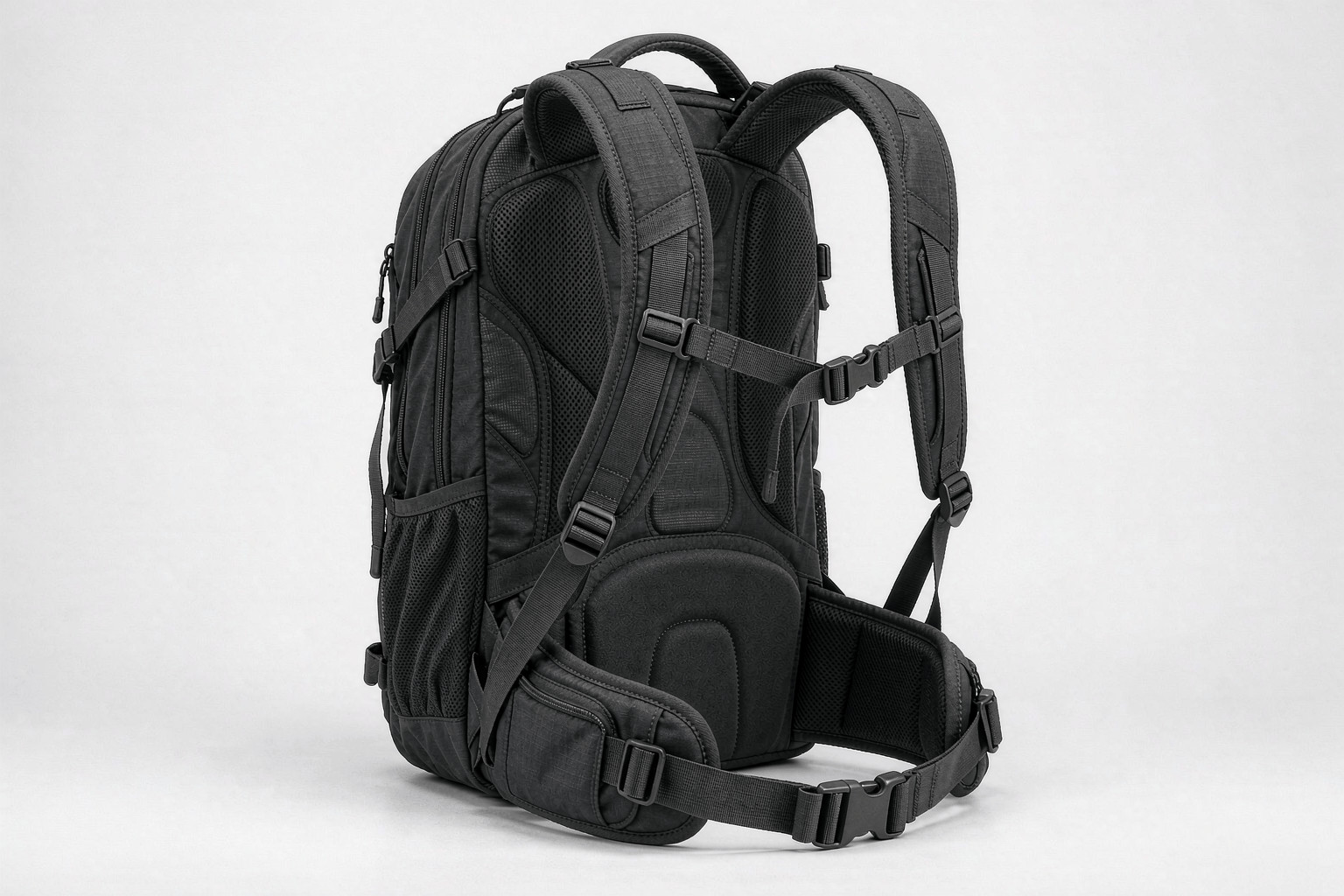
Specifying ergonomic backpack features means writing the suspension—contoured straps, a framed back panel, a sternum strap, and often a hip belt—as measurable tolerances rather than a look. Get these right and the build carries for hours without shoulder and back strain, which is what protects your return rates.
What “Ergonomic” Means in Manufacturing Tolerances
An ergonomic build is designed around how the body carries weight: keep the load close to the spine, spread pressure across the strongest muscles, and let air move between the user and the pack. On the factory floor that translates into spec values, not marketing language. A great hip belt means little if the shoulder straps dig in, and a ventilated panel does nothing if the pack swings because there is no sternum strap. Treat the suspension as a system and spec every part.
Back Panel and Frame Specs
The back panel meets the body and does three jobs at once: padding protects against hard items inside, a frame sheet keeps the load from collapsing into the lower back, and raised channels create air gaps so heat escapes. Specify a panel with a slight S-curve and a centre gap that mirrors the spine. A flat, thin panel lets the bag roll and press straight into the back, which causes the end-of-day ache that drives complaints. For packs above 25 L, require a frame sheet or a rigid insert rather than soft foam alone.
Shoulder Strap and Sternum Specs
Shoulder straps should be padded and contoured to follow the collarbone instead of cutting straight across it, with a breathable face fabric for warm commutes. Target 8–10 SPI at the strap anchors and bar-tack each mount with double stitch rows. A sternum strap clips the two straps together so the load cannot slide off the shoulders; specify it adjustable and positioned at roughly armpit height. For a 20–26 L daily build, padded straps plus a sternum strap are the minimum; a hip belt becomes essential above about 25 lb of load.
Hip Belt and Load Transfer
A load-bearing hip belt shifts 50–80% of the weight onto the hips, the strongest part of the body for carrying. Specify the belt to centre on the iliac crest, with padding of 8–10 mm closed-cell foam and a secure buckle rated for daily open-close cycles. For travel and hiking tiers, the belt is non-negotiable; for a light laptop-and-charger commute, padded straps and a sternum strap are enough. Confirm pull strength at the belt anchors reaches 20 kg+.
Load Lifters and Compression
Load lifters are the short straps above the shoulders that pull the top of the pack toward the centre of gravity. Compression straps and a back-panel laptop bay lock heavy items near the spine so the load cannot swing. Together they turn a 20 lb pack into something the hips barely notice. Specify these as part of the layout, because packing order alone cannot fix a build that places the anchors wrong.
Matching Features to Use Case
Not every program needs the full kit. Match the feature set to the heaviest, most frequent use case, then trade down.
| Use case | Recommended suspension spec |
|---|---|
| Daily commute | Ventilated panel, adjustable sternum strap, padded straps, suspended laptop bay |
| Cycling | Ventilated panel, stable hip belt, reflective trim, weather-resistant shell |
| Travel | Hip belt, load lifters, compression straps, carry-on friendly size |
| Campus or hiking | Full frame sheet, hip belt, multiple access points, bottle pockets |
| Light office carry | Padded straps and a basic sternum strap are enough |
Fabric and Hardware Specs
Scale the shell with capacity. Use 600D–1680D polyester or nylon with a PU or TPU coating of 0.15–0.3 mm; 900D–1200D covers most programs, 1680D for heavy daily use. Use self-repairing coil zips #5–#10 by opening size, bar-tack every strap and belt anchor at 8–10 SPI, and reinforce the base with a moulded or layered panel. For EU sustainability asks, rPET at 600D–900D needs a GRS chain-of-custody file. Confirm a verified colorfast rating if the program ships through hot, humid transit.
Compliance and QC for Export
For the EU, REACH conformance for dyes and coatings is the baseline, with OEKO-TEX Standard 100 supporting audits; for US retail, Prop 65 limits apply to specific phthalates and lead. Write QC into the PO: AQL 2.5 for major defects and AQL 4.0 for minor, with inline checks at 20% and 80% production plus a final audit. Add a strap-pull test of 20 kg+ at anchors, a foam-thickness check at three panel points, and a fit check against the torso spec. An ISO 9001-certified factory and a BSCI or SMETA audit report satisfy most onboarding questionnaires.
MOQ, Lead Time, and Carton Planning
An ergonomic backpack program runs a MOQ of 300–1,000 units per colorway, with a development sample in 7–12 days and bulk lead time of 35–55 days after approval. Because the product is bulky relative to weight, carton dimensions drive freight and warehouse handling, so confirm pack method and carton size with your forwarder before tooling. A 35–55 day bulk window plus ocean transit of 25–40 days puts a restock two to three months out, so keep the approved sample, test reports, and spec sheet on file for repeat orders.
Get a Custom Bag Quote
With suspension tolerances, fabric, and QC defined, the next step is a manufacturability review. Send your tech pack for a costed quote and a realistic lead-time window: Request a quote →
We put the two formats side by side in Backpack vs messenger bag.
If you are choosing between options, Laptop bag vs backpack breaks down the trade-offs.
Frequently Asked Questions
What makes a backpack ergonomic?
An ergonomic build is designed to carry weight in line with the body: padded contoured shoulder straps, a breathable and framed back panel, a sternum strap, and often a hip belt, plus internal pockets that keep heavy items close to the spine. Specified as tolerances, these cut strain on the shoulders, neck, and lower back.
Do I need a hip belt on an ergonomic backpack?
Only if the load is heavy or carried for hours. A hip belt shifts 50–80% of the weight onto the hips, far stronger than the shoulders. For a light laptop-and-charger commute, padded straps and a sternum strap are enough; above about 25 lb or all-day carry, the hip belt becomes essential.
What foam thickness should the back panel use?
Specify closed-cell foam of 8–10 mm on the back panel and hip belt, with a frame sheet or rigid insert for packs above 25 L. Open sponge flattens under compression and stops absorbing impact, so closed-cell is the right call for repeated daily use.
What denier fabric suits an ergonomic backpack?
900D–1200D polyester covers most programs; 1680D ballistic nylon suits heavy daily use and travel. Pair either with a 0.15–0.3 mm PU or TPU coating, and consider rPET at 600D–900D for EU sustainability asks with a GRS file.
What MOQ is typical for a custom ergonomic backpack?
Most cut-and-sew programs start at 300–1,000 units per colorway. Below that, tooling and setup costs push unit price up. A 300-unit minimum usually keeps the line cost-efficient while leaving room for colorway testing.
What QC plan checks ergonomic builds at scale?
Specify AQL 2.5 for major defects and AQL 4.0 for minor, with inline checks at 20% and 80% production plus a final audit. Add a strap-pull test of 20 kg+ at anchors, a foam-thickness check at three panel points, and a fit check against the torso spec.
Buyers comparing suppliers can review our backpacks and laptop bags for OEM/ODM specs, materials, and MOQ.