A sports bag sourcing checklist comes down to five checks: capacity in litres, fabric and coating, zip and strap quality, ventilation for shoes and damp kit, and carry style. Work through those in order, and set your budget last. The bag that suits your routine is usually cheaper than the one that looks toughest, and the right spec prevents the returns that erode margin on a new program.
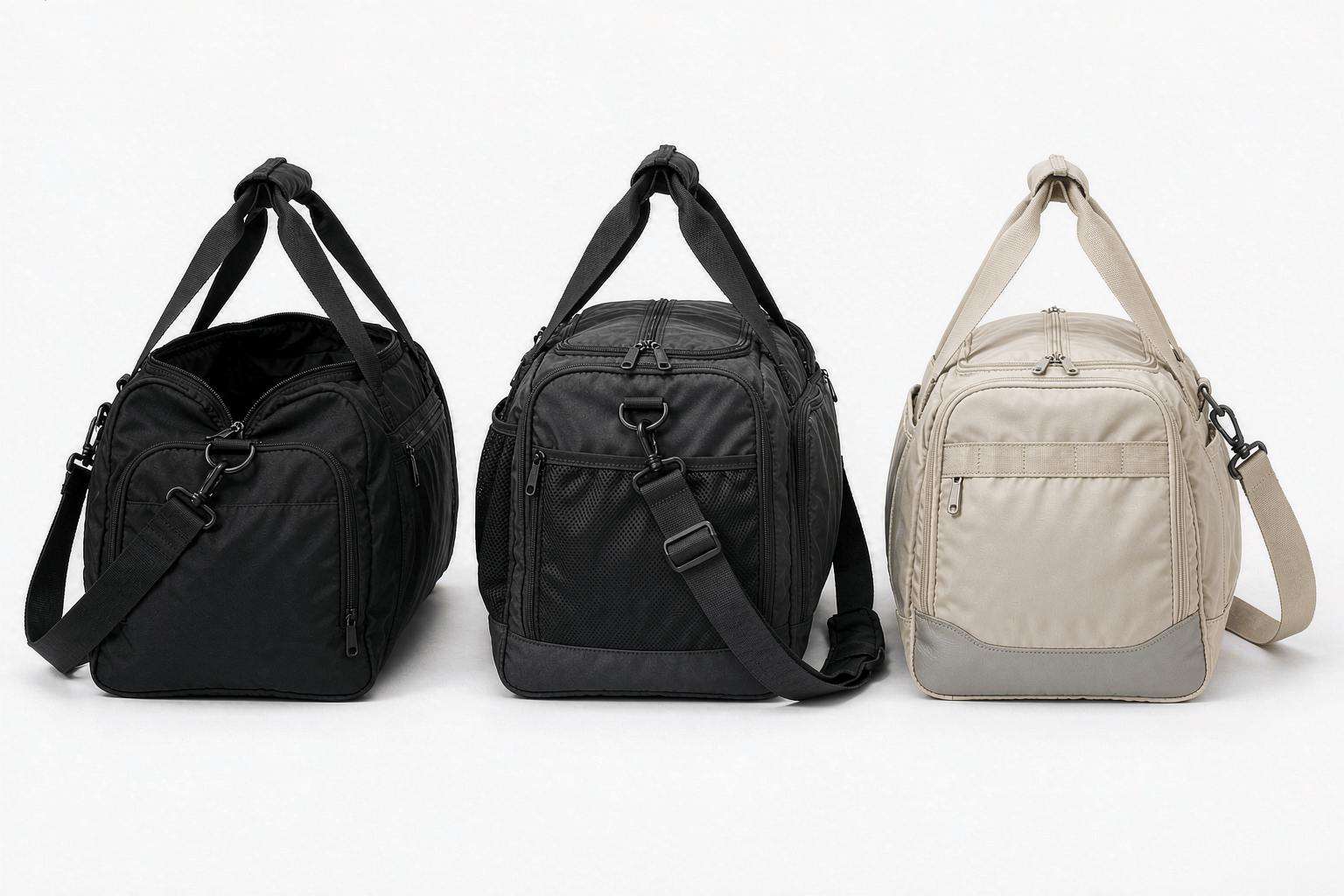
The Five Checks Before You Source
Use this as your shortlist when briefing a factory. If a sample fails more than two points, keep looking.
- Capacity that matches the week, not the best guess. Twenty to thirty litres covers daily training; 45 L and up covers tournaments and trips.
- Fabric with a stated denier, ideally 600D polyester or higher. Vague descriptions like “durable material” tell you nothing.
- Chunky zips that run smoothly at the corners, where cheap sliders bind and split.
- Bar-tack stitching at strap anchors, the dense blocks of thread where handles meet the body.
- A separate shoe or vented pocket so dirty soles and wet clothes stay away from clean kit.
The order matters. Capacity and fabric decide whether the bag suits the job, hardware decides how long it lasts, and comfort decides whether the user keeps reaching for it.
Fabric Denier and Coating Choices
Fabric is quoted in denier, a number followed by D. Higher denier means thicker yarn and usually better abrasion resistance, but also more weight. Coatings matter as much, because the coating on the inside face is what stops water passing through. The table maps common shells to their best use.
| Fabric | Typical denier | Water resistance | Best for |
|---|---|---|---|
| Polyester | 300D–600D | Fair with PU coating | Everyday gym use, light weight |
| Ballistic nylon | 840D–1680D | Good with coating | Heavy loads, team gear |
| Abrasion-resistant nylon weave | 500D–1000D | Good | Outdoor and court training |
| TPU laminate | Not quoted in D | Excellent, often welded | Swimming, rowing, wet climates |
| Canvas | 12–18 oz | Poor unless waxed | Style-led bags, dry conditions |
Two practical notes. First, a 600D polyester bag with clean stitching outlasts a 1680D bag with sloppy seams, so construction beats raw numbers. Second, high denier adds weight carried every day, which is why a heavy ballistic duffel is a poor daily gym bag for a commuter on foot.
How to Judge Zips, Straps, and Stitching
Hardware is where bags die, and it is the fastest thing to inspect in a factory audit. Run these checks on a pre-production sample.
- Run the zip around a full corner twice; it should not catch. Prefer wide teeth and a recognised self-repairing coil slider.
- Pull the strap anchors firmly; you want reinforced webbing that wraps the base, not a tab riveted to a single fabric layer.
- Check for bar tacks, the dense rectangles at stress points; their absence at handles is a red flag.
- Squeeze the base corners; reinforced or double-layered corners survive concrete and car boots.
- Look inside at the seam tape; raw cut edges fraying on day one will keep fraying.
Water Resistance vs True Waterproof
For most gym users, water resistant is enough. A coated polyester shell with a covered zip shrugs off rain on the walk from the car and contains a leaking bottle long enough to notice. You need a genuinely waterproof build with welded seams and a roll top or storm flap if the user swims, rows, or trains outdoors through winter. One overlooked detail: waterproof fabrics do not breathe, so unpack the same evening and leave the bag open to dry.
Backpack, Duffel, or Wheels: Carry Style
Carry style depends on how the user gets to training, not on how much they pack.
- Sports backpack: best if they walk, cycle, or use transit; weight on both shoulders, hands free, ventilated back panel.
- Gym duffel: classic for driving; wide opening, easy to load bulky kit, quick to grab; look for a removable padded sling.
- Wheeled duffel: right for coaches, parents managing several kits, and anyone moving 60 L or more; trade-off is 2–3 kg of empty weight.
- Hybrid convertible: straps tuck away so one bag works as duffel and backpack; slightly heavier, rarely as comfortable as a dedicated pack.
Which Compartments Actually Matter
Extra pockets sell bags, but only a few earn their keep. Specify a vented shoe compartment accessible from outside, a wet pocket lined with coated fabric, a small zip valuables pocket near the top, and a laptop sleeve only if the user goes straight from work. Skip bags with a dozen tiny external pockets; two well-placed pockets beat eight decorative ones.
Compliance for Export Programs
Sports bags sold into the EU need REACH conformance for dyes and coatings, with OEKO-TEX Standard 100 supporting retailer audits. US retail triggers Prop 65 limits on specific phthalates and lead. If the product includes a USB port or wiring, confirm electrical-safety documentation for the target market before mass production.
QC Checkpoints to Write Into the PO
Use AQL 2.5 for major defects and AQL 4.0 for minor, with inline checks at 20% and 80% production plus a final audit. Add a zip-cycle test of 5,000+ openings and a lining-wipe test for coating integrity.
- Confirm fabric denier and coating thickness on arrival.
- Check stitch density at three random seams per batch.
- Verify strap-anchor pull strength (target 20 kg+).
- Confirm the vented shoe stall and wet pocket seal correctly.
- Hold a final AQL inspection before carton sealing.
MOQ, Lead Time, and Carton Planning
A typical sports-bag program runs a MOQ of 300–1,000 units per colorway, with a development sample in 7–12 days and bulk lead time of 35–55 days after approval. Wheeled bags are bulky relative to weight, so confirm carton dimensions with your forwarder to keep freight per unit sensible.
Because bulk lead time of 35–55 days plus ocean transit of 25–40 days puts a restock two to three months out, plan reorders alongside the first run and keep the approved sample, test reports, and spec sheet on file.
How to Brief a Factory With This Checklist
Send a one-page spec: litre range, fabric denier, coating thickness, zip and strap grade, compartment layout, carry style, compliance marks, QC plan, MOQ, and target landed cost. A technical drawing of the compartment layout and the mount points removes the ambiguity that leads to wrong first samples.
Get a Custom Bag Quote
With the capacity, fabric, hardware, and QC plan defined, the next step is a manufacturability review. Send your tech pack for a costed quote and a realistic lead-time window: Request a quote →
Related: for a sport-specific program, see our guide on how to choose a golf bag for divider, base-stability, and club-line sourcing.
The measurable thresholds behind that call are listed in Recycled & Eco Materials in Bag Manufacturing.
Frequently Asked Questions
What size sports bag is best for daily gym use?
Twenty to thirty litres suits most people for daily training: trainers, a towel, a change of clothes, and a water bottle without encouraging overpacking. Step up to 30–35 L if you also carry a laptop or lifting belt.
Is a sports backpack better than a duffel?
It depends on the commute. A backpack is better if the user walks, cycles, or uses transit because the weight is shared across both shoulders. A duffel is easier to pack and unpack, which suits driving to the gym.
What denier should I look for in a sports bag?
Aim for 600D polyester or higher for everyday use, and 840D or above in ballistic nylon for heavy team gear. Clean stitching and quality zips matter as much as the denier figure itself.
Can a sports bag be airline carry-on?
Often yes, if it is roughly 30–40 litres and within the airline dimension limits, typically around 55 x 35 x 20 cm. Soft duffels bulge when overpacked, so pack to the size of the gate sizer rather than to the seams.
How do I stop a sports bag from smelling?
Unpack it the same day, use a vented shoe compartment and a lined wet pocket, and leave the bag open to dry. Most odour comes from damp kit sealed inside overnight, not from the fabric.
Is a waterproof sports bag worth the extra cost?
Only if the user swims, rows, or trains outdoors in poor weather. For gym use, a water-resistant coated shell is enough, and a simple dry bag inside a standard duffel handles the occasional wet towel.
Buyers comparing suppliers can review our travel and duffle bags for OEM/ODM specs, materials, and MOQ.