Sizing a sports bag line starts with capacity in litres, not the look of the bag. A 20–30 L bag covers daily gym trips, 30–45 L suits weekend training, and 45–70 L handles team gear or cabin travel. Map litres to the activity, then confirm dimensions against locker, car, and airline limits before you commit tooling or a fabric order.
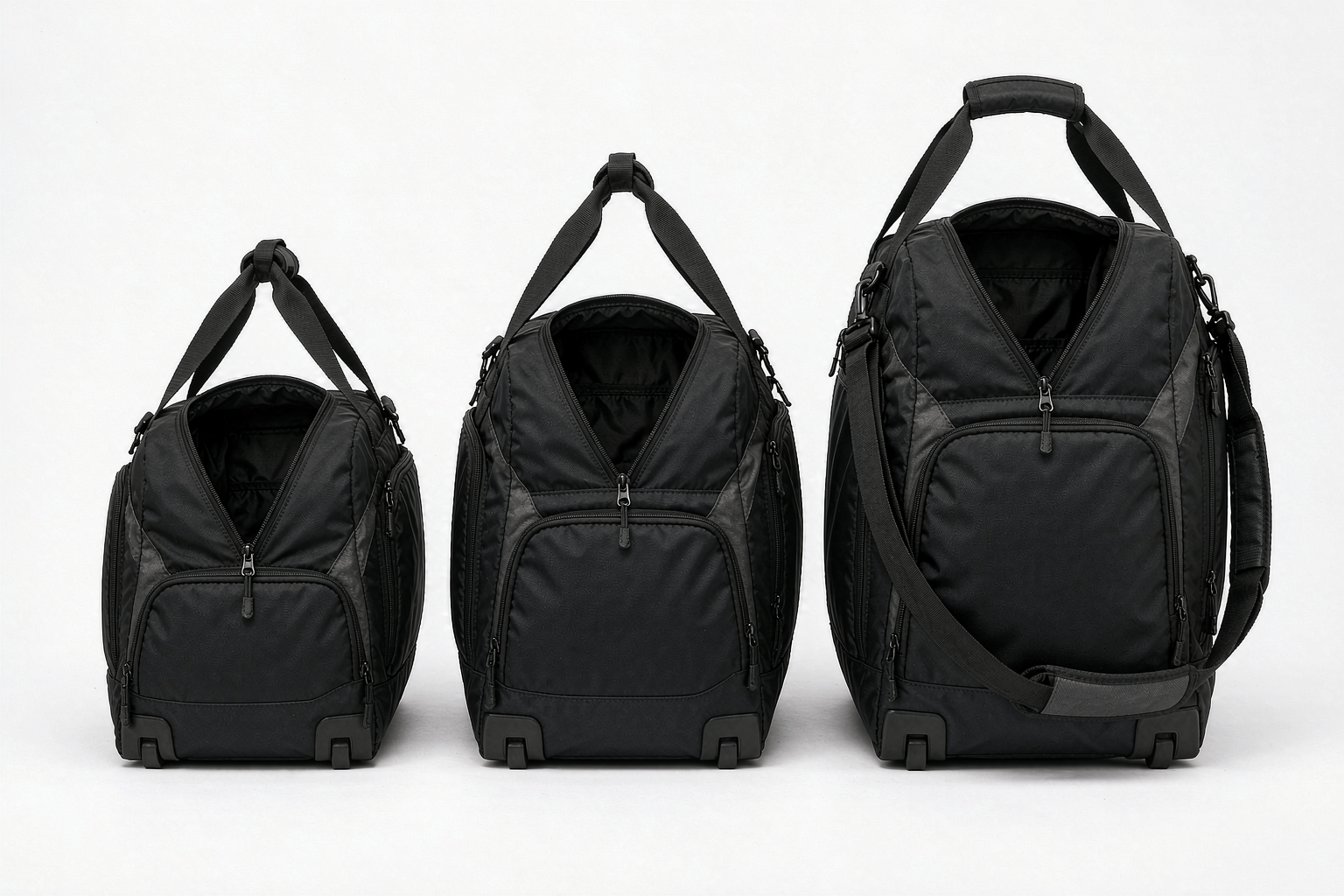
Start With Litres, Then Check Dimensions
Capacity tells you what fits inside; dimensions tell you whether it fits the space you store it in. A practical size plan matches litres to how often and how far the user trains, then confirms the bag’s length, width, and height against a gym locker, a car boot, and an airline cabin box. Most adults do well with one 25–35 L bag for daily use and a second 50–70 L bag for trips.
- Daily gym: 20–30 L, roughly 45 x 25 x 25 cm.
- Yoga or studio: 15–25 L, roughly 40 x 20 x 20 cm.
- Weekend tournament: 45–60 L, roughly 60 x 30 x 30 cm.
- Cabin travel: 30–40 L, roughly 55 x 35 x 20 cm.
Size Guide by Activity
The table is the core of a sourcing size plan: match the main activity to a litre range, then check the typical size against the places the bag is actually used.
| Activity | Capacity | Typical dimensions (L x W x H) | Best bag type |
|---|---|---|---|
| Daily gym | 20–30 L | 45 x 25 x 25 cm | Backpack or small duffel |
| Yoga or studio | 15–25 L | 40 x 20 x 20 cm | Tote or slim backpack |
| Weekend tournament | 45–60 L | 60 x 30 x 30 cm | Large duffel |
| Team equipment | 60–90 L | 75 x 35 x 35 cm | Wheeled duffel |
| Air travel carry-on | 30–40 L | 55 x 35 x 20 cm | Cabin duffel or backpack |
Notice the jump between daily use and team gear. A 20 L bag holds shoes, a towel, and a change of clothes; a 70 L bag holds all of that for three people plus balls and pads. Buying the smaller size for a big job is the most common regret in this category.
Cabin and Locker Dimension Limits
Airlines set their own cabin limits and enforce them at the gate. The widely cited IATA cabin guidance is about 55 x 35 x 20 cm, which lines up with a 30–40 L soft duffel. If a sports bag doubles as a weekend carry-on, size it to that box first, and remember that soft bags overpack easily and then bulge past the gate sizer.
- Cabin: keep under roughly 55 x 35 x 20 cm and 30–40 L.
- Locker: small duffels and backpacks fit; large wheeled bags do not.
- Car boot: measure before committing a 90 L rigid bag behind compact seats.
How Material Changes Usable Volume
The litre number on the tag is not the whole story, because material and build change how much of that space is usable. Two bags with the same rating can feel a full size apart once packed.
- Soft shell: stretches and swallows odd shapes like boots and helmets.
- Structured: holds its shape on a shelf but rejects bulky items.
- Padding: a 30 L backpack with a padded laptop sleeve may offer only 24 L of open storage; budget about 20% of labelled capacity as lost to structure.
- Zippers: a wide U-zip opens the whole top so a smaller bag feels larger in daily use.
Shell Fabric and Coating Specs
For sports bags, 600D polyester is the entry workhorse, 900D–1200D the retail standard, and 1680D ballistic nylon the durable top end. Apply a PU or TPU coating of 0.15–0.3 mm for water resistance. TPU laminate is excellent for swim and rowing programs. rPET at 600D–900D meets many EU retailer sustainability asks.
- 600D polyester: cost-efficient for promotional and light-use programs.
- 900D–1200D: the common choice for branded retail lines.
- Antimicrobial lining: a wipe-clean interior that resists odour.
- Coated base: lifts the bag off wet locker-room floors.
For the EU, confirm REACH conformance for dyes and coatings; for US retail, Prop 65 limits apply to certain phthalates and lead. OEKO-TEX Standard 100 or GRS documentation supports both market access and buyer audits.
Hardware and Stress Points
Specify self-repairing coil zips, bar-tack every strap anchor with double stitch rows, and a reinforced or moulded base panel. A padded, removable shoulder strap plus a top grab handle are baseline. Webbing of 700D–1000D holds shape better than thin tape under daily load.
- Zips: coil #5–#10 by opening size; a recognised self-repairing coil.
- Stitch density: 8–10 SPI at load-bearing seams.
- Base: reinforced or moulded panel to survive wet floors.
Compliance for Export Programs
Sports bags sold into the EU need REACH conformance for dyes and coatings, with OEKO-TEX Standard 100 supporting retailer audits. US retail triggers Prop 65 limits on specific phthalates and lead. If the product includes a USB port or wiring, confirm electrical-safety documentation for the target market before mass production.
QC Checkpoints for Sized Bags
Write QC into the purchase order. Use AQL 2.5 for major defects and AQL 4.0 for minor, with inline checks at 20% and 80% production plus a final audit. Add a zip-cycle test of 5,000+ openings and a dimension check against the spec at the final audit.
- Confirm fabric denier and coating thickness on arrival.
- Check stitch density at three random seams per batch.
- Verify strap-anchor pull strength (target 20 kg+).
- Measure filled dimensions against the locker and cabin limits.
- Hold a final AQL inspection before carton sealing.
MOQ, Lead Time, and Carton Planning
A typical sports-bag program runs a MOQ of 300–1,000 units per colorway, with a development sample in 7–12 days and bulk lead time of 35–55 days after approval. Large wheeled bags are bulky relative to weight, so confirm carton dimensions with your forwarder to keep freight sane.
Because bulk lead time of 35–55 days plus ocean transit of 25–40 days puts a restock two to three months out, plan reorders alongside the first run and keep the approved sample, test reports, and spec sheet on file.
How to Brief a Factory on Bag Sizes
Send a one-page spec per size: capacity in litres, outer dimensions, shell denier, coating thickness, compartment layout, hardware grade, compliance marks, QC plan, MOQ, and target landed cost. A technical drawing with dimensions removes the ambiguity that leads to a bag that fits the photo but not the locker.
Get a Custom Bag Quote
With the litre ranges, dimensions, fabric, and QC plan defined, the next step is a manufacturability review. Send your tech pack for a costed quote and a realistic lead-time window: Request a quote →
Related: for a sport-specific program, see our guide on how to choose a golf bag for capacity, divider, and base-stability sourcing.
Sizing and fit are covered in Duffel bag buying guide bulk.
If you need the baseline definitions first, What is a sports bag covers them.
Frequently Asked Questions
What size sports bag covers most gym use?
For most adults a 20–30 litre bag is enough for trainers, a towel, a water bottle, and a change of clothes. If you also carry a laptop or lifting belt, step up to 30–35 L.
Can a sports bag work as cabin carry-on?
Yes, if it stays within the airline cabin limit, typically around 55 x 35 x 20 cm or 30–40 litres. Soft duffels and cabin backpacks fit best; always check the specific carrier before flying because low-cost airlines can be stricter.
How many litres is a standard duffel?
A standard gym duffel runs 30–50 litres, while travel and team duffels go up to 90 L or more. About 40 L covers most weekend trips.
What size team equipment bag should I source?
For one athlete’s full kit, 50–60 L works. For coaches or families moving gear for several players, choose 70–90 L, ideally wheeled, to protect the user’s back and the car boot.
What compliance marks apply to EU and US sports bags?
For the EU, REACH conformance for dyes and coatings is baseline, with OEKO-TEX Standard 100 supporting audits. For US retail, Prop 65 limits apply to certain phthalates and lead. GRS helps if you specify recycled content.
What MOQ is typical for custom sports bags?
Most cut-and-sew programs start at 300–1,000 units per colorway. Below that, tooling and setup costs push the unit price up and can extend lead time.
Buyers comparing suppliers can review our travel and duffle bags for OEM/ODM specs, materials, and MOQ.