This duffel bag buying guide bulk buyers can act on centers on five checkpoints that decide whether 500 identical bags survive a season: fabric and base coating, the main U-zip, base and handle reinforcement, logo decoration, and the AQL and compliance line. Set an MOQ of 300 to 1,000 units, plan 30 to 50 days of production, and require REACH or Prop 65 reports before shipment.
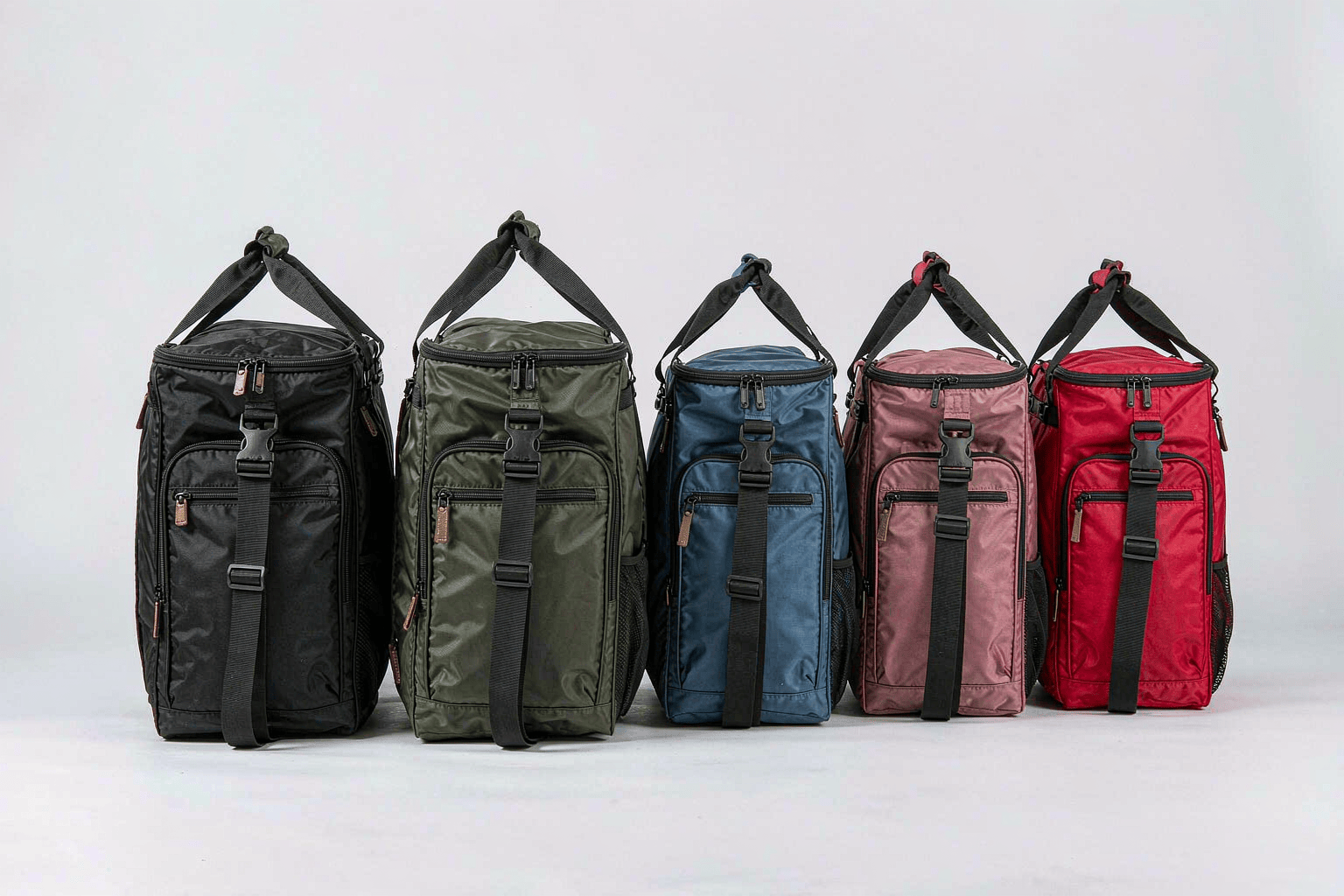
What Does a Duffel Bag Buying Guide Bulk Program Need to Cover?
A duffel bag buying guide bulk programs need starts by fixing the production model, because OEM, ODM, and hybrid change who owns the tooling and the risk.
- OEM: You supply the tech pack, patterns, and bill of materials; the factory cuts, sews, and finishes to spec. Tooling is light — cutting dies for the base-board channel, end-cap patterns, strap templates — with no injection molds to amortize.
- ODM: The factory supplies a proven duffle block, barrel or rectangular, that you rebrand, recolour, or modify with a custom print and hardware. Faster to market, but the base shape is shared with other buyers.
- Hybrid: Start from the factory’s existing base pattern and add a custom lining, zipper colour, and woven label; the most common entry point for first-time bulk programs.
All three models need the same four inputs before a quote means anything: a tech pack, a confirmed material spec, a target FOB price, and the destination market. Without them, two factories return two different bags at two different prices.
Which Fabric and Coating Fit a Duffel’s Body and Base?
A duffel is carried by its handles but lives on the floor, so the base takes more abuse than on a backpack or a tote. Specifying fabric by the word “nylon” alone is the most common error, because that term spans a tenfold weight and price range. Denier (D) measures filament weight; higher numbers mean heavier, more abrasion-resistant cloth.
| Use case | Recommended fabric | Denier / weight | Coating | Why it fits |
|---|---|---|---|---|
| Promotional giveaway | 300D–420D polyester | 300–420D / 110–150 gsm | PU 0.10 mm | Lowest cost, single-event use |
| Team sports / gym | 600D polyester | 600D / 220 gsm | PU 0.15 mm | Daily abrasion resistance |
| Travel retail | 840D–1200D ballistic nylon | 840–1200D / 280–340 gsm | TPU film | Tear resistance, hydrolysis-proof |
| Premium / heritage | 18–24 oz waxed canvas | 610–815 gsm | Wax finish | Structured, brand-positioned |
| Wet-gear / aqua | TPU-laminated 500D | 500D / PVC-free | RF-welded TPU | Submersible seams |
Specify a heavier base cloth than the body — a second 1000D layer or an RF-welded TPU patch — since that panel meets the floor. For daily-use duffels, require a Martindale result of at least 20,000 rubs (ISO 12947) and a base one weight class above the body.
Why Is the Main U-Zip the Weak Point, and How Do You Spec It?
The defining feature of a duffel is a single U-shaped zipper running most of the top opening. Its length makes it the top return driver — an estimated 30–40% of functional defects on travel duffels — and the easiest line for a factory to downgrade.
- Size: #10 coil for large duffels above 40 L, #8 for small formats; coil flexes around the curve better than moulded tooth.
- Slider: A self-locking slider rated for roughly 1,000 open-close cycles from a tier-one maker; unbranded equivalents often fail at 200–300 cycles, just past the return window.
- End stops and pulls: Double-pull sliders open from either end; retractable rain flaps protect the teeth from grit.
- Spec language: Name the brand class in the tech pack, not “as standard,” because that is where the cheap zip hides.
Stitch the tape at 8–10 SPI with a bartack at each end stop; a skipped bartack there splits the whole opening.
How Should You Reinforce the Base and Handles for Bulk Use?
Two duffels in the same fabric can fail three years apart based purely on how the load points were built.
- Base board: A sewn-in HDPE or EVA board of 1.5–3 mm in a dedicated channel keeps the bag from collapsing; add 4–6 riveted plastic feet rated to 10 kg each for hard use.
- Handles: 38 mm polypropylene webbing, 1,200–1,800 N tensile, anchored with X-box stitching of 18–28 bartacks rather than a single line.
- Shoulder strap: A detachable 25 mm webbing strap with a 22 kg side-release buckle and a padded section; reinforce the anchors at both ends.
- Drop test: Load to 1.5× expected payload (a 12 kg bag at 18 kg) and drop 1.2 m, five times per corner, before approving the PP sample.
A board plus feet is the difference between a bag that stands in a locker room and one that folds into a puddle; both add cents per unit and remove a class of returns.
Which Logo Decoration Method Works for Team and Promo Duffels?
Decoration makes a bulk duffel yours, but each method carries a different MOQ and setup cost that changes the quote before you discuss the bag.
- Screen printing: Lowest cost at volume; water-based inks feel softer and pass stricter chemical rules than plastisol. One screen per colour, so 1–2 colours stays economical.
- Embroidery: 4,000–12,000 stitches; adds 30–90 seconds per unit. Digitization is a one-time file cost.
- Woven label and hangtag: The cheapest brand signal; specify material, fold style, attachment point.
- Debossed or printed patch: Highest perceived value; needs a custom die, so budget tooling time into the first order.
- Dye-sublimation: Best for photographic artwork on polyester; lower durability than screen print under heavy abrasion.
Avoid four-colour embroidery plus a custom patch on a 300-unit promo run, where decoration can cost more than the bag.
What MOQ, Tooling, and Lead Time Apply to Duffel Bulk Orders?
Bulk minimums are driven by fabric lot sizes, screen setup, and sewing-line changeover, not factory preference.
- MOQ: 300–500 units per style and colour for a basic polyester duffel; 500–1,000 with custom hardware, embroidery, or a unique fabric. Below 300, most factories add a small-order premium.
- Tooling: Cutting dies, screen prep, embroidery digitization, and custom patches take 5–10 working days and may be a one-time charge or amortized across the first order.
- Sampling: A proto sample runs 7–14 days; the approved PP sample another 10–18 days once materials are confirmed.
- Production: 30–50 days after PP approval for 1,000–10,000 units; complex builds sit at the upper end.
- Transit: 25–40 days by sea to a US or EU port; 5–10 days by air at roughly 4–6× the cost.
Plan 75–115 days door-to-door from tech pack to warehouse; skipping the PP sample to save time usually adds two weeks of rework.
Which Compliance and Quality Checks Protect a Bulk Shipment?
Compliance is a spec you set at the start, because the required tests differ by market. For the underlying standards, the OEKO-TEX Standard 100 and ISO 9001 pages explain scope in detail.
- EU — REACH (EC 1907/2006): Restricts azo dyes, phthalates, and nickel; any substance of very high concern above 0.1% w/w must be declared.
- US — California Prop 65: Requires a warning if the product exposes users to a listed chemical above the safe-harbor threshold; a missing warning can trigger litigation.
- OEKO-TEX Standard 100: Independent test for harmful substances; Class II covers direct skin contact, which fits most duffels. Request the valid certificate number, not just a logo.
- ISO 9001:2015 and a BSCI or Sedex SMETA audit: Process discipline and social compliance, required by most EU retailers and many US distributors before a PO.
Run three QC gates: a first article inspection (FAI) of two to five units before bulk cutting; a during-production (DUPRO) check at roughly 20% completion; and a final random inspection (FRI) under ANSI/ASQ Z1.4, where a 1,200-piece batch is sampled at 80 units, accept 7, at AQL 2.5 major / 4.0 minor / critical 0. For a partner that can hold these lines, see our guide to choosing a bag manufacturer. Request third-party test reports within 12 months and name the accredited lab.
How Do You Compare Two Duffel Bulk Quotes on Equal Terms?
Two quotes at $6.50 and $7.20 per unit are not comparable until they describe the same duffel. Normalize them with a short checklist before you decide.
- Request a line-item breakdown: fabric cost per kg, hardware class, labour minutes per unit, overhead, and tooling amortization.
- Confirm the fabric spec matches your bill of materials exactly — “recycled 600D” and “virgin 600D” differ in both price and story.
- Verify the AQL level on each quote; AQL 4.0 is cheaper to pass than AQL 2.5 and shows up as a lower price.
- Check the certification scope: a quote that omits Prop 65 or REACH testing is not landed-cost complete.
- Normalize the lead time to an ex-factory date, not “a few weeks,” and confirm whether the quote is EXW or FOB.
The lowest number usually hides one of these variables; the quote that survives this normalization is the one you can reorder at the same quality next season.
Which Spec Gaps Cause the Most Duffel Returns?
Most post-launch pain traces back to a handful of omissions in the original spec, and each is preventable on paper.
- Underspecifying fabric as just “nylon” produces inconsistent batches where lot two feels thinner than lot one.
- Skipping the U-zip brand class lets a 200–300 cycle zipper reach customers, then fail just past the return window.
- No base reinforcement leads to sagging and bottom blowouts; one missed board channel can mean 30% rework.
- No Pantone reference lets colour drift past 3 ΔE, which buyers read as a different product.
- Wrong certification for the market gets a container held at customs, with demurrage climbing daily.
Writing the spec once, with numbers, is cheaper than absorbing any one of these at volume.
For the fundamentals behind this, start with What is a sports bag.
For the practical sequence, see How to choose a sports bag.
Frequently Asked Questions
What MOQ should I expect for a bulk duffel order?
Most factories set a floor of 300 to 500 units per style and colour for a basic polyester duffel, rising to 500 to 1,000 units when custom hardware, embroidery, or a unique fabric is involved. Orders below 300 usually carry a small-order premium.
How long does a first duffel bulk order take from approval to ex-factory?
Plan for 30 to 50 days of production after pre-production approval: 7 to 14 days for a proto sample, 10 to 18 days for the PP sample once materials are confirmed, then 30 to 50 days of bulk sewing and QC. Repeat orders compress because materials and the approved PP sample are already on file.
Which certifications do I need for the EU versus the US?
For the EU, REACH compliance and an OEKO-TEX Standard 100 Class II certificate are the baseline. For the US, California Prop 65 warning compliance is essential where applicable, and children’s products need CPSIA third-party testing. Confirm the end-user age and destination before locking the line.
What AQL level is standard for bulk duffel bags?
AQL 2.5 for major (functional) defects, AQL 4.0 for minor (cosmetic) defects, and an accept number of zero for critical (safety) defects, per ANSI/ASQ Z1.4. A batch of 1,200 pieces is typically sampled at 80 units with an accept number of 7.
How do I stop a factory from substituting a cheaper U-zip?
Lock the zipper by size and brand class in the tech pack, require a first article inspection on two to five units, and ask for the supplier’s cycle-life test certificate. An unexpectedly low quote on a long U-zip is the early warning sign that the cheap slider is hiding inside.
Should I choose OEM or ODM for my first duffel line?
Choose OEM if you already hold a design and a tech pack and want a factory to execute it. Choose ODM if you want to start from the factory’s existing duffle block and adjust it — faster to market, but less control over the final silhouette and less differentiation from other buyers.
Get a Custom Bag Quote
This duffel bag buying guide bulk teams use is meant to travel with your tech pack to the supplier. The fastest way to turn it into a priced program is to send a finished tech pack: a supplier can review manufacturability, flag spec conflicts — for example, a 300D body with a #10 zip, or a waxed canvas with no base board — and return a costed quote with a realistic lead time.
Send your tech pack for a manufacturability review and a costed quote: Request a quote →
Related:
Buyers comparing suppliers can review our travel and duffle bags for OEM/ODM specs, materials, and MOQ.