When a brand or distributor adds board transport gear to its catalog, the surfboard travel bag is one of the harder items to spec well. It is long, awkwardly shaped, and expected to survive baggage handlers, roof racks, and damp changing rooms. Specifying it well starts long before the factory quote and tech pack—it starts with a clear picture of who will carry the board and how far.
Two formats, two very different specs
The first decision is whether the product is a day bag or a travel bag.
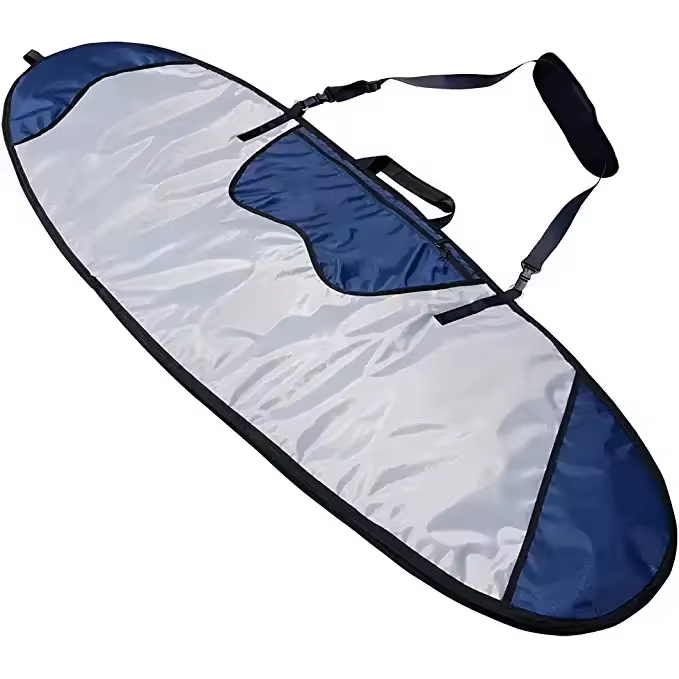
A day bag, sometimes called a sock or day cover, is a light sleeve meant for short trips from the car to the beach. It protects against wax marks and minor dings but adds almost no padding. A travel bag—often called a coffin bag—is built for flights and long road trips. It carries thicker foam, a reinforced base, and usually a compartment for multiple boards.
Mixing the two up is the most common sourcing mistake. A traveler who ordered a thin day sleeve will not forgive a product that arrives without padding at the nose and tail.
Wheeled travel coffins put the same stress on hardware that they put on the shell, so the wheel and trolley assembly is worth specifying separately from the fabric — see what goes on a rolling bag spec sheet.
Shell fabric and padding
Most bags are built from polyester or nylon in the 420D to 840D range. Heavier denier resists abrasion on conveyor belts but adds weight, which matters when airlines measure both the bag and the board inside it. Tarpaulin or coated fabrics shed water better and are easier to wipe down after a session. How well a shell sheds that water is worth pinning down separately — spray ratings and hydrostatic head figures measure different things, and the difference is set out in [how water resistance is specified](https://imarobag.com/bag-water-repellency-ratings/).
Tarpaulin and coated shells also open up welded construction, which removes the needle holes a stitched seam leaves behind; the practical limits of welded and taped seams decide how far that helps on a bag that spends its life on wet sand.
Padding is where samples differ most. A travel bag should hold closed-cell foam along the rails and at the nose and tail, not just a thin lining. Ask the factory for the actual foam thickness in millimeters and check it against the sample—spec sheets and physical product do not always match.
Fin fit and board length
Fins are the part that gets crushed first. A good travel bag leaves room for the fin(s) or includes a fin slot so the board sits flat instead of bending the tail. Single-fin longboards, thruster setups, and quads all need different clearance, so the fin configuration should be part of the spec, not an afterthought.
Length is the other fixed constraint. Shortboards run roughly 5’0″ to 6’8″, while longboards and guns go well past 9′. Many buyers order a small size run (for example 6’0″, 6’6″, and 7’0″) to cover most customers rather than stocking every inch. If the bag must hold two or three boards, confirm the internal width and the strap layout that keeps them from rubbing.
What to verify in the sample
Before committing to a production run, check the physical sample against the order:
- Zipper: a continuous, heavy coil zipper that does not snag when the bag is full.
- Stitching: double-stitched seams at stress points, especially around handles and the base.
- Hardware: padded, reinforced handles and a shoulder strap that sits without slipping.
- Venting: at least one vent to reduce mold when a damp board is bagged for hours.
A short factory audit, or a pre-shipment inspection run against the checkpoints in bag quality control, catches most of these issues before they reach a customer.
A note on customization
For brands building a private-label line, the bag is also a canvas: print, webbing color, and internal dividers are all adjustable at the OEM stage. Minimum order quantities and the cost of a custom mold or print should be confirmed early, because they shape both the unit price and the lead time.
FAQ
Q: Should a surfboard travel bag be padded or unpadded?
A: It depends on use. A day sleeve can be unpadded and light, but any bag meant for flights or long trips should have closed-cell foam at the rails, nose, and tail.
Q: How do I choose the right length?
A: Match the bag to the longest board you expect to carry, then confirm internal width if you want to stack two or three boards. Most brands stock three lengths to cover shortboards through longboards.
Q: What fabric weight is best?
A: 600D polyester is a common balance of durability and weight for travel bags; heavier 840D resists abrasions better but adds airline weight. Waterproof-coated fabric helps in wet climates.
Q: Can the bag be customized with my brand?
A: Yes. Print, webbing, and internal layout are adjustable during OEM production, though custom work affects MOQ, unit price, and lead time.
Buyers comparing suppliers can review our ski and snowboard bags for OEM/ODM specs, materials, and MOQ.