Material selection is the single biggest lever in a bag program. When you know how to choose bag material for the actual use case, the base fabric, coating, and lining typically drive 40–70% of landed cost and decide whether a line survives returns and warranty claims. Match denier, water resistance, and compliance certificates to the product’s end-use and target market *before* tooling is cut. Validate every claim with third-party abrasion and chemical testing rather than a supplier’s spec sheet alone.
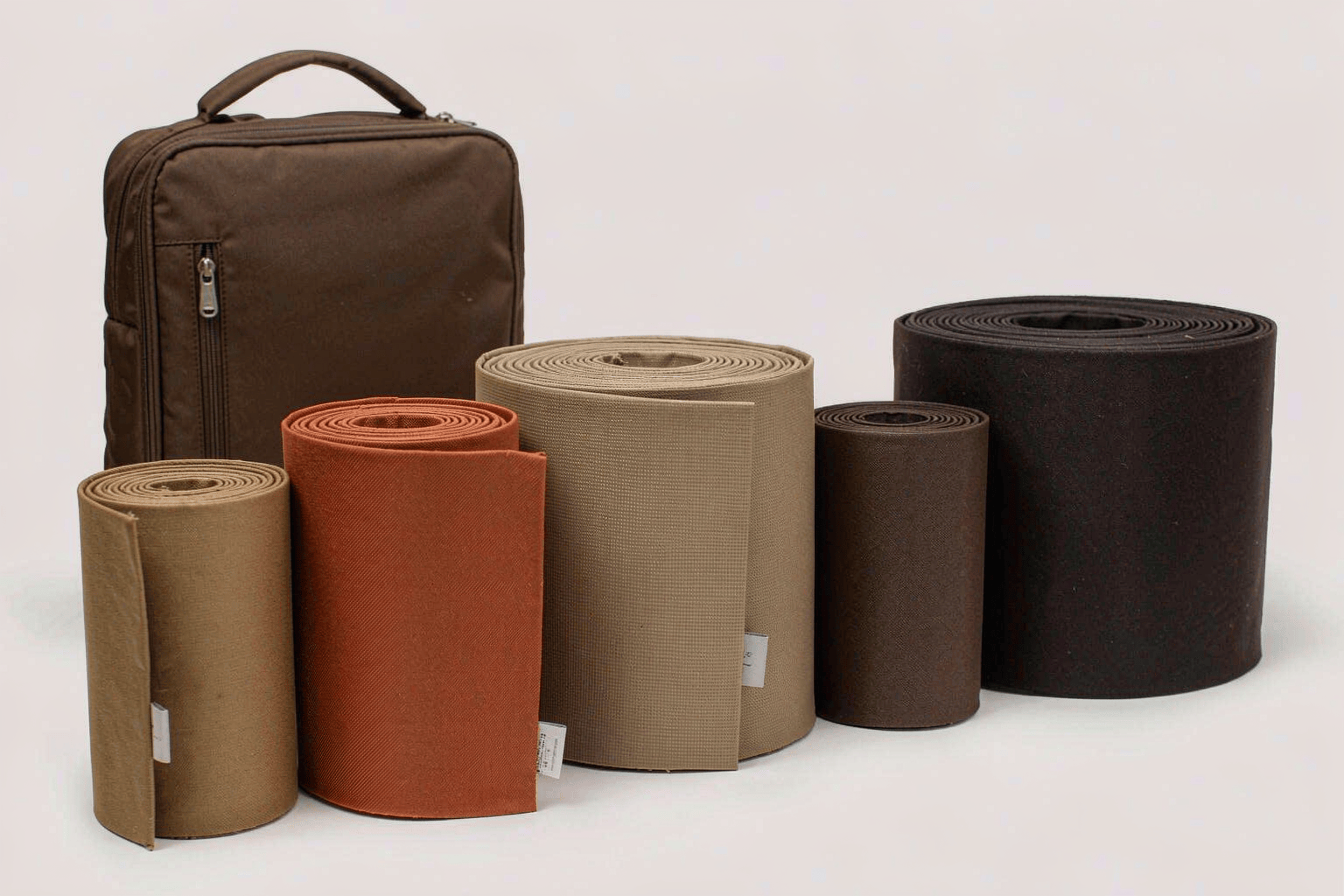
What does the right material actually control in your line?
Before comparing fabrics, separate the five variables a material decision moves:
- Landed cost — fabric is priced per linear yard or kilogram; a 1680D nylon plain weave runs roughly 2.5–4× the cost of a 300D polyester of similar width.
- Weight — a 600D fabric weighs about 180–220 g/m²; the same bag in 1680D ballistics can add 300–500 g to the finished unit.
- Durability — measured by abrasion cycles (Martindale or Wyzenbeek) and tear strength, not by feel.
- Compliance — REACH, OEKO-TEX, and Prop 65 thresholds are material-specific and checked at customs.
- Decoration — embroidery, screen print, and sublimation each need a compatible surface; the wrong base fabric rejects ink or puckers.
Treating material as a late-stage detail is the most common reason a first production run misses margin or fails inspection.
Which material families should a buyer compare first?
Most programs narrow to six base constructions. The table below uses representative mill values; always confirm against the specific mill’s test report for your order.
| Material family | Typical construction | Weight (g/m²) | Abrasion (Martindale cycles) | Water resistance (hydrostatic head) | Relative fabric cost | Decoration fit | Best use |
|---|---|---|---|---|---|---|---|
| Polyester (PES) | 300D–600D plain weave | 120–180 | 8,000–15,000 | 300–800 mm (uncoated) | $ | Screen print, sublimation | Promotional, light totes |
| Nylon (PA) | 420D–1000D ripstop | 160–260 | 20,000–40,000 | 500–1,500 mm | $$ | Embroidery, PU print | Backpacks, travel |
| High-tenacity nylon | 1680D ballistic | 380–480 | 50,000+ | 1,000–2,000 mm | $$$ | Embroidery, deboss | Technical, luggage |
| Recycled PET (rPET) | 600D–900D from flakes | 170–240 | 15,000–25,000 | 400–900 mm | $$ | Screen print, woven label | Eco-positioned lines |
| PU-coated fabric | Nylon + 0.15–0.3 mm PU | 200–320 | 25,000–45,000 | 3,000–10,000 mm | $$ | Deboss, embroidery | Rain, golf, outdoor |
| Canvas / cotton | 10–18 oz woven | 280–500 | 10,000–20,000 | <200 mm (needs wax) | $$–$$$ | Embroidery, screen print | Fashion, heritage totes |
Note the gap between “uncoated” and “coated”: a 600D nylon at 800 mm hydrostatic head wets through in sustained rain, while the same weave with a 0.2 mm PU backing reaches 5,000 mm. Coating, not denier, is what makes a bag weatherproof.
PU, TPE, or PVC: which coating fits the job?
The base weave is only half the material story; the coating decides water resistance, hand-feel, and weldability. Three coatings dominate bag production:
| Coating | Thickness applied | Hydrostatic head | Hand-feel | Welding / bonding | Notes |
|---|---|---|---|---|---|
| PU (polyurethane) | 0.15–0.3 mm | 2,000–10,000 mm | Soft, flexible | Limited | Most common; REACH-compliant grades widely available |
| TPE (thermoplastic elastomer) | 0.2–0.4 mm | 5,000–15,000 mm | Matte, rubbery | Excellent (RF weld) | PVC-free, preferable for EU eco lines |
| PVC | 0.3–0.6 mm | 8,000–20,000 mm | Stiff, glossy | Poor | Cheapest; restricted under REACH phthalate rules |
For most programs, a 0.15–0.2 mm PU backing on a 600D nylon is the cost-and-performance sweet spot. TPE earns its premium when the design uses welded seams (no stitch holes) or must avoid PVC for EU retail compliance. Specifying “PVC-free” in the tech pack is now a routine requirement for German and Nordic buyers, not a differentiator.
How to choose bag material across climates and use cases
The fastest way to shortlist is to start from the product type, then work backward to a base fabric and a coating. This avoids over-specifying (wasted cost) or under-specifying (returns).
| Product type | Recommended base | Coating / lining | Why |
|---|---|---|---|
| Everyday backpack | 600D–840D nylon ripstop | 0.15 mm PU back, 210D lining | Balanced weight, 20k+ cycles, sub-$1.5/unit fabric |
| Travel / duffle | 900D–1000D nylon or rPET | 0.2 mm PU, TPU-welded option | Abrasion at contact points, water resistance |
| Golf / outdoor | 1680D nylon or PU-coated | 0.25–0.3 mm PU, foam padding | Stand wear, dew, club friction |
| Laptop / corporate | 600D–1680D + rPET option | Suspended EVA base, 210D lining | Device protection, gift decoration |
| Fashion tote | 12–16 oz canvas or PU | Uncoated or light PU | Hand feel, print surface, structure |
| Promotional giveaway | 300D–600D polyester | None or light PU | Cost ceiling, sublimation graphics |
A frequent error is specifying 1680D for a tote that only needs 600D — the extra denier adds weight and 30–50% fabric cost with no consumer-noticeable benefit. Conversely, a 300D promo fabric used for a school backpack fails at the straps within a season.
What numbers prove a fabric will survive daily use?
Spec sheets say “durable.” Buyers should ask for measurable thresholds:
- Denier — yarn thickness; 600D is the entry point for daily-carry bags, 1000D+ for high-abrasion.
- Martindale cycles — 20,000 cycles is a reasonable floor for a backpack; 50,000+ signals technical/luggage grade.
- SPI (stitches per inch) — 8–10 SPI on structural seams resists unraveling; below 7 SPI the seam fails under load.
- Zipper cycle life — request 5,000 open/close cycles minimum on the main zipper.
- Seam strength — a top-stitched stress point should hold 25–40 kgf before separation.
- Colorfastness — ISO 105-X12 crocking grade 4+ prevents dye transfer to clothing.
Incoming inspection should use AQL 2.5 for major defects and 4.0 for minor, sampled per ANSI/ASQ Z1.4 (formerly MIL-STD-105). A fabric that passes the showroom but fails AQL at container level is a召回 risk, not a saving.
Which compliance checks block a material at customs?
Compliance is where material choice intersects with market access. The table maps the common certificates to what they actually verify.
| Certificate / regulation | What it covers | When it’s required |
|---|---|---|
| REACH (EU) | SVHC chemicals < 0.1% in articles; 240+ substances | All EU imports |
| OEKO-TEX Standard 100 | Tested for harmful substances, Class I–IV | EU/retailer requirement, link: oeko-tex.com |
| California Prop 65 | Lead, phthalates, listed carcinogens | US (California sales) |
| GRS (Global Recycled Standard) | Recycled content claim, chain of custody | rPET / recycled lines |
| ISO 9001 | Quality management of the factory | Buyer due diligence, link: iso.org |
| amfori BSCI / Sedex | Social audit of the facility | EU retailer code compliance |
A material can be physically perfect and still be held at the border if its dye lot exceeds an REACH SVHC limit or lacks an OEKO-TEX class matching the product’s contact level. Specify the required certificate *in the tech pack*, not after the first shipment is flagged.
How does material choice affect MOQ and lead time?
Two material decisions quietly extend your timeline:
- Mill minimums — commodity 600D nylon may have a 500 m minimum; a custom-dyed 1680D ballistic can require 3,000–5,000 m, forcing a larger first order.
- Coating line booking — PU/TPE coating runs in batches; a 0.2 mm spec may add 7–12 days versus a stock fabric.
A realistic timeline for a material-driven program:
- Fabric sourcing & lab dip: 5–10 days
- Coating / lamination (if custom): 7–12 days
- Bulk weave + QC: 15–25 days
- Cutting & sewing: 20–35 days depending on SKU count
Total lead time for bags from material confirmation to FOB typically lands at 50–80 days. Choosing a stock, certificate-ready fabric at the right denier is the most reliable way to compress the front end without rushing inspection.
What should your tech pack specify for materials?
A vague “nylon, waterproof” invites substitution. A spec that survives a factory audit reads like this:
- Base fabric: 600D nylon ripstop, ≥180 g/m², Martindale 20,000+ cycles
- Coating: 0.15 mm PU back, hydrostatic head ≥3,000 mm
- Lining: 210D polyester, colorfastness grade 4
- Hardware: YKK-equivalent, 5,000-cycle zipper
- Decoration: embroidery, 8 SPI, Pantone-matched thread
- Compliance: REACH + OEKO-TEX Class II; GRS if recycled
- Test method: third-party report from an accredited lab (SGS / TÜV / Intertek)
This single page lets a supplier return a costed quote instead of a guess, and it gives your QC team the acceptance criteria before bulk cutting.
How do you validate a supplier’s material claims?
Specs on paper are not proof. Before committing tooling:
- Request the mill’s test report, not a summary — check the lab name, date, and sample lot.
- Order a pre-production pilot (30–50 units) and run your own wear test on straps and zippers.
- Build a bullet sample with the exact fabric/coating/hardware to confirm hand-feel and print.
- At bulk, inspect against the tech pack using AQL 2.5/4.0 and retain a sealed reference sample per lot.
A supplier that resists third-party verification or cannot produce a current certificate is a material-risk flag regardless of price.
The numbers and specs are broken down in Custom Bag Material Options: Canvas, Nylon, PU, Recycled.
FAQ
What denier is best for an everyday backpack?
600D to 840D nylon ripstop is the standard range: it delivers 20,000+ Martindale cycles and keeps finished weight near 400–600 g. Use 1000D+ only where abrasion is extreme, such as a skate or motorcycle line.
Is recycled PET strong enough for bags?
Yes, when specified correctly. A 600D rPET weave reaches 15,000–25,000 Martindale cycles — adequate for totes and light backpacks. For structural loads, pair rPET with a PU backing and verify the GRS chain-of-custody certificate.
Which compliance certificates do I need for the EU and US?
For the EU, REACH conformity and usually OEKO-TEX Standard 100 (Class II for bags with skin contact). For US sales into California, Prop 65 screening for lead and phthalates. rPET lines need GRS; retailer programs may ask for BSCI or Sedex.
How much does material choice affect total cost?
Base fabric and coating commonly represent 40–70% of landed unit cost. Moving from 600D to 1680D nylon can add 30–50% to fabric spend; switching from stock to custom-dyed material adds both cost and 7–12 days of lead time.
Can I mix materials within one bag?
Yes, and it is common: a 600D body with a 1680D base panel, or a canvas face with a PU-coated bottom. The tech pack must specify each panel’s fabric, coating, and test standard so inspection is unambiguous.
How do I specify material in a tech pack so factories don’t substitute?
State base fabric, denier, weight, coating thickness, lining, hardware grade, required certificates, and the accredited test method. Reference a sealed bullet sample. Vague terms like “waterproof nylon” should be replaced with measurable thresholds.
Mastering how to choose bag material is what separates a line that ships on margin from one that eats returns in the first season — and the discipline starts in the tech pack, not the showroom.
Get a Custom Bag Quote
Send your tech pack for a manufacturability review and a costed quote. Once you know how to choose bag material for your line, the next step is pricing each option against your volume and compliance target: Request a quote →
Related:
Buyers comparing suppliers can review our full bag catalog for OEM/ODM specs, materials, and MOQ.