Radio-frequency identification (RFID) skimming has moved from a niche worry to a routine procurement question. When buyers ask for a “secure” or “anti-theft” laptop bag — especially for corporate gifting, conference swag, or executive travel programs — the spec they usually mean is an RFID-blocking layer. For a factory receiving that request, the job is less about magic fabric and more about pinning down exactly what the shielding should cover and proving it works.
RFID shielding is one layer of a broader anti-theft spec — pair it with slash-resistant panels and lockable zippers as set out in our anti-theft bag features checklist.
For travel use, pair the shielding with a rear trolley sleeve so the laptop bag docks to a rolling suitcase instead of riding a shoulder.
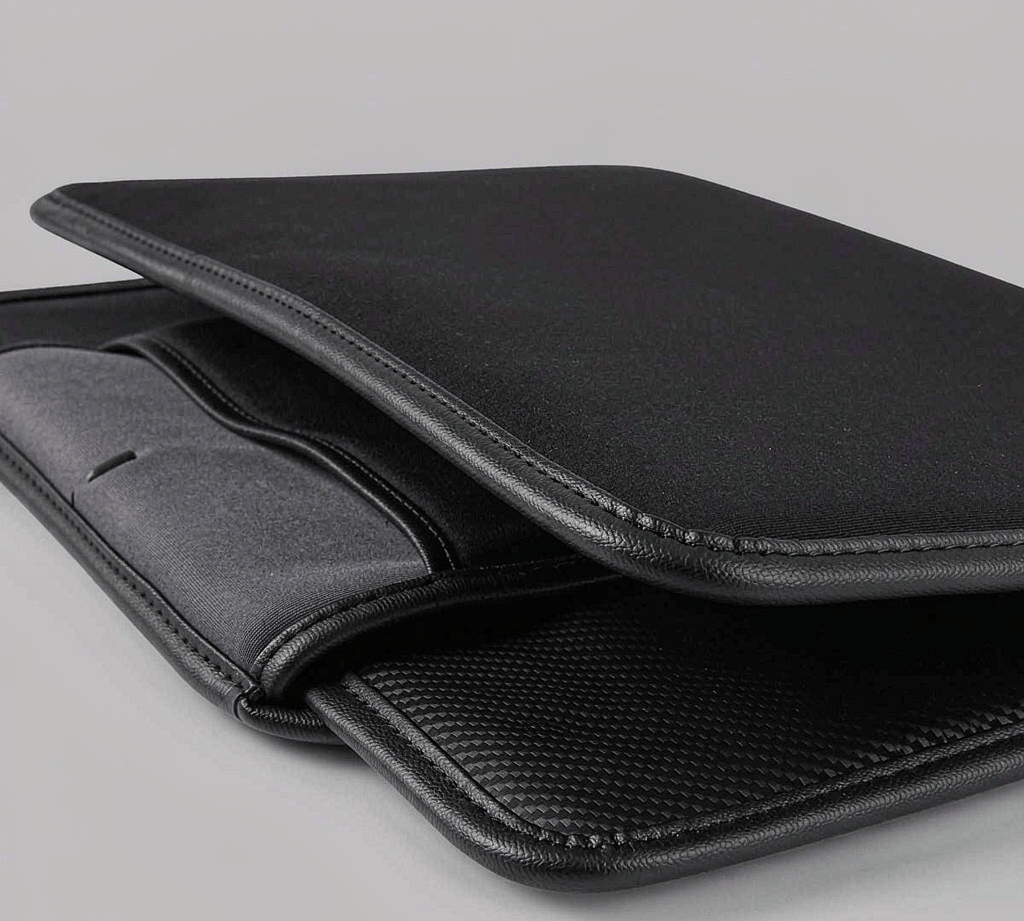
What the shielding layer actually is
An RFID-blocking panel is a thin sheet of conductive material — most often a nickel- or copper-coated fabric, or a printed conductive ink laminated between two layers. It does one thing: it reflects or absorbs the radio waves used by contactless cards and passports so a reader a few centimeters away cannot read them through the bag. It is not a structural layer, it does not make the bag waterproof, and on its own it adds almost no weight.
That last point matters for buyers. A shielded laptop bag should feel like a normal laptop bag. If the sample feels stiff or heavy, the shielding has probably been over-specced, or it has been applied to areas where it is not needed.
A separate question is whether the surrounding panel holds its shape at all. That is the job of the insert behind the padding, and the options are set out in frame sheets, PE boards and stiffeners.
Where the shielding goes
There are two common build approaches, and the choice changes both cost and usefulness:
- Dedicated shielded pocket. A single zippered compartment — usually the laptop sleeve or a small slip pocket — is lined with the conductive layer. This is the cheaper option and the easiest to verify.
- Full interior lining. The entire interior is backed with shielding. More expensive, heavier, and usually unnecessary unless the whole bag is meant to be a faraday enclosure.
For most corporate and bulk orders the dedicated pocket is the right call. It keeps the bill of materials sane and gives the buyer a clear, demonstrable feature to show end users. If you are deciding between the two, the interior lining guide covers how different lining materials behave once they are sewn in.
Spec points to put in the purchase order
Vague requests like “make it RFID safe” create disputes at inspection. A workable spec names:
- Coverage area — which pocket or panel is shielded, down to the centimeter.
- Claim versus standard — a supplier may say “blocks RFID” based on a card demo, not a tested attenuation level. Ask for the frequency range (13.56 MHz for most contactless cards; 125 kHz for older key fobs) and any attenuation figure they can stand behind.
- Durability — the layer must survive folding, washing of the outer fabric, and repeated opening. Request a material data sheet.
- Laptop fit — the shielded sleeve still has to fit the target device. A layer that bulks the pocket harms the core function.
Hardware choices matter here too. A shielded pocket with a flimsy zipper undermines the claim, so pair it with the same closure hardware you would specify for any security-minded build — the zipper and hardware guide is a useful reference when pinning those details down.
Retail orders still need a scannable barcode as well as any shielding, and the retail labeling spec sets out where it goes.
Verifying before bulk production
Do not wait for the container to test the claim. Request a shielded-sample evaluation during the development stage, and include a simple acceptance check in the quality plan — the kind covered in a standard bag quality control write-up. A supplier that can show the material spec and a repeatable test method is lower risk than one offering only a live demo at the sales meeting.
For a deeper buyer-side breakdown of the category, see the laptop bag buying guide.
FAQ
Does an RFID-blocking laptop bag need a different outer material?
No. The shielding is an internal layer; the outer fabric is chosen for the same reasons as any other laptop bag — abrasion resistance, weight, and appearance.
Will the shielding interfere with the laptop’s own wireless connection?
No. The layer only blocks signals in the specific low-frequency bands used by contactless cards. Wi-Fi, Bluetooth, and cellular signals pass through normally.
Is a card demo at the factory enough proof?
It is a useful illustration, not a specification. For bulk orders, ask for the material data sheet and a documented test method so the claim is repeatable at incoming inspection.
How much does adding RFID shielding add to unit cost?
Typically a modest per-unit increase driven by the conductive fabric and the extra sewing step. The dedicated-pocket approach keeps this lower than a full interior lining.
Buyers comparing suppliers can review our backpacks and laptop bags for OEM/ODM specs, materials, and MOQ.