A waterproof bag that is sewn rather than welded still has one weak point: the row of needle holes along every seam. Heat-taped seams fix this by laying a thin adhesive film over the stitch line and melting it into the coating, so water cannot track through the threads. Specifying the right tape and sealing parameters is what separates a bag that survives a downpour from one that wets its contents on the first trip.
Why a sewn seam leaks
A needle punches a channel through the fabric and any PU or TPU coating. Even a fine needle leaves a capillary path, and once the outer surface is wet the water creeps inward along the thread. Painting the seam with liquid sealant helps, but a bonded tape gives a continuous, flexible barrier that survives flexing far better. This is a different problem from fabric water repellency, which treats the cloth surface rather than the stitch line.
The three tape families
Hot-melt PU film tape is the workhorse for coated nylon and polyester; it bonds to the coating and stays supple. TPU tape is the choice when the substrate itself is TPU-laminated or when you need higher heat and chemical resistance. Butyl or rubber tape is used on heavy tarpaulin-style builds where repositioning before final sealing matters. Each family needs a matching sealing temperature, so the tape and fabric must be specified together.
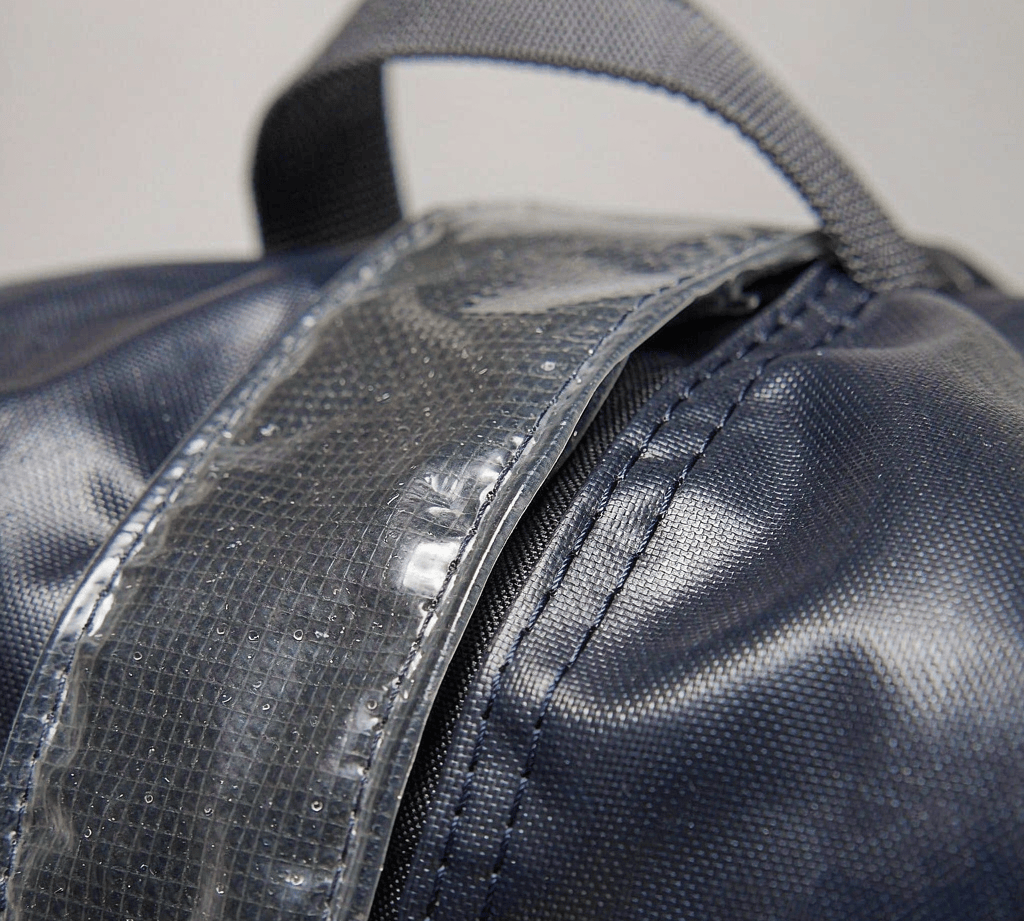
Width and overlap rules
The tape has to be wider than the seam allowance and must cover every bar-tack and reinforcement. An 18–22 mm tape is common for main body seams; stress points such as bartacked haul loops need the tape to run past the knot by at least 10 mm. Skipping this is the usual reason a “waterproof” bag leaks exactly where it was reinforced.
Temperature, pressure and speed
Heat sealing runs in a narrow window. Too cool and the tape peels on the first flex; too hot and it melts the coating or discolors the face fabric. Typical settings land near 130–180 °C at modest roller pressure, with line speed set so the tape dwells long enough to wet out. The factory should lock these numbers in the tech pack rather than leaving them to the operator.
Peel strength and how to test it
Adhesion is measured as seam peel strength, usually reported in newtons per 15 mm of width. A field-usable tape holds well above 8 N/15 mm after curing; the spec should name the test method and the minimum. Buyers can ask for a destruct sample: pull the tape off an offcut and watch whether it tears the coating (good) or releases cleanly (weak bond).
Substrate compatibility
Tape bonds to the coating, not the woven base, so a bag with a thin or uneven PU coating seals poorly. TPU tape grabs TPU-laminated fabrics cleanly; plain PU tape can release on silicone-treated surfaces. This is why seam taping and fabric coating decisions belong in the same tech-pack section rather than two separate documents.
When taping beats welding
Taped seams suit complex 3D shapes, curved panels and bags with many pockets, where radio-frequency welding jigs get expensive. Welded seams still win on flat, high-volume panels for speed. Many lines use both: welded main bodies with taped detail seams. Knowing which process covers which seam keeps cost and waterproofing in balance.
What to put in the tech pack
List the tape family, width, sealing temperature and pressure, line speed, minimum peel strength, and the substrate coating it must bond to. Naming the test method turns a vague “waterproof” claim into something a factory can actually build and a QC inspector can check.
FAQ
Are taped seams as waterproof as welded seams?
For sewn bags, a well-bonded tape closes the needle holes completely, so performance matches welding on those seams. Welding still avoids stitches entirely, which some buyers prefer on flat panels.
What tape width should I specify?
18–22 mm covers most body seams; go wider at bartacked stress points. The tape must overlap the stitch line and any reinforcement by at least 10 mm.
How do I test seam tape adhesion?
Request peel strength in N/15 mm with the test method named, and ask for a destruct sample. If the tape tears the coating off, the bond is sound; a clean release means it is too weak.
Can seam taping be done on any fabric?
No. Tape bonds to the coating, so thin or silicone-treated surfaces seal poorly. Specify the tape and the substrate coating together so the factory validates the combination.
Related reading
For the wider build, see how seam sealing fits into the full bag manufacturing process from cutting to QC.
Sewn-in details like a [care label](https://imarobag.com/bag-care-label-spec/) get the same scrutiny — fiber content and care symbols are small, but a mismatch can stop a shipment at the border.