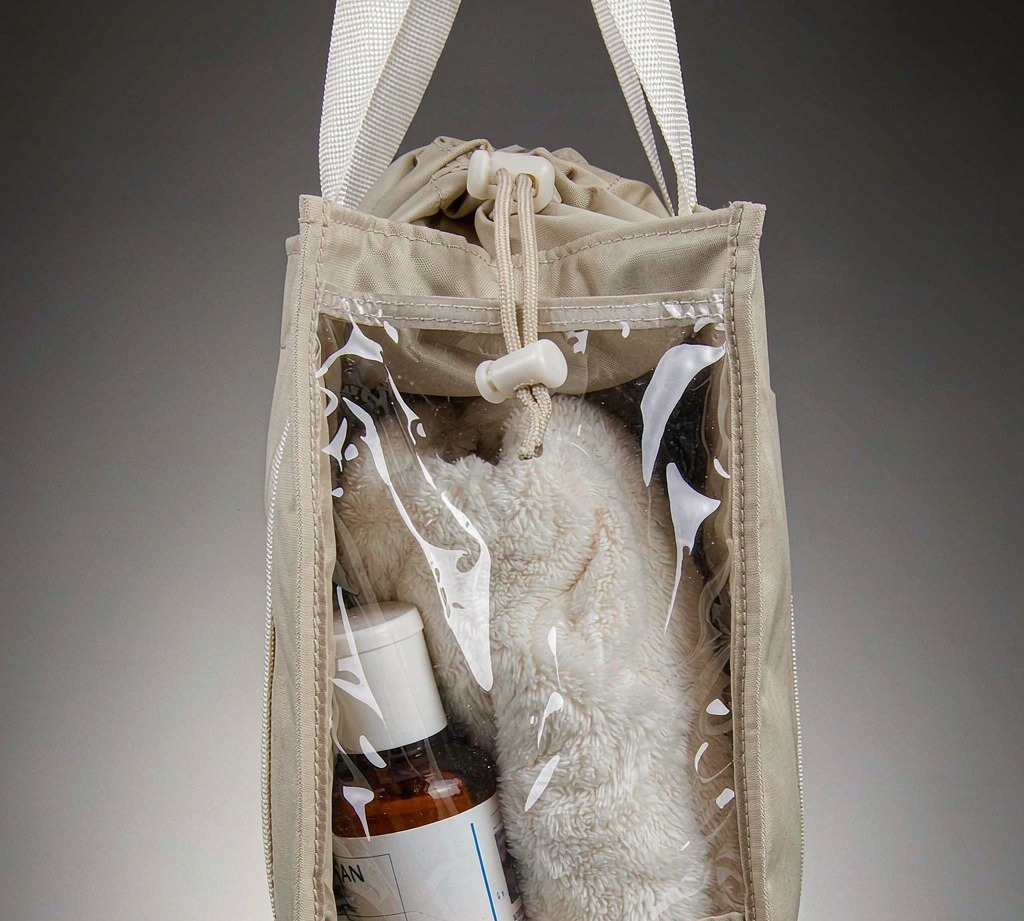
A clear PVC window lets a buyer see what is inside a bag without unzipping it. That single feature shows up across cosmetic pouches, medical kits, tool rolls, and stadium-compliant totes where security or quick identification matters. If you are sourcing a custom bag and want visibility without making the whole body transparent, a well-specified window is cheaper and cleaner than a fully see-through panel. For the surrounding join, our guide to seam construction types explains which seam to specify per panel.
When a clear window earns its place
Not every bag needs one. A window makes sense when the contents must be identified fast, when regulations require see-through panels, or when the product is sold as “viewable” (cosmetics, samples, first-aid). If the item is meant to stay hidden, skip it — every window is a seam and a potential leak or yellowing point. For a breathable alternative on sport bags, a mesh pocket does the see-through job without film.
PVC film versus TPU film
Most windows use calendered PVC film in the 0.15–0.50 mm range. Thin film (0.15–0.25 mm) stays flexible and light but scratches and creases; thick film (0.35–0.50 mm) holds shape and resists puncture but adds weight and a stiffer hand-feel. TPU film is the premium option — clearer, more abrasion resistant, and it does not harden in cold the way PVC can. If you want the same see-through benefit with better durability, a TPU film lamination on the panel is worth the upcharge for premium programs.
Thickness, clarity, and yellowing
Specify thickness in millimeters, not “thin” or “medium.” Clarity is a separate property: optical-grade film stays clear longer, while economy film hazes after months of UV exposure. Ask the factory for a yellowing test (often a QUV or Xenon-arc cycle) and set a pass/fail against a control sample. This matters for brands selling on shelves where a foggy window looks like a defect within a season.
Welded versus sewn attachment
A window is attached two ways. High-frequency (RF) welding fuses the film to a PVC or TPU border with no needle holes — best for waterproof bags where a waterproof zipper already sets the seal expectation. Sewn windows use a folded seam and stay tape; they are cheaper and work on fabric bodies, but every stitch is a potential leak and fray point. For a fabric body, match the film edge to the ripstop or woven shell so the panel does not bag or pucker.
Quality checks buyers should request
On incoming inspection, check four things: (1) no entrapped air bubbles or wrinkles in the weld; (2) a pull test on welded borders so the film does not lift; (3) clarity against the approved sample; (4) edge trimming flush with the seam so there is no sharp lip. A simple rub test with a soft cloth tells you whether the surface scratches in normal handling. These checks belong in the inspection criteria, not left to the line operator’s judgment.
Tech-pack fields to write
Put the following in your tech pack so the factory quotes apples to apples: film material (PVC/TPU), thickness in mm, clarity grade, attachment method (weld/sew), window dimensions and placement, and any compliance mark (REACH, Prop 65, or region-specific phthalate limits). Leaving any of these open invites substitution with the cheapest film the factory has in stock.
FAQ
Is PVC film safe for cosmetic and food-contact bags?
For cosmetic and food-adjacent use, specify phthalate-free PVC or switch to TPU, and confirm compliance with REACH (EU) or Prop 65 (California). Do not assume “PVC” is automatically compliant — request the test report from the supplier.
Can a clear window be waterproof?
Yes, if it is RF-welded to a compatible film border and the surrounding panel is also sealed. A sewn window is water-resistant at best because needle holes remain. Pair it with welded construction if the bag must keep contents dry.
How do I stop the window from yellowing?
Specify optical-grade, UV-stabilized film and ask for a QUV or Xenon test with an agreed pass level. Economy calendered film yellows faster; the upcharge for stabilized grade is small compared with a returned batch.
Does a window add much cost?
A small welded window adds modest cost — mainly film and one extra operation. The bigger risk is rework from bubbles or misalignment, so a clear spec and a first-article sample save more than squeezing the film price.
Conclusion
A clear PVC window is a small detail that carries real spec decisions: film type, thickness, attachment, and compliance. Write those fields into the tech pack, pick weld or sew by the bag’s waterproof need, and verify on incoming inspection. For the broader production picture, our bag manufacturing process guide walks through how windows fit into line assembly.
Any sewn-in trim, from a clear window to a [care label](https://imarobag.com/bag-care-label-spec/), should be called out in the tech pack with exact placement and text so the factory does not improvise.