Two shells can both be labelled 600D polyester and behave nothing alike after one season of use. One comes back from the field with a fuzzy, greyed-out base panel; the other looks almost new. Denier is a measure of yarn mass, not of how a surface survives being dragged across a concrete step or the back of a chair. That gap between what a spec sheet says and what a bag actually does is where abrasion resistance data earns its keep.
The base is the panel that drags across rough ground, so its abrasion threshold is normally set higher than the sides — see how to specify a reinforced bag base.
Why the fibre number doesn’t answer the wear question
Denier counts mass per 9,000 metres of a single yarn. It says nothing about how tightly that yarn is woven, how many filaments it is split into, or what finish sits on top of it. A loosely constructed 600D plain weave can start fuzzing well before a dense 420D ripstop shows any change at all, simply because the tight weave keeps the surface yarns from being lifted and broken. Finish matters just as much: a polyurethane coating adds a sacrificial layer that takes the rubbing first, but once that layer cracks the base cloth degrades quickly. If you are specifying shell fabric, the denominators and coatings are only the starting point — see how denier, weave and coating interact before you set a wear target.
The three methods that show up on test reports
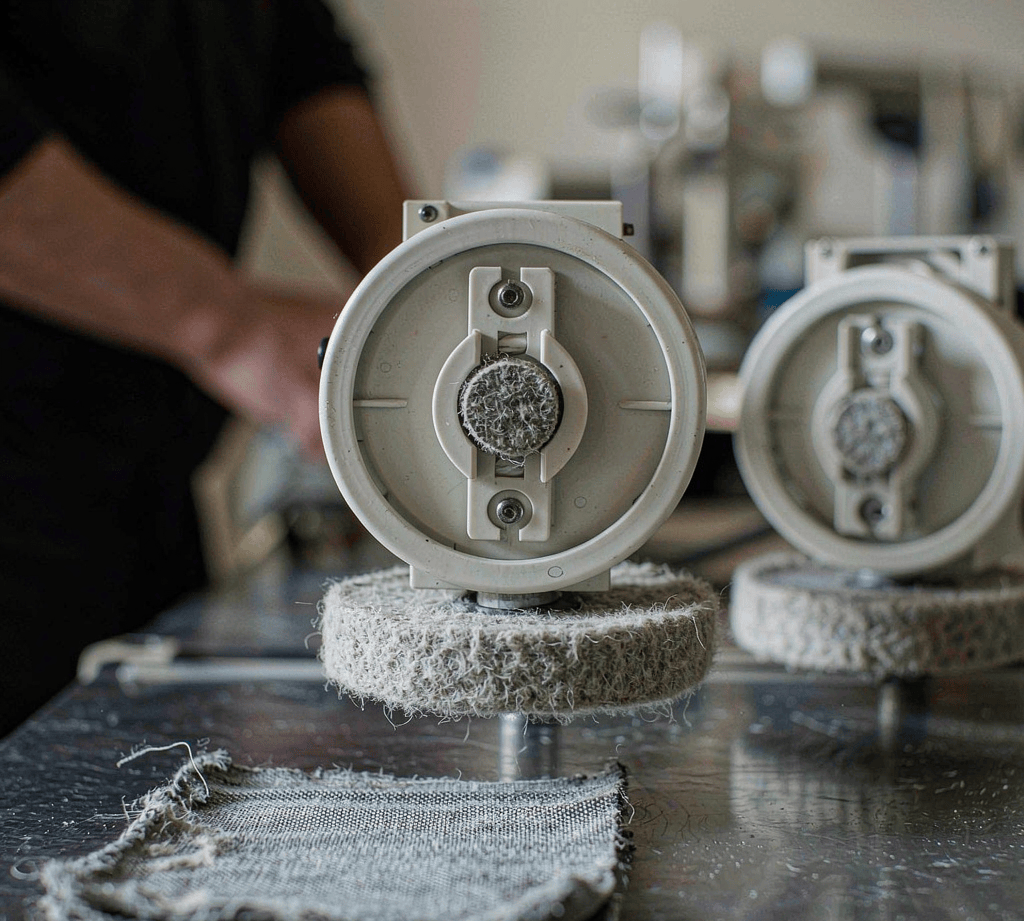
Martindale (ASTM D4966 / ISO 12947). The specimen is rubbed against a standard wool abradant in a figure-eight (Lissajous) path under a fixed load. Results are reported as cycles to a defined endpoint — typically two broken yarns, or an agreed appearance change. It is the default method in Europe and in most apparel and outdoor supply chains, and commercial outdoor fabrics often sit somewhere in the 20,000–50,000 cycle range.
Wyzenbeek (ASTM D4157). A back-and-forth straight rub using cotton duck or a wire screen abradant, reported as “double rubs”. It has its roots in upholstery and is common in North American specs.
Taber (ASTM D3884). Rotating abrasive wheels run over a flat specimen, with results given as cycles to an endpoint or as mass loss. It tends to appear with coated fabrics, laminates and TPE-faced materials where the surface layer, not the yarn, is what fails.
The important part: these three do not convert into one another. Ten thousand Martindale cycles is not ten thousand Wyzenbeek double rubs, and a supplier who “translates” one into the other is guessing. Name the method, the abradant and the endpoint, or the number is decorative.
 Keep results comparable by tying the check to the order’s AQL inspection level for sampling.
Tests that get mistaken for abrasion resistance
Buyers ask for an abrasion test and are handed a report for something else often enough that it is worth naming the neighbours. Pilling resistance (ASTM D3512) measures surface fuzzing. Colour fastness to rubbing, or crocking (AATCC 8), measures dye transfer onto a white cloth — a different failure, one that usually shows up only on dark or heavily pigmented shades, which is why it sits alongside lab dips and colour fastness checks rather than inside them. Tear strength (ASTM D2261 tongue tear, or D1424 Elmendorf) tells you how a rip propagates once it starts. Hydrostatic head is about water, not wear.
A fabric can pass 40,000 Martindale cycles and still crock badly on a navy shell. Each property needs its own line in the specification.
Where bags actually wear out
Field returns cluster in predictable places: bottom corners and the base panel, the strap run where it crosses a shoulder, handle roots, the fabric immediately beside a zipper track, and the lining at the bag mouth. Lining is usually a lighter, cheaper cloth and often fails first — worth reading up on lining fabric selection before you upgrade the shell and leave the interior as-is. Reinforcement at those same points, whether that is a boxed X-stitch, a binding or a patch, usually buys more real-world life per cent than moving the whole shell up a grade, and it is the same reasoning behind stress-point reinforcement.
Writing a wear requirement into the tech pack
State four things: the test method, the abradant, the endpoint, and the minimum result. “30,000 cycles Martindale, wool abradant, to two yarn breaks” is enforceable; “high abrasion resistance” is not.
Then decide when it gets tested. A pre-production report on the exact finished laminate is the baseline — not on the greige cloth, because coating, printing and bonding all change the surface. For repeat orders, one report per production batch or per colour lot is usually enough, and third-party testing through a lab such as SGS, Intertek or TÜV adds a few days and a modest fee that is easy to justify on a first order. Expect some batch-to-batch variation; treating a 10% swing as a defect stalls shipments without improving the product.
FAQ
Which abrasion method should I specify?
Whichever your market already uses. European and outdoor programmes default to Martindale; North American buyers often see Wyzenbeek double rubs. Consistency matters more than the choice.
Is a higher cycle count always better?
Not automatically. Very high counts are often reached with a heavy coating, which can crack, stiffen the hand feel and add weight. Match the number to how the bag is actually used.
Do coatings change the result?
Yes, and usually favourably at first. That is why the finished laminate — not the base fabric — should go into the machine.
Can I compare two suppliers’ reports?
Only if both used the same method, abradant and endpoint. Otherwise you are comparing two different experiments.
Related reading
For a broader walk-through of material trade-offs across shell, lining and trim, see how to choose the right bag material.
Buyers comparing suppliers can review our full bag catalog for OEM/ODM specs, materials, and MOQ.