Buyers spend their attention on fabric, hardware and stitching. The step that decides whether those things line up happens before a needle moves: cutting the panels. A part trimmed a millimetre off, with an edge that frays or a grain line running the wrong way, produces faults no sewing operator can correct.
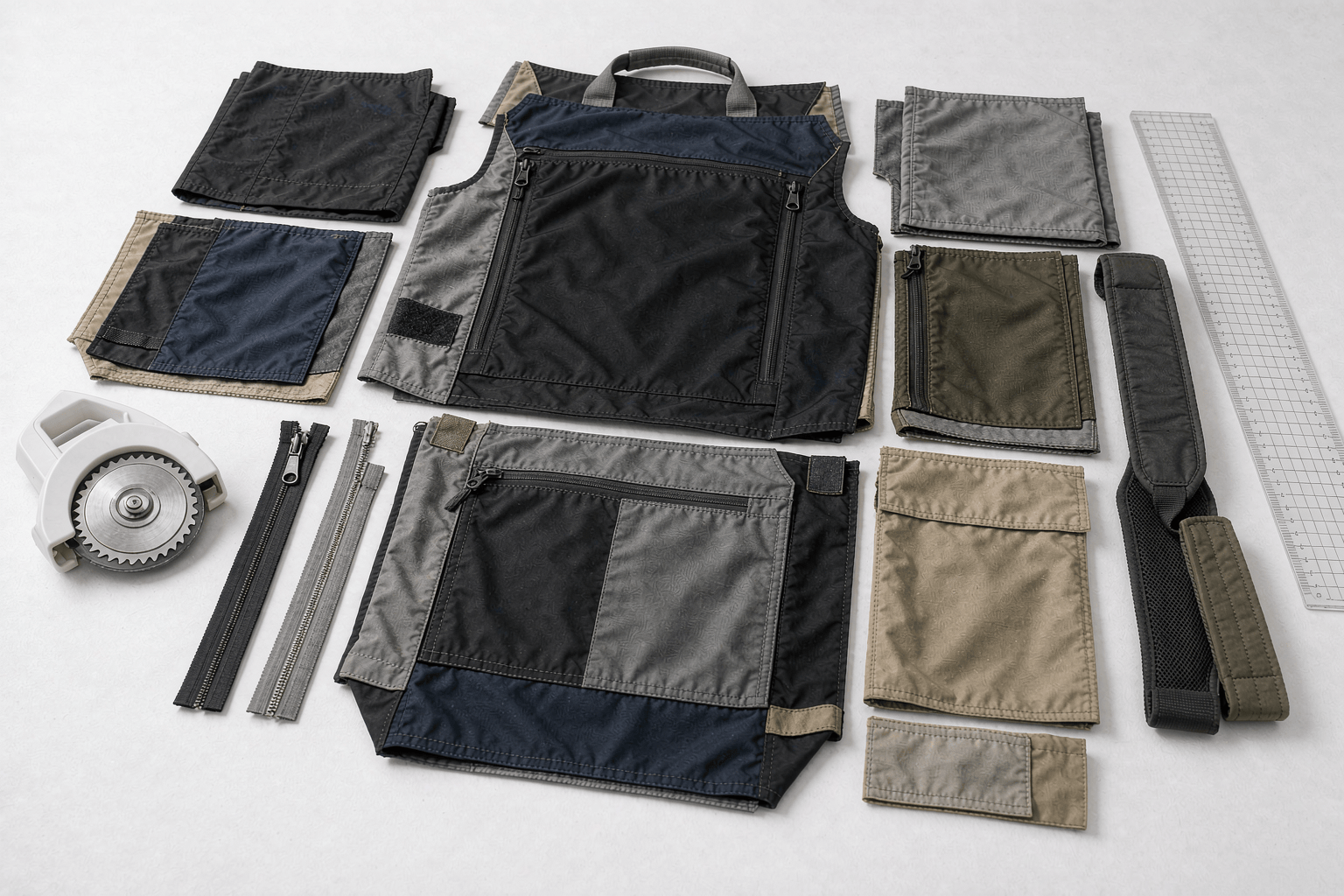
Why the cutting room shows up three steps later
Cut errors rarely look like cut errors. They surface as a lid that fits tight on one side, a logo sitting off-centre, a strap that twists because its grain line was ignored, or an edge unravelling inside a lining. Match marks, notches and grain direction are all established here, and once panels are bundled they travel through the line as a fixed fact.
Die cutting: repeatable, and priced for volume
A steel rule die is a shaped blade bent to the panel outline and mounted in a board; a clicker or beam press drives it through the material. Because the geometry is fixed in steel, every part is identical and multi-ply stacks cut cleanly in one stroke. The die has to exist before production starts, so the run needs to be long enough to absorb the tooling, and late design changes get expensive — one reason how custom tooling is costed belongs in the same conversation as panel geometry. Dies suit leather, foam, webbing stacks and heavy coated fabrics.
Laser cutting: no tooling, sealed edges, real limits
A CO2 laser works from a digital file with no physical tool, so a prototype panel costs the same to make as the thousandth one. On thermoplastics — polyester and nylon especially — the beam fuses the edge as it passes, so parts arrive sealed and do not fray, which removes a step that would otherwise need binding or overlocking.
The limits are equally real. The heat-affected zone can leave a hard, slightly brittle edge on light-coloured fabric, and scorch shows as yellow or brown along the cut line. A laser will not touch PVC or vinyl: chlorinated materials release hazardous gas, and no competent shop will run them. Thick foam melts back unevenly. Coatings react differently to heat as well, so the fabric and coating spec you settled on decides whether laser work is even an option. Coatings and repellent finishes respond differently to that heat too, and the rating system behind them is explained in [how water resistance is tested](https://imarobag.com/bag-water-repellency-ratings/).
Oscillating knife and CNC tables: the thick-stack answer
A reciprocating blade on a CNC table cuts many plies at once with no heat and no fumes. It is the workhorse for foam, EVA, leather hides and laminated panels where a hot edge is unacceptable, and nesting software packs pieces tightly — which matters on expensive material.
The constraint is geometry. A physical blade has width and deflects under load, so tight internal radii and sharp corners come out rounded or slightly overcut, and thin single-ply fabric can shift unless the table holds it well. It is slower per part than a laser on single-ply work and faster on stacks.
Ultrasonic knives: narrow goods and webbing
Ultrasonic knives trim and seal in one pass, used mainly on webbing, elastic and narrow straps. The result is a clean, non-fraying end with no separate heat-cut or folding step — worth knowing when you specify strap and connector hardware. It only works on synthetics; cotton webbing will not seal and still needs a folded or taped end.
What belongs on the cutting spec
A tech pack that gives only panel dimensions leaves decisions to the cutting room. Worth stating explicitly:
- Grain line or nap direction on every panel, especially printed or patterned fabric, so stripes do not run different ways across the product.
- Mirror parts called out as left and right, not “as shown”, so nesting produces both shapes.
- Notches and match marks where alignment actually matters: zipper ends, strap centres, pocket tops.
- Edge treatment: leave raw, seal, or plan for binding and piping to cover it.
- Tolerance expectations, stated as a range, on panels that mate with moulded parts or stiffeners.
Foam and padding deserve their own note, since the method changes how the piece feels — the same reason foam padding is specified by density and thickness rather than by look.
None of this requires the buyer to choose the machine. It does require knowing the choice was made deliberately, and that the geometry on the drawing can actually be produced by the method in use.
FAQ
Does laser cutting always seal the edge?
Only on thermoplastics such as polyester and nylon. Natural fibres like cotton and canvas still fray, and PVC cannot be laser cut at all because it releases hazardous chlorine gas.
Why would a factory refuse to laser cut a design I already sampled?
Usually the material. A coated or PVC-backed fabric, or a foam thickness that melts unevenly, forces a switch to die or knife work — which may change the edge finish you approved.
Is die cutting only for large orders?
It suits long runs because the die cost has to be spread over volume, but dies are also used for repeat components like pockets and strap ends on smaller programmes. Shape stability matters as much as quantity.
Do I need to specify tolerance on every panel?
No. Call it out where parts must mate — with a moulded shell, a frame sheet or a stiffener — and let standard practice govern the rest.
Related reading: for how cutting and tooling choices feed into order economics, see custom bag MOQ.
>
Buyers comparing suppliers can review our full bag catalog for OEM/ODM specs, materials, and MOQ.