A first OEM quote often arrives with a line item that surprises new buyers: tooling. Everything else in the quote scales with quantity, but tooling is a one-time charge that appears whether you order 300 pieces or 30,000. Knowing what that charge actually buys — and when you can avoid it — is one of the faster ways to control unit cost on a custom program.
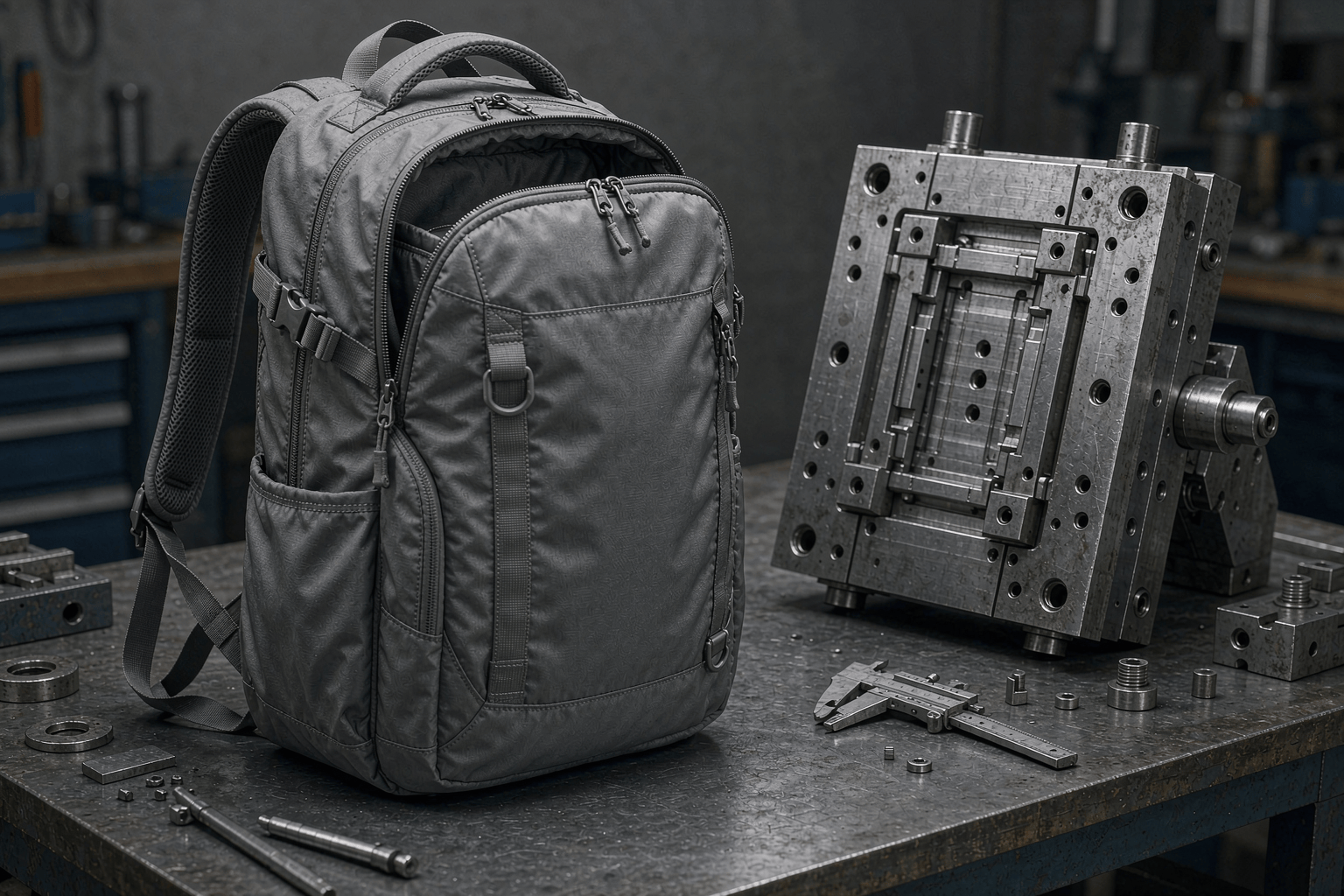
What the tooling line actually covers
Bags are mostly cut and sewn, and cutting and sewing need no custom tooling. The charge shows up when a component has to be shaped instead of stitched:
- Molded shells and panels — EVA or PU shells for protective cases, camera inserts, helmet bags and structured equipment bags, formed in a heated aluminum mold.
- Injection-molded plastic parts — custom buckles, ladder locks, cord locks, and shaped back panels that stock hardware cannot match.
- Die-cast metal hardware — a zinc alloy logo plate, an original puller, a specific D-ring geometry.
- Cast soft PVC or silicone badges — the label itself is molded, one tool per design and per colorway.
- Steel rule dies — the cutting die for a panel profile that repeats through the whole bill of materials.
Each of those is a separate tool with its own price, and a program rarely needs only one.
Whether a steel rule die is worth buying also depends on panel geometry and run length: die, laser and knife cutting compared sets out the trade-offs.
Where you probably do not need a tool
Most components have a stock equivalent. Standard side-release buckles, ladder locks, webbing, zippers and cord ends exist in dozens of catalog sizes. Picking a stock part removes the tool, shortens development, and lets you reorder components years later without re-qualifying anything.
The usual compromise is a stock part with a custom finish, or a logo molded into an existing tool — you get the branded detail without paying for new geometry.
Structure can be faked too. A panel cut from laminated foam and stitch-shaped will hold a form that reads as molded, as long as the volume does not justify a shell. That approach is common in foam padding specifications for mid-range protective bags, where the visual gap is much smaller than the tooling gap.
Rigid inserts follow the same logic. A flat sheet can usually be die-cut rather than moulded, so it is worth asking which route a panel was quoted on before a tool is signed off — frame sheets, PE boards and stiffeners walks through the trade-off.
How the cost actually behaves
Tooling is fixed; unit price is variable. The number that matters is the amortized cost per piece — the tooling spend divided by the total quantity you expect to buy over the life of the tool, not over the first purchase order.
A quick way to test it: if a mold costs roughly what 800 finished bags cost to make, and your realistic two-year volume is 5,000, the tool adds a small fraction to every unit. If your realistic total is 600, the same tool adds more than one full unit of cost to each bag, and the business case usually collapses.
That is why tooling and order minimums get negotiated together. A supplier may reduce or waive the charge at a higher minimum order quantity, because the tool becomes recoverable across a longer run.
Settle these before any steel is cut
Cutting the mold is the point of no return. Before it:
- Freeze the drawings. A dimension change after the tool is cut means rework on hardened metal, and that is not a small invoice.
- Approve a T1 sample off the real tool. Hand-cut prototypes behave differently from molded parts — wall thickness, draft angle and shrinkage only appear after the first shot.
- Confirm ownership and storage. Ask who holds the mold, what happens if you move production, and how long it is kept after the final order.
- Agree on maintenance and tool life. Production molds have a finite shot count; clarify who pays for refurbishment and when it happens.
Lead time runs longer than a sewn sample
A sewn prototype can come back in days. A new shell mold usually adds several weeks before the first usable part exists, because the mold has to be machined, trialed and corrected. Build that into your sample development timeline instead of discovering it after you have already promised a launch date.
Branding work follows the same pattern. A cast badge or custom logo application needs its own tool, and each colorway usually needs a separate one — so a four-color logo range can quietly become four tooling charges.
Common Questions
Can I move a tool I already paid for to another factory?
Usually, if the contract says the mold is yours — but moving it takes coordination, and the new factory has to re-qualify the parts. Get the ownership clause in writing at the start rather than negotiating it later.
Why is tooling quoted separately from unit price?
Because it is fixed and does not scale with quantity. Folding it into unit price hides the true cost of small runs and makes quotes from different suppliers impossible to compare.
Is a molded shell always better than a padded one?
For crush protection and repeatable shape, yes. For most carrying jobs a laminated, stitch-shaped panel does the work at a fraction of the development cost — and stock hardware keeps cost and lead time down unless a custom geometry earns its place.
If you are still weighing materials before committing to a molded structure, how to choose the right bag material walks through the trade-offs in more detail.
Buyers comparing suppliers can review our full bag catalog for OEM/ODM specs, materials, and MOQ.