A bag that looks crisp on the sampling table and one that slumps in a warehouse photo are often the same bag — the difference is usually in the parts nobody sees. Shell fabric, foam and webbing take most of the attention in a spec, but what decides whether a pack stands up or an empty duffel folds in on itself are the semi-rigid inserts buried under the lining. Buyers call them stiffeners, frame sheets, base boards or stays depending on where they sit. Leaving that choice to default is a common reason a third sample still doesn’t look right.
A base insert is the stiffener that does the most visible work, holding the bottom flat when the bag is set down — see reinforced bag base construction.
Where structure in a soft product comes from
Soft goods carry load in tension. Fabric is strong when you pull it and useless when you push it, so a panel alone cannot resist compression. Once a bag is loaded, everything sags toward the lowest point unless something inside the panel takes the compressive path. That is the whole job of a stiffener: give the panel a skeleton so the shell only handles abrasion and tension.
It also changes how a bag looks: a supported panel photographs cleanly, while the same panel unsupported shows every wrinkle — worth remembering when the product page is the first sales tool.
The families you will be quoted
PE / HDPE sheet. Extruded polyethylene, typically 0.5–2.0 mm, die-cut or knife-cut. Cheap and tolerant of flat packing. The trade-offs are real: a sharp fold leaves a permanent crease, and thin grades stiffen noticeably in cold weather, which is when cracking starts.
PP fluted board. Corrugated plastic sheet for base boards, dividers and shipping-friendly structures. Very light for its rigidity and inexpensive. It crushes at fold lines, and open edges must be covered or they will chew through lining fabric, usually with a binding tape like the ones described in edge binding and piping.
EVA sheet or moulded EVA. Softer to the touch and recovers after bending, so it is the usual pick for shaped back panels. Die-cut sheet is affordable; a moulded panel needs a tool. This is where stiffener choice overlaps with foam padding specifications — the two are often laminated into one part.
Metal or composite stays. Narrow aluminium or fibreglass strips that transfer load down a frame rather than stiffening a whole panel. They concentrate force, so they need capped ends and a proper sleeve; an uncapped stay works through a lining fast.
Placement matters more than material
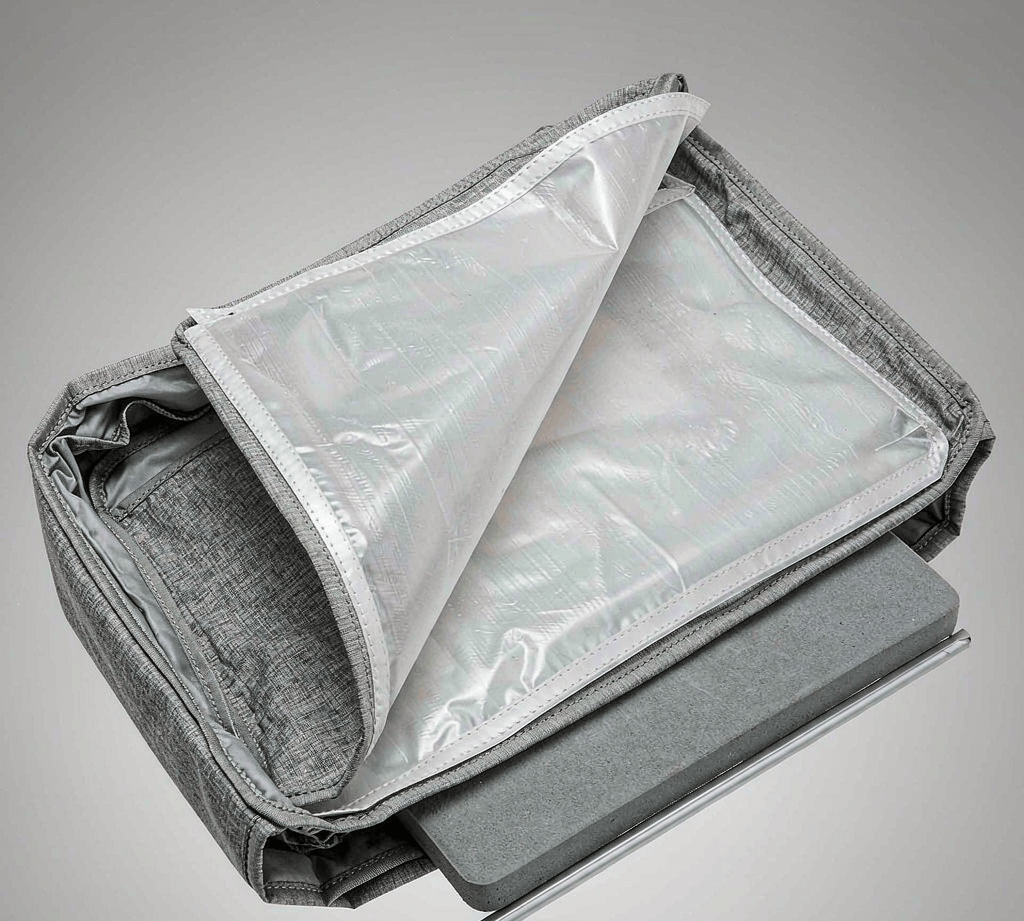
The same 1.0 mm PE sheet behaves completely differently in a back panel, a base and a side gusset.
Removable or enclosed? A sheet in a sleeved closure can be pulled out for washing, replacement or end-of-life sorting — relevant where brands must answer for recyclability. A fully enclosed insert never shifts or rattles, but it cannot be serviced and adds sewing operations.
How is it fixed? Floating inserts migrate. On a base board that shows up as a corner that no longer sits square; in a back panel it becomes a hard edge drifting into the wearer’s back. Tacking the insert at two or three points costs little and prevents most of it.
What is the allowance? The sleeve has to be cut larger than the insert — a couple of millimetres per dimension is normal — or the panel bows. Corners should be radiused, because a sharp insert corner telegraphs through the shell as a visible point within weeks. Thin shells show it sooner, which is why stiffener decisions belong with fabric denier and coating choices.
What belongs on the tech pack
A line that only says “PE board” invites guesswork. Spell out material, thickness, cut dimensions, corner radius, which face goes outward, the sleeve fabric, the fixing method, and whether it is removable. If the part is die-cut or moulded, note that the tool is a separate line item, for the reasons covered in tooling and mould costs.
Ask for the real insert in the first sample, not a substitute later; datasheet thickness is nominal, and an oversized sheet will not enter the drafted sleeve.
Failure modes that appear after approval
Creasing during flat packing is the most common: an insert that survived sampling gets folded once for a carton and never recovers. Cold-weather cracking appears in transit or in a winter market, and telegraphing shows up as hard lines through the shell. Migration and rattle show up in returns. Each is cheap to prevent at the pattern stage and expensive after a run, and most trace back to an attachment detail rather than the insert itself — the same territory as stress point reinforcement.
FAQ
How thick should a base board be? There is no universal figure — it depends on span, load and how flat the base must look. Thicker sheet is stiffer but heavier and cracks more readily when flexed, so sample two thicknesses in the same shell.
Do stiffeners add much weight? A base board plus a back panel insert often account for a noticeable share of an empty bag’s weight. EVA is heavier than PE or PP at equal rigidity, so lightweight programs lean towards PP or thin HDPE.
Why does the approved sample stand up but production units slouch? Check the insert first. Substituted thickness, a sleeve cut too tight, or an insert installed backwards all soften a panel while every visible dimension still measures correct.
Can the stiffener be removed for recycling? Only if designed that way. A sleeved insert with an accessible closure can be pulled out; a welded one cannot, which limits what a brand can honestly claim at end of life.
Related reading
Structural choices sit inside a wider sourcing decision about panels, capacity and carrying comfort — the backpack buying guide for brands covers how those pieces fit together for OEM programs. A panel that holds its shape also preserves the bag’s rated volume, which is why the bag capacity rating guide belongs in your spec sheet.
Buyers comparing suppliers can review our full bag catalog for OEM/ODM specs, materials, and MOQ.