When a brand sources backpacks through OEM or ODM production, the buying decision is controlled by five spec layers: material construction (fabric denier and coating), hardware grade, stitching tolerances (SPI and bartack), compliance documentation (REACH, OEKO-TEX, Prop 65), and production terms (MOQ and lead time). Define these before requesting quotes.
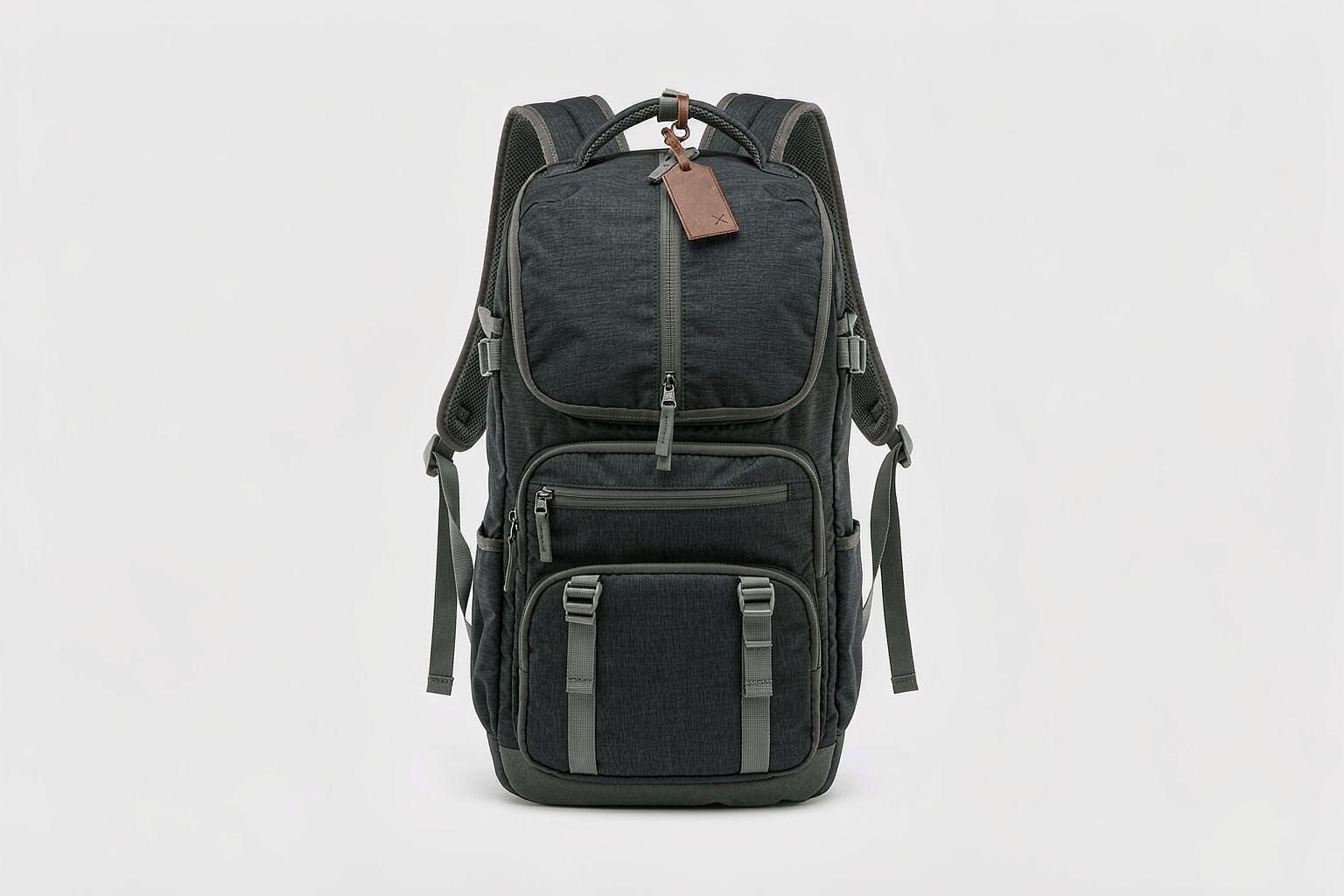
What Should a Backpack Tech Pack Include Before You Request Quotes?
A complete tech pack is the contract that stops a factory from guessing. For a backpack program it should contain five documents, and each one removes a class of dispute that otherwise surfaces at the final inspection.
- Construction drawings with tolerances of ±3 mm on panel dimensions and ±2 mm on strap length, so two factories cut the same shape.
- A bill of materials (BOM) that names fabric by spec — for example “600D polyester, 220 gsm, PU-coated” — rather than by color or by feel.
- Color standards referenced to Pantone TCX codes, with a ±1.5 ΔE acceptance window measured on a spectrophotometer.
- A hardware schedule listing zipper size, slider class, and buckle load rating, down to the puller shape.
- A packing spec: 0.04 mm polybag, 5-ply carton, and a carton gross-weight cap at 18 kg to protect freight handling.
Brands that ship a quantified tech pack typically cut sampling rounds from four to six down to one or two, which removes two to three weeks from the development calendar before a single unit is bulk-produced.
How Does a Backpack Buying Guide for Brands Reduce Sourcing Risk?
The difference between retail buying advice and a brand sourcing spec is accountability. A shopper asks “will I like it”; a brand asks “will 1,000 identical units pass inspection and clear customs.” A backpack buying guide for brands exists to convert vague preferences into measurable acceptance criteria that a quality team can enforce at the factory gate.
Written as numbers instead of adjectives, a spec makes sampling converge faster, defect rates predictable, and landed cost comparable, because two factories are finally describing the same product.
Which Fabric Denier and Coating Match Your Backpack’s Use Case?
Choosing fabric by the words “nylon” or “polyester” alone is the most common spec error a new brand makes, because those terms span a tenfold range in weight and price. Denier (D) measures filament weight; higher numbers mean heavier, more abrasion-resistant cloth. The table below maps use cases to a defensible starting spec.
| Use case | Recommended fabric | Denier / weight | Coating | Typical application |
|---|---|---|---|---|
| Everyday commuter | 600D polyester | 600D / 220 gsm | PU 0.15 mm | Panels, base |
| Performance / outdoor | 420D–840D nylon | 420–840D / 160–280 gsm | TPU or PU | Body, straps |
| Lightweight daypack | 210D ripstop nylon | 210D / 70 gsm | DWR finish | Body |
| Heavy-load trekking | 1000D nylon (Cordura-type) | 1000D / 340 gsm | PU back coat | Base, abrasion zones |
The coating decides water behavior. A PU (polyurethane) back-coat at 0.15 mm is the commuter baseline; a TPU (thermoplastic polyurethane) film weld resists hydrolysis better for humid-market programs. A DWR (durable water repellent) top finish beads surface water but is not a substitute for a coated interior. Specifying “600D polyester, PU 0.15 mm back-coat” is a sentence that prevents a factory from quietly shipping 420D to protect margin.
How Do Zipper and Hardware Grades Affect Durability and Unit Cost?
Hardware is where cheap backpacks fail first, and it is the easiest line for a factory to downgrade without the brand noticing. A #5 coil zipper from a tier-one maker is rated for roughly 1,000 open-close cycles; an unbranded equivalent often fails at 200–300 cycles, which is exactly the point where a customer’s zipper dies just past the return window.
- Zipper size and type: #3 for light pockets, #5 for main compartments, #8 or #10 for heavily loaded panels. Coil for flexibility, vislon (molded tooth) for load.
- Buckles: a specified side-release buckle rated to 22 kg (50 lb) holds a loaded hip belt; generic buckles commonly crack at 7–9 kg (15–20 lb).
- Webbing: 25 mm or 38 mm polypropylene with 1,200–1,800 N tensile strength for shoulder straps.
Each upgrade adds cents to the unit, but the failure-cost math runs the other way: one broken buckle on a 5,000-piece run is 5,000 potential returns. Name the brand class in the tech pack rather than leaving “as standard” open.
What Stitching Tolerances Separate a Quality Backpack From a Cheap One?
Stitch density and reinforcement are the quiet indicators of build quality, and they are fully specifiable. Main seams should run at 8–10 stitches per inch (SPI) using a lockstitch per ISO 4915:2018 type 301, which balances seam strength with the ability to stop a run if a thread breaks.
Bartacking is the second half of the story. Stress points — strap junctions, zipper ends, handle bases, and webbing loops — should carry 18–28 bartack stitches in a 10×20 mm area, applied in two to three rows. A pack built without bartacks at the shoulder-strap root will fail there first, typically after 15–25 kg of repeated load.
Two inspection checks catch most stitching problems early:
- Pull-test the strap root with a 20 kg dead weight for 30 seconds; the seam should not walk or show skipped stitches.
- Measure SPI on a 25 mm sample with a stitch counter; variance beyond ±1 SPI across panels signals inconsistent machine setup.
Which Compliance Certifications Does Your Market Actually Require?
Compliance is not a single certificate; it is a short list that depends on where the backpack is sold and who carries it. Specifying the wrong set wastes budget, while missing the right one can block a shipment at the border.
- European Union: REACH (EC 1907/2006) limits substances of very high concern to below 0.1% w/w; OEKO-TEX Standard 100 certifies skin-safe textiles (Class 1 for children’s items, Class 2 for adult skin contact).
- United States: California Prop 65 caps lead at 100 ppm in accessible parts and restricts phthalates to below 0.1%; children’s products additionally require CPSIA third-party testing.
- Factory management: ISO 9001:2015 signals a documented quality system; a BSCI or Sedex SMETA audit covers social compliance for most retail buyers.
A brand shipping adult commuter packs to Germany needs REACH and OEKO-TEX Class 2; the same pack aimed at US schoolchildren needs Prop 65 and CPSIA instead. Confirm the end-user age and destination before locking the certification line, and request the test report number, not just the logo.
How Do Factories Run Quality Control on a Backpack Order?
A credible production QC flow has three gates, and a brand should require evidence at each. The first article inspection (FAI) examines two to five completed units against the tech pack before bulk cutting. A during-production (DUPRO) check at roughly 20% completion catches line-setup drift — wrong SPI, misaligned panels — while it is still cheap to fix.
The final random inspection (FRI) is where the acceptance number is decided. Under ANSI/ASQ Z1.4, a batch of 1,200 pieces is inspected at general inspection level II, sampling plan 1.5, which calls for 80 units examined with an accept number of 7. The defect band matters as much as the count:
- Critical defects (safety, e.g., a sharp exposed fastener on a child’s pack) carry an accept number of zero.
- Major defects (functional, e.g., a misaligned zipper over 3 mm or a missing bartack) run at AQL 2.5.
- Minor defects (cosmetic, e.g., a stray thread) run at AQL 4.0.
Requesting “AQL 2.5 / 4.0, critical 0” in writing is one line that prevents a surprise at the dock.
What MOQ and Lead Time Should You Expect From an OEM Backpack Line?
Production terms are where negotiation reality sets in, and the ranges are tighter than many first-time brands expect. For a backpack, tooling is light — die-cut boards and a few sewing fixtures rather than injection molds — so minimum order quantities sit lower than for hard goods.
- OEM: 300–500 pieces per style per colorway is the typical floor, because below that the cutting and setup cost per unit stops making sense.
- ODM: 500–1,000 pieces, since the factory amortizes its existing mold and pattern library across your order.
Lead time for a first order runs 35–55 days: 7–10 days to source materials, 7 days for the pre-production (PP) sample, 20–30 days of bulk sewing, and 5–7 days for QC and packing before the goods are ex-factory. Repeat orders compress to 25–35 days because materials and the approved PP sample are already on file. Confirm whether the quote is EXW (ex-works, you handle freight) or FOB (free on board, factory handles to port), because that changes both the calendar and the Incoterms responsibility.
How to Compare Backpack Quotes Without Losing Spec Control
Two quotes at $6.50 and $7.20 per unit are not comparable until they describe the same backpack. Normalize them with a short checklist before you decide.
- Request a line-item breakdown: fabric cost per kg, hardware class, labor minutes per unit, overhead, and tooling amortization.
- Confirm the fabric spec matches your BOM exactly — “recycled 600D” and “virgin 600D” differ in both price and story.
- Verify the AQL level on each quote; AQL 4.0 is cheaper to pass than AQL 2.5 and shows up as a lower price.
- Check the certification scope: a quote that omits Prop 65 or REACH testing is not landed-cost complete.
The lowest number usually hides one of these variables; the quote that survives this normalization is the one you can reorder at the same quality next season.
Which Spec Mistakes Inflate Returns and Chargebacks?
Most post-launch pain traces back to a handful of omissions in the original spec, and each is preventable on paper.
- Underspecifying fabric as just “nylon” produces inconsistent batches where lot two feels thinner than lot one.
- Skipping the AQL level leaves “defective” undefined, so a 6% functional-defect rate becomes a dispute instead of a known risk.
- No Pantone reference lets color drift past 3 ΔE, which buyers/readers read as a different product.
- Waiving the FAI lets a setup error replicate across the whole run; one missed bartack pattern can mean 30% rework.
- Wrong certification for the market gets a container held at customs, with demurrage climbing daily.
Writing the spec once, with numbers, is cheaper than absorbing any one of these in volume.
If you need the baseline definitions first, What is a backpack covers them.
The step-by-step walkthrough lives in How to choose backpack.
Frequently Asked Questions
What MOQ should I expect for a custom OEM backpack?
Most factories set a floor of 300–500 pieces per style per colorway, because cutting and setup cost per unit stops being viable below that. ODM programs using the factory’s existing patterns typically start at 500–1,000 pieces.
How long does a first backpack order take from approval to ex-factory?
Plan for 35–55 days: 7–10 days to source materials, about 7 days for the PP sample, 20–30 days of bulk production, and 5–7 days for QC and packing. Repeat orders with materials and PP sample on file compress to 25–35 days.
Which certifications do I need for the EU versus the US?
For the EU, REACH (SVHC below 0.1% w/w) and OEKO-TEX Standard 100 (Class 2 for adult skin contact) are the baseline. For the US, California Prop 65 and, for children’s products, CPSIA third-party testing apply. Confirm end-user age and destination before locking the line.
What AQL level is standard for backpacks?
AQL 2.5 for major (functional) defects, AQL 4.0 for minor (cosmetic) defects, and an accept number of zero for critical (safety) defects, per ANSI/ASQ Z1.4. A batch of 1,200 pieces is typically sampled at 80 units.
How do I stop a factory from substituting cheaper materials?
Lock the fabric by spec and, where possible, by mill name in the tech pack, require a first article inspection on two to five units, and ask for third-party lab test reports referenced to the certification you specified. Unexpectedly low quotes are the early warning sign.
Should I choose OEM or ODM for my first backpack line?
Choose OEM if you already hold a design and a tech pack and want a factory to execute it. Choose ODM if you want to start from the factory’s existing molds and patterns and adjust them — faster to market, less control over the final silhouette.
Get a Custom Bag Quote
If you have a backpack design, a tech pack, or even a structured brief, the fastest next step is a manufacturability review against these same spec layers. Send your tech pack for a manufacturability review and a costed quote: Request a quote →
Related:
Buyers comparing suppliers can review our backpacks and laptop bags for OEM/ODM specs, materials, and MOQ.