Sourcing talks spend hours on fabric denier and hardware, then leave the seam undefined. The bag photographs well and comes apart at a strap root six months later — because every strap and panel hands its load to a few millimetres of thread that nobody specified.
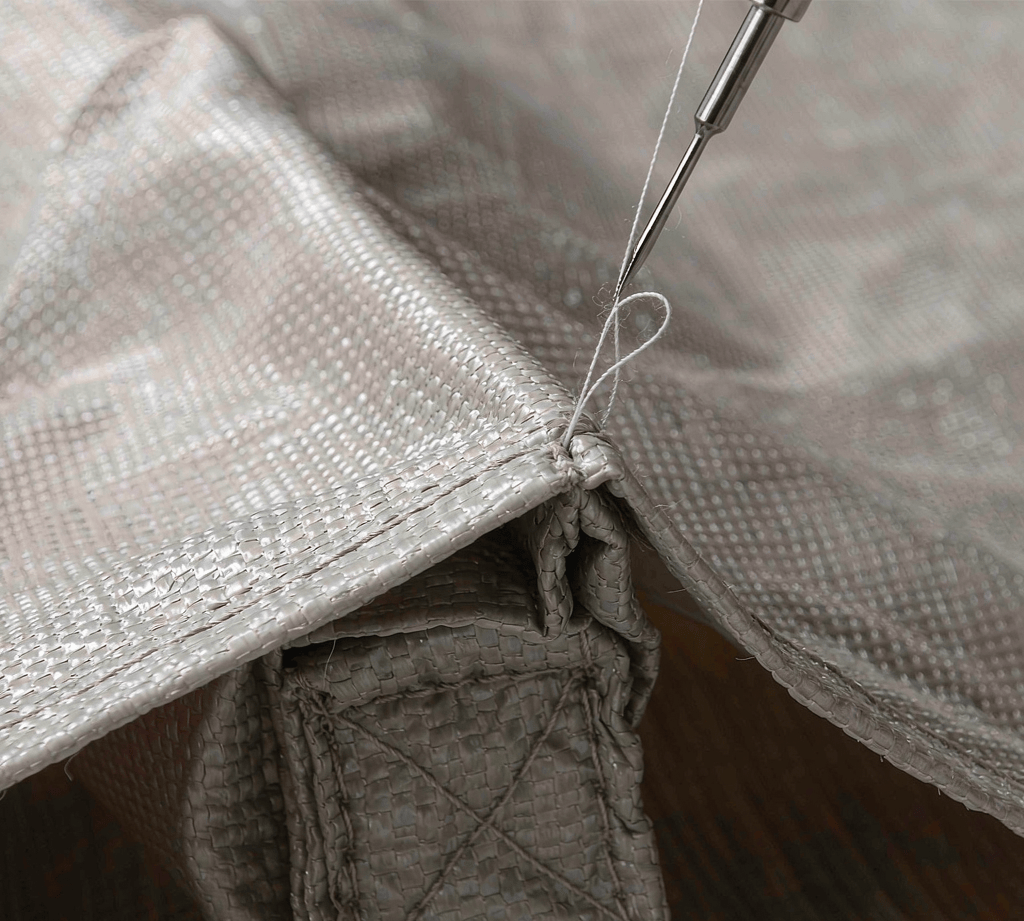
Thread material sets the ageing curve
Bonded nylon is the traditional workhorse: high tenacity, good abrasion resistance, and it lies flat along a seam. Its weakness is ultraviolet light and moisture — nylon loses strength under long sun exposure, which matters for anything stored outdoors.
Bonded polyester has slightly lower tenacity but holds up far better under UV and absorbs little water, so it is the safer default for outdoor, travel, and golf categories where a bag sits in direct sun for a season.
Spun and multifilament polyester are not interchangeable either: spun reads matte with less strength per ticket, multifilament is glossier and stronger. A sample that looks right but fails a pull test often fails here.
Handle seams are a good place to see this matter — our bag handle construction guide explains how stitch density keeps a carry loop from tearing free under load.
Ticket size, and why bigger is not better
Thread thickness is quoted as a ticket number or a Tex value, and casual usage runs the two in opposite directions — name the system you mean. In practice, light linings and webbing edges take the finest thread; main structural seams and handle attachments take the heaviest.
The mistake is specifying the heaviest thread everywhere. Too heavy for the needle, it skips stitches and frays at the eye; too light, it becomes the weak link in an over-built seam. Pair thread ticket with needle size on the tech pack — mismatch is a common cause of defects that never appear in hand-made samples.
Stitch density cuts both ways
Stitches per inch is the second number that rarely makes the spec. Too few and the seam grins open under load. Too many and you have perforated the fabric along a dotted line: every needle hole is a place where a coated shell can wick water, and on tightly woven high-denier fabric, dense stitching weakens the panel itself.
Heavier fabric and heavier thread want fewer stitches per inch; light linings want more. What matters is that the value is written down and re-checked after wash or abrasion testing — a seam that grins after laundering was under-stitched, not under-built.
Stitch type matters as much as the count
A plain lockstitch is the default for structural seams: balanced and secure, with little give under a sudden load along the seam line. A chainstitch stretches more and suits hems, binding, and some lining assembly, but a broken loop can unravel along the run, so it is not the default where the seam carries weight.
At handle roots, strap ends, and webbing junctions, the stitch doing the work is neither — it is a bartack or box-X tack, a dense block that spreads load into the panel instead of concentrating it on one seam line. Thread and stitch density are the mechanism; reinforcement geometry is the design. Neither works alone.
The extra bartacks that anchor a cut-proof strap’s internal cable are exactly the high-load stitches this spec covers — see our anti-theft bag features guide for where they belong in a tech pack.
Needles, coatings, and water resistance
Needle choice is invisible in the finished product and decisive in it. A cutting point slices coated fabric cleanly but leaves a larger hole; a round point separates yarns but can drag on tightly coated shells. Running fine needles fast through PU-coated fabric builds heat at the eye, glazing or breaking thread in a pattern that looks random on the line.
Every needle hole is also a potential leak path. If the product claims water resistance, choose the seam strategy deliberately: dense stitching plus seam tape, or a construction that avoids perforations in the critical area. Welded and taped construction trades stitch aesthetics for fewer holes, and that decision belongs on the spec sheet rather than in a post-production fix.
Go one step further and replace sewn panels with a molded shell and the cost structure shifts from labour to tooling, which is why bag tooling and mold costs get amortized over the whole program rather than one order.
What belongs on the spec sheet
Four lines cover most of it: thread material and ticket, needle size range, stitches per inch per fabric weight, and the stitch or tack type for each seam class. Flag any seam carrying a strap or handle, because those generate the complaints.
Two details prevent most sampling loops. Specify thread colour by a physical reference or standard code — three black threads on three fibres read as three different blacks, and the mismatch is obvious on a topstitched panel. And ask for a seam sample on the production fabric, since seam behaviour comes from the combination of thread, needle, and fabric, not any one alone. For a first program scoped end to end, the backpack buying guide for brands shows where seam specs sit among the other decisions.
FAQ
Polyester or nylon thread for bags?
Polyester is the safer default where bags see sun and weather: it holds strength under UV and absorbs little moisture. Bonded nylon carries more tenacity and abrasion resistance, and suits applications with limited UV exposure.
What stitches-per-inch value should I specify?
There is no single correct number. Specify a target band for each fabric weight rather than one global figure, then verify after wash or abrasion testing that the seam does not grin open.
Why does a sample pass a pull test but production fails?
Usually a needle-and-thread mismatch or inconsistent stitch density. Samples are sewn slower and with more attention than a line, so skipped stitches and thread glazing only appear at production speed.
Does higher stitch density make a bag stronger?
Up to a point. Past that, closely spaced holes perforate the fabric and weaken the panel, and on coated fabrics they create more paths for water to wick through the seam.
Buyers comparing suppliers can review our full bag catalog for OEM/ODM specs, materials, and MOQ.