A drawcord closure looks simple, but it is one of the most failure-prone details on a custom bag. The good news: the common problems are predictable, and they are fixed on the spec sheet, not the production line. If you source drawstring backpacks, gym bags, shoe bags, storage pouches, or bucket bags, the decisions below separate a closure that lasts from one that frays, slips, or tears out in the first month.
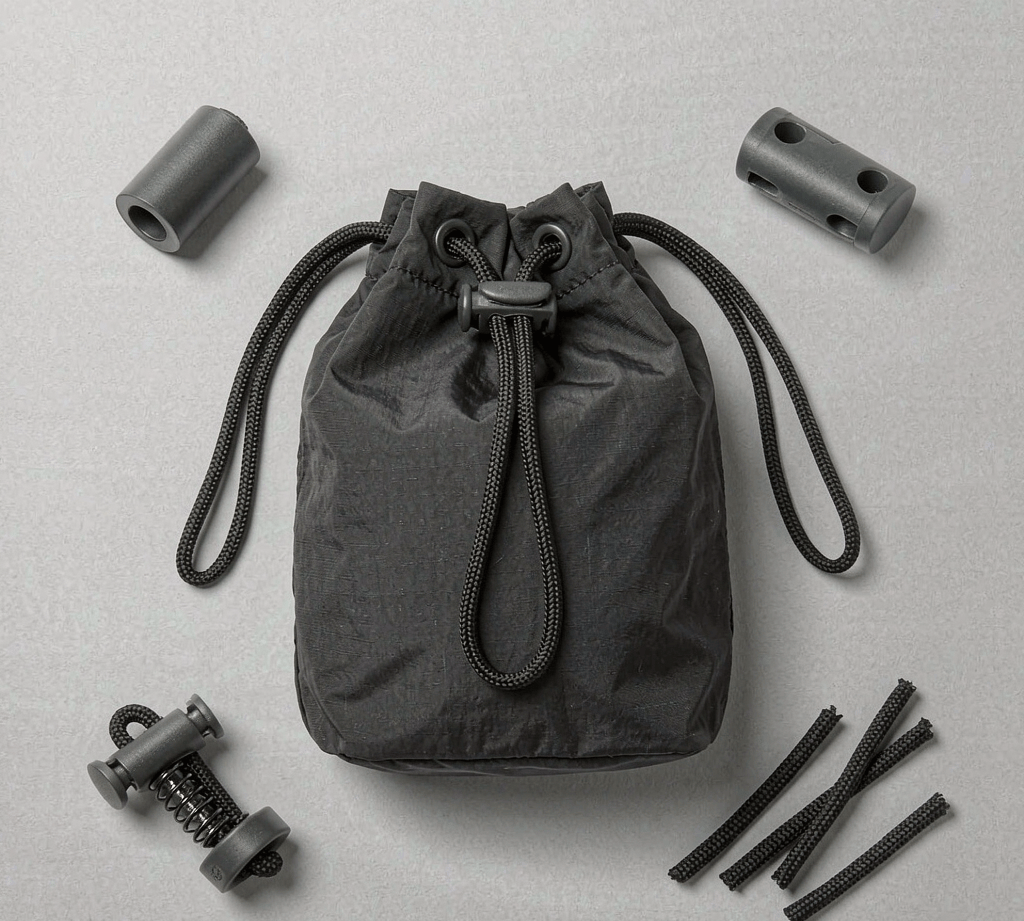 The cord that runs through those locks is typically elastic shock cord — our shock cord specification guide explains how to fix diameter, core, and stretch.
The four parts of a working drawcord closure
A drawcord system is not just a string and a lock. It has four parts, and a weak link in any one fails the whole closure:
- The cord — round elastic, flat woven, cotton, polyester, nylon rope, or paracord.
- The channel (casing) — the fabric tunnel the cord runs through.
- The grommet or eyelet — the reinforced ring where the cord exits the fabric.
- The stopper or cord lock — the part that grips the cord and holds the cinch.
Get the sizing wrong between these parts and you see the failures described later. For a broader look at closure choices, our guide to bag closure hardware compares cord locks with snaps, buckles, and hook-and-loop. For a removable quick-attach point, a carabiner clip is a common alternative to a fixed webbing loop.
Choosing the cord: material and diameter
Cord diameter is the master variable. Most standard plastic cord locks grip cords in the 3–6 mm range, so specify the cord first and match the lock to it.
- Round woven polyester — the default for promotional and gym drawstring bags: cheap, colorfast, easy to heat-seal.
- Cotton cord reads premium but absorbs water and frays if the tip is unfinished.
- Paracord or nylon rope suits outdoor and heavy-duty bags where the cinch carries load.
- Elastic cord is used where the opening should spring back, such as shoe and laundry bags.
Finished cord ends matter. Knotted ends are cheapest; heat-sealed (for synthetics) stop unraveling; metal tipping (aglets) gives a high-end feel and protects the cord at the grommet.
Picking the cord lock type
Three styles cover almost every bag:
- Single-hole barrel lock — compact, for lightweight pouches.
- Dual-hole flat lock — lets the cord pass through and back, common on drawstring backpacks.
- Spring-loaded toggle — grips the cord at any point and releases with a push.
Material is the next call. POM plastic locks are light, wash-safe, and cheap, but can go brittle in cold weather, so outdoor programs should ask for cold-impact tested parts. Zinc-alloy or brass metal locks read premium and carry more load, at the cost of weight and price. Either way, the lock’s grip range must match the cord diameter — a lock rated for 6 mm cord slips on a 3 mm cord. Cord locks belong with strap hardware like D-rings and triglides in the same spec mindset.
Where drawcord closures actually fail
Two failure modes cause nearly every return:
- Grommet tear-out. The eyelet pulls through lightweight fabric when the exit hole is too close to the seam or the grommet was sized by looks. Size it to the cord and keep it clear of the seam.
- Stopper slip. The lock slides on smooth cord because its grip range was rated for a thicker cord. This is why matching cord diameter to lock spec is non-negotiable.
Both are caught cheaply at the sample stage. Reinforcing the cord channel and its seam is the same logic used at bag stress points, where load concentrates.
Tech pack and sample test
Treat the drawcord as a row in the tech pack, not a mention: cord material, cord diameter, grommet inside-diameter, lock type and material, and attachment method. Then prove it on the pre-production sample.
A practical buyer-side check is a 100-opening wear test: run the cord through 100 full cinch-and-release cycles and watch where it frays and where the grommet sits. If the stopper drifts or the eyelet lifts, change the spec before bulk. The same webbing and strap specification discipline applies — measure first, then source the matching part.
FAQ
What size cord lock do I need for my drawstring bag?
Match the lock to your cord diameter, not the other way around. Most standard plastic cord locks grip cords roughly 3–6 mm thick, so specify the cord first, then pick a single-hole, dual-hole, or spring-toggle lock whose grip range covers that diameter.
How do you stop a drawstring from slipping?
Use a cord lock whose grip range matches the cord diameter, and size the grommet to the cord and set it away from the seam. A lock rated for thicker cord will slip on a thin cord — the most common cause of a drawstring that will not stay cinched.
What material are cord locks made of?
The two common choices are POM plastic and metal (zinc alloy or brass). Plastic is light, wash-safe, and cheap but can go brittle in cold weather; metal carries more load and looks premium but adds weight and cost. Outdoor programs should ask for cold-impact tested plastic parts.
How do you specify a drawcord in a tech pack?
Add a row with cord material, cord diameter, grommet inside-diameter, lock type and material, and attachment method. Then run a 100-opening wear test on the pre-production sample to confirm the cord does not fray and the grommet does not lift before approving bulk.
For a deeper look at backpack construction where drawcord cinch tops are common, see our backpack buying guide for brands.