The fastener is the part of a bag a customer touches dozens of times a day. When it feels cheap or fails after a few weeks, the whole product feels cheap — even if the fabric and stitching are excellent. For buyers placing a custom order, the closure is also one of the easiest specs to leave vague, and one of the most expensive to fix after production starts.
So does a hip belt buckle: rated load and release feel matter.
Most bags still rely on a zipper as the primary opening, and that decision deserves its own zipper hardware guide. But a large share of everyday and travel bags also use secondary fasteners: a magnetic snap on a flap, a side-release buckle on a strap, or a strip of hook-and-loop on an internal pocket. Each one carries a different load and fails in a different way.
Three closures you will actually specify
Magnetic snaps are the quiet workhorse of totes, wallets, and flap bags. A strong pair holds a flap closed through handling but releases with one hand. The number that matters is holding force, usually stated in grams or newtons. A light wallet flap may be fine at 300 g; a structured tote that carries weight in the flap wants 600 g or more.
Side-release buckles show up on straps, sling bags, and anything that needs to open in a hurry. They are rated in pounds of force (lbf) before the arms spread. For a bag that hangs from one shoulder, ask for the rating and then ask how it was tested — a buckle that passes on a tensile rig can still walk open if the webbing is cut too short.
Hook-and-loop (the generic name most buyers still say as one brand) is the cheapest adjustable closure and the one with the shortest life. Its spec is cycle count: how many open-close cycles before it loses half its grip. A pocket that opens a few times a week can live with 5,000 cycles; a strap adjuster that is fiddled with daily needs 20,000 or more.
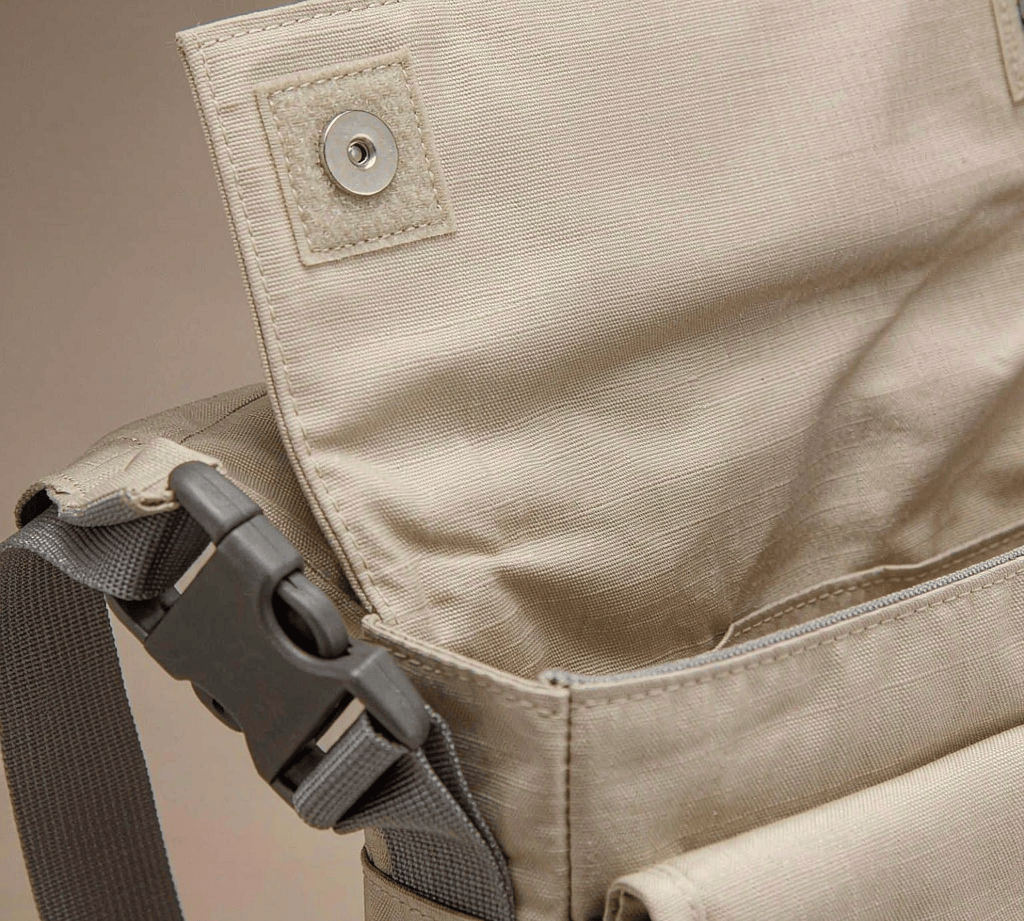
For light flaps where speed matters more than a lock, a magnetic closure gives a clean one-hand snap with no visible hardware.
Finish is a hardware decision, not an afterthought
A snap or buckle is only as good as its coating. Stamped steel parts rust if the plating is thin; cast hardware hides porosity that eats through finish from inside. The corrosion-resistant hardware guide walks through the plating and salt-spray grades worth specifying for outdoor and sports use. Even an indoor tote benefits from a clean nickel or matte finish that will not rub off on light fabric in the first month.
Push further and ask for an original buckle or puller shape and you move into new tooling, which is a fixed cost rather than a per-piece one — the trade-off is laid out in how bag tooling and mold costs work.
Zipper pulls are also a cheap place to add retroreflective trim, because the moving part catches a driver's eye. When a recycled claim covers the full bag, the zipper and buckle trims fall into scope as well — our guide to specifying recycled bag fabric explains which supplier certificates that requires.
Where production goes wrong
The closure part itself is rarely the failure. The failure is the anchor. A buckle sewn to webbing that is not backed, or a snap whose two halves are not aligned during assembly, lets the whole fastener pull free. That is the same stress-point logic that governs rivets and bar-tacks: the load has to spread into the panel, not hang on two threads. A pre-production sample should be pulled, not just looked at.
The cloth immediately beside a zipper track is one of the first places a shell scuffs through, so give it a rub-count minimum too; the methods are set out in what abrasion testing tells you about a fabric.
What to write on the purchase order
A useful closure spec has four lines: the type, the rated force or cycle count, the finish, and the anchor method. “Magnetic snap” is not a spec. “Magnetic snap, 600 g hold, matte nickel, sew-on with backing washer” is one the factory can actually build and the quality check can actually verify. Buyers who hand over those four lines get fewer surprises and far fewer returns.
FAQ
Do I need a rated closure for a light tote?
Not a high rating, but you still want a number. Even a 300 g magnetic snap beats “a strong one,” because “strong” means something different to every operator on the line.
Magnetic snap or buckle for a child’s bag?
Buckle, generally. A side-release buckle is harder to swallow and easier for small hands to operate than a snap that needs alignment. Avoid loose magnetic parts around very young children entirely.
How do I stop hook-and-loop from sounding like tearing paper?
Spec a softer-loop facing and a lower-profile hook side, and keep it away from the main opening where it gets yanked. The noise is mostly the hook density, which is a supplier choice you can request.
Can I mix closures on one bag?
Yes, and most good bags do. A zipper for security, a magnetic snap for speed, and hook-and-loop for an adjustable pocket is a normal, sensible combination — as long as each one has its own spec line.
Related reading
For a buyer-side view of how closures fit into a whole tote program, see the tote bag buying guide for private label.
Buyers comparing suppliers can review our full bag catalog for OEM/ODM specs, materials, and MOQ.