Buyers spend weeks on shell fabric, top dividers and strap padding, then accept whatever leg system the factory has on the shelf. That is backwards. On a carry bag the golf bag stand mechanism is the assembly most likely to come back as a warranty claim: it takes the full weight of a loaded bag every time the bag is set down, cycles thousands of times a season, and fails in ways users notice at once — legs that splay, a hinge that seizes, feet that crack on frozen ground.
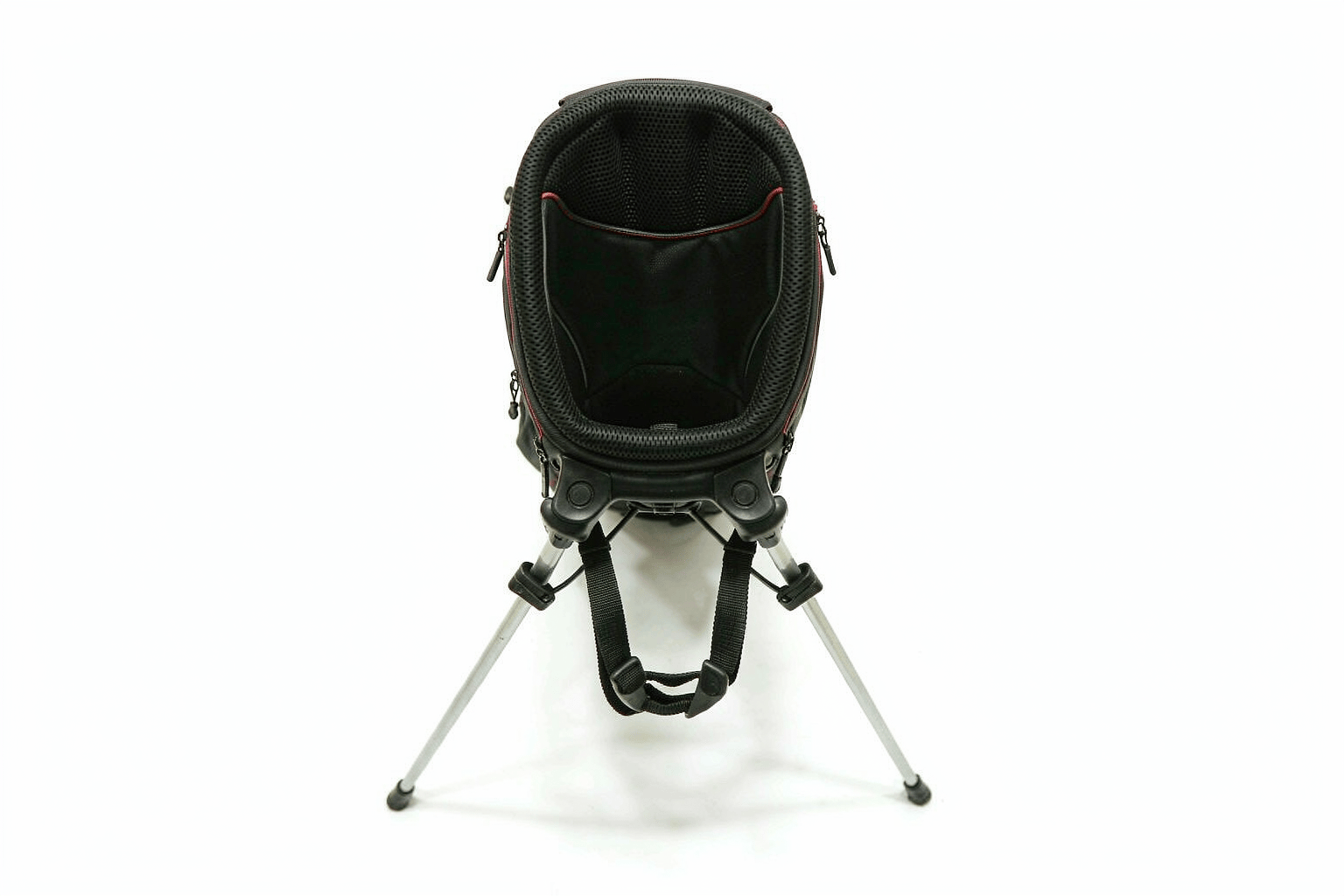
Two layouts dominate production
Spring-assisted, base-mounted. A torsion or compression spring near the base pushes the legs out once the bag tilts forward, pivoting on a bracket riveted to the base or a moulded spine. Cheap, few parts, easy to repair — but the spring rate has to match loaded weight. Too stiff and the bag pops open when you lift it; too soft and it will not hold on a slope.
Rod- or cable-actuated. A rod or cable runs from the base up to a pivot plate under the top collar, driving both legs out together when the bag tips. Deployment is more controlled and the legs stay matched over time, at the cost of more parts and tighter tolerances. Mid to premium programmes usually land here.
Single-post legs and scissor-style arms are riffs on these two ideas and inherit the same failure modes. Worth reading alongside the broader materials and construction choices for golf bags, since the stand has to work with the shell rather than against it.
Where the load actually goes
The legs carry the weight, but in a golf bag stand mechanism the part that fails first is almost always the mount.
- Top collar pivot. On rod-actuated systems the reaction force lands on a plate or moulding under the top collar. Screwed into a thin wall with no backing washer, the fixings pull through after repeated cycling.
- Base bracket. Spring systems put spring force and ground reaction on the same bracket. Rivets work loose here; a bracket bonded and riveted to a reinforced base moulding outlasts rivets alone.
- Leg-to-hinge joint. Legs swaged or riveted into a hinge casting develop play. Play becomes wobble, and wobble is what customers describe as “the stand feels cheap.”
Same problem seen elsewhere in bag construction, same fixes: backing plates, larger flanges, fixings sized for shear. The patterns are set out in how stress points get reinforced.
Leg material and feet
Legs are usually aluminium tube, fibreglass rod or moulded nylon. Aluminium is stiff and cheap but dents; fibreglass flexes and returns; moulded nylon holds entry-level cost yet creeps under sustained load.
Feet matter more than most specifications suggest. Hard nylon slips on wet turf and cracks in the cold, while a softer thermoplastic rubber compound grips and stays flexible — a small unit cost increase that pays off in any four-season market. Feet should also be replaceable, so a worn cap becomes a parts shipment instead of a whole-bag return.
Metal finish and corrosion
Every pivot component — rivets, springs, hinge plates — is metal, and it sits at the bottom of a bag that gets set down on wet grass. Specify the finish rather than accepting “stainless.” Springs in particular are commonly carbon steel with a plating that rusts once scratched. The trade-offs are covered in our hardware finishes and corrosion guide.
What to ask for in testing
Cycle testing a golf bag stand mechanism is cheap and tells you most of what you need. A fair starting benchmark is several thousand open-and-close cycles under realistic load, plus a static load test with the bag full and set down on a slope.
Ask the factory to report: cycles completed before visible play at the leg-to-hinge joint; whether legs still deploy and retract fully afterwards; whether static load is held without permanent splay; and foot condition after cold cycling if the bag sells into cold climates.
Sourcing notes
The stand assembly often comes from a sub-supplier rather than being made in-house, so the factory may have little room to change spring rate or hinge geometry without a tooling conversation. A non-standard deployment angle, a custom leg length or a branded hinge cover pulls tooling and mould cost into the quotation, and that mould stays tied to your programme.
Agree spares before the goods ship: feet, springs and rivets at two to three percent of unit quantity as service stock costs little and removes the most common reason a retail partner returns whole bags. Still weighing the direction? Stand bag vs cart bag lays out the buyer-side trade-offs.
FAQ
How many open/close cycles should a golf bag stand mechanism survive?
No universal standard exists, but several thousand cycles under realistic loaded weight is a fair expectation for a retail bag. Always ask what load was used — an unloaded test proves very little.
Why do the legs splay after a season?
Usually play at the leg-to-hinge joint or a spring that has lost rate, not bent legs. Once play appears, the geometry shifts and the feet land further apart.
Can the deployment angle be changed?
Sometimes. Rod-actuated systems set the angle through pivot plate geometry, which means tooling. Spring systems are often tunable by changing spring rate or bracket position.
What does sensible spare parts stock look like?
Feet, springs and hinge rivets at roughly two to three percent of order quantity is a common starting point for a retail programme.
Buyers comparing suppliers can review our golf bags for OEM/ODM specs, materials, and MOQ.