Ask three suppliers whether a bag is waterproof and you get three answers that do not match. Not because anyone is hiding something, but because one word is standing in for four decisions: what the shell does with water on its surface, what barrier sits behind it, how panels are joined, and how openings close. Buyers who spell those out get quotes they can compare.
A DWR finish slows soaking but is not a seal; for true closure waterproofing, specify a sealed waterproof zipper rather than relying on fabric treatment alone.
Three words used for four things
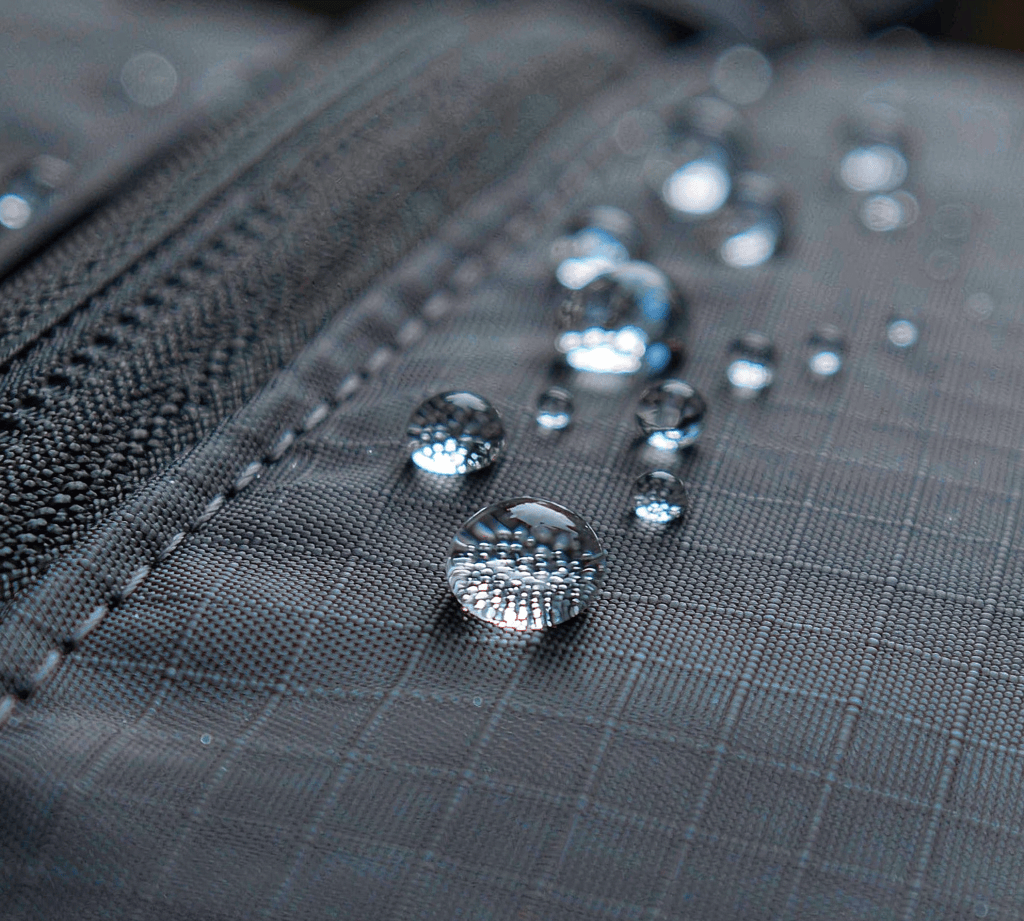
Water-repellent describes a surface behaviour. Beads form and roll off, but the fabric is not a barrier — press on it or rub it against a strap and it wets out. For sustained rain, an external bag rain cover adds a second waterproof layer over the zippers and open top.
Water-resistant is a fabric claim. A coating or laminate resists penetration for a defined exposure, and that can be given a number.
Waterproof, on a finished bag, is a system claim: barrier plus sealed seams plus closures that do not wick. A cut-and-sewn panel with a standard coil zipper is not that, whatever the shell fabric is rated.
The finish, and the spray number behind it
Beading comes from a durable water repellent finish on the face of the fabric, which lowers surface energy so water pulls into droplets instead of spreading.
It is measured with a spray test — AATCC 22 in the US system, ISO 4920 internationally. A fixed volume of water falls through a nozzle onto fabric mounted at an angle, and the wetted pattern is compared to reference standards. Results come back on a 0–100 scale in set steps: 0, 50, 70, 80, 90, 100. A 100 means the face stayed dry; a 0 means it soaked completely.
Two habits make that number useful. Ask for the rating after laundering rather than as received — a fresh finish nearly always starts at 90 or 100, and what matters is where it sits after five wash cycles. And remember that heat reactivates a finish: when a retailer says the beading died, it is often a dirty or unactivated finish, not a worn-out one.
The barrier, and why millimetres are not the whole story
Beading only buys time. Behind the finish, a coating or laminated membrane is what stops water under pressure. That is measured as hydrostatic head — a column of water raised against the fabric until droplets appear on the far side. AATCC 127 and ISO 811 describe the method; the result is reported in millimetres.
Outdoor specs commonly treat around 1,000–1,500 mm as the point where a fabric earns the word waterproof, with daypack and travel shells frequently specified in the 600–3,000 mm band and ground-contact panels going higher. Read those as working ranges, not rules: the test runs on flat fabric, while a panel stretched over an internal frame or folded at a corner behaves differently. Coating weight and head move together but are not the same variable — more on that in our breakdown of fabric denier and coating choices.
Where bags actually let water in
The failure is rarely mid-panel. It is the needle holes along every seam, zipper tape wicking moisture inward, and the base losing finish each time the bag is set on concrete. Seam treatment — tape, weld or bound construction — is a separate line item from the fabric, and the options are set out in our piece on welded seams and waterproof construction. Closures matter just as much: water-resistant tape and a covered garage change the outcome more than another 1,000 mm of coating, as covered in the zipper and hardware guide. Since a worn base loses finish first, pair this with the abrasion testing methods used to predict that wear.
What changes with PFAS-free finishes
More briefs now require a C0, PFAS-free finish. The profile is different: these chemistries bead well when new but tend to wet out sooner under abrasion, and resist oils less. So a spray rating that looks fine on a fresh sample may drop faster in service. Specify the after-laundering rating a step more conservatively, and treat periodic re-treatment as part of the product’s life rather than a defect.
Four lines that belong in the tech pack
- Shell: fabric, denier, coating or laminate type, hydrostatic head in mm, test method.
- Finish: repellent type including any PFAS-free requirement, plus the spray rating required after a stated number of wash cycles.
- Seams: which seams are taped, welded or bound — “all seams” and “critical seams” quote very differently.
- Closures: zipper type, tape treatment, and whether the finished bag must pass a shower test as a complete item.
FAQ
Is 1,500 mm hydrostatic head enough for a backpack?
For most shoulder-season rain, yes. Below that, the bag wets through under sustained pressure from a strap or a loaded panel. Above roughly 3,000 mm, the money usually buys less than fixing seams and zippers would.
Does a high spray rating mean the bag will not leak?
No. The spray test only scores the face finish. It says nothing about water passing through under load, or entering at a seam or closure.
Can a lost finish be brought back?
Often, yes. Wash off dirt and body oils, then apply low heat — a short tumble or a warm iron — which reorients the finish. If beading still does not return, a spray-on or wash-in re-treatment is next.
Do taped seams matter if the fabric is already waterproof?
Usually yes. Every needle hole is a path, and the base and lower side panels are exactly where water pools.
Related reading
Water behaviour is one input among many when shortlisting shell materials; the wider trade-offs are covered in how to choose bag material.
Buyers comparing suppliers can review our full bag catalog for OEM/ODM specs, materials, and MOQ.