Most soft goods are built by cutting flat panels and sewing them together. That fails the moment a product needs a three-dimensional curve that fabric will not hold on its own — a helmet dome, a camera body pocket, a golf bag top cuff. Molded EVA is the usual answer, and it behaves very differently from the flat foam most buyers specify.
What EVA is doing in a bag
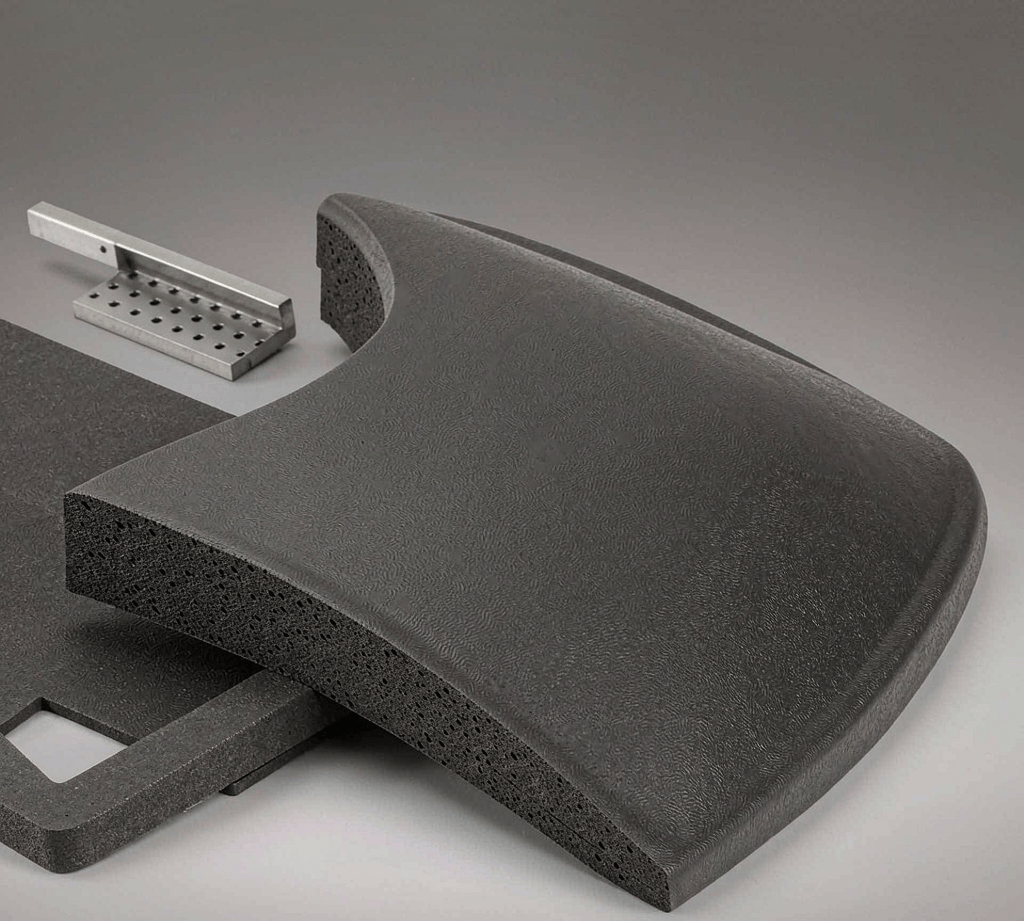
EVA (ethylene-vinyl acetate) is a closed-cell foam supplied in sheets: light, non-absorbent, heat-pressable into a fixed shape, and slow to recover after compression. Those traits explain most of its uses in bags — padding that must not soak up rain, shells that survive being crushed in transit, parts that hold a curve without a frame. Sunlight and heat also drive polymer breakdown in molded shells over time, so pair this with the fabric-side UV spec in UV resistance in bag fabrics.
The vinyl acetate content changes how rubbery it feels. Higher VA gives a softer, more elastic foam; lower content behaves closer to a rigid plastic.
Three forms, three cost structures
- Die-cut flat sheet. Cut from a standard sheet with a steel rule die, then laminated or slipped into a fabric sleeve. Cheapest per piece, but only flat or gently curved.
- Compression-molded shell. A heated sheet pressed in an aluminium mold into a three-dimensional shape. This is what gives a bag a rigid front panel or a domed lid.
- Thermoformed. A heated sheet pulled over a mold by vacuum. Shallower draws and thinner walls, usually cheaper tooling.
The jump from the first to the second is where budget and lead time change most, so decide early rather than after the first sample comes back flat.
The numbers that actually matter
Four specifications drive how a shell performs, and they are routinely left out of tech packs:
- Density. Low-density foam is light and soft; high-density foam resists crushing and holds a sharper edge.
- Hardness. Usually quoted on a Shore C (or Asker C) scale. Softer grades cushion; harder grades act almost like a plastic shell.
- Thickness. Controls both protection and how bulky the bag looks. Thicker is not automatically better — thick walls on a small mold round off detail.
- Draft angle. A mold needs a slight taper so the part releases. Vertical or undercut walls will not come out, which is the most common reason a first drawing gets redrawn.
If you are weighing foam choices more broadly, the trade-offs are covered in our foam padding specs guide.
What the tooling bill is really for
A compression mold is machined aluminium: two heated halves, sometimes with several cavities so multiple parts come out per cycle. You pay for machining time, cavity count and revisions once the first shot reveals a thin spot.
Because tooling is a one-off cost, it only makes sense above a certain volume. Below that, a die-cut laminate or a frame sheet gives you most of the stiffness for a fraction of the setup. Our breakdown of tooling and mold costs covers how that break-even point is calculated.
Cheaper resin or plaster molds exist for prototypes. Fine for a fitting sample, a bad idea for production: they wear quickly and drift out of tolerance.
Where molded EVA is the wrong choice
Molded shells are not automatically the premium option. They lose on three counts:
- Weight at large sizes. A full EVA shell on a big duffel can outweigh a fabric-plus-PE-board build doing the same job.
- Repair. A cracked shell usually means replacing the whole panel, while a sewn structure can often be repaired.
- Detail fidelity. Sharp corners soften as the foam expands. Injection-molded plastic wins here, at much higher tooling cost.
For a lid that only needs to hold its shape, a stiffener plus fabric is often better value — a point that comes up in capacity and volume planning, because a thick shell eats internal space.
Failure modes that reach the customer
The complaints that come back from the field are consistent:
- Shrinkage after molding. The part keeps moving for a day or two; assembling too early leaves gaps at the binding.
- Delamination. Fabric laminated to the shell lifts at the edges, usually because the adhesive was not rated for the flex in use.
- Cold-weather cracking. Some grades stiffen noticeably at low temperatures, worth testing if the product ships to cold climates.
- Odour. Low-grade foam can off-gas. It is a real return reason, not a cosmetic one.
What to write in the tech pack
Specify shape, density, hardness, thickness and surface finish, and say whether the part is laminated to fabric or left as a visible shell. Note the draft allowance and the tolerance on wall thickness. Add one line on who pays if the mold needs a second revision.
Material selection sits alongside the outer fabric and lining decisions described in how to choose the right bag material.
FAQ
How many units justify a compression mold?
There is no universal threshold. Compare the tooling cost against the per-piece saving and the units you can realistically sell in two seasons. Below a few hundred pieces per style, a die-cut laminate is the safer call.
Can a molded shell be recycled with the rest of the bag?
Not easily. EVA is thermoplastic and can in principle be reprocessed, but a shell laminated to fabric and adhesive is a mixed material most streams will not separate.
Why did the first sample come back a slightly different colour?
EVA takes colour from a masterbatch and the surface finish changes how light reads it. Approve a physical swatch, not a Pantone reference alone.