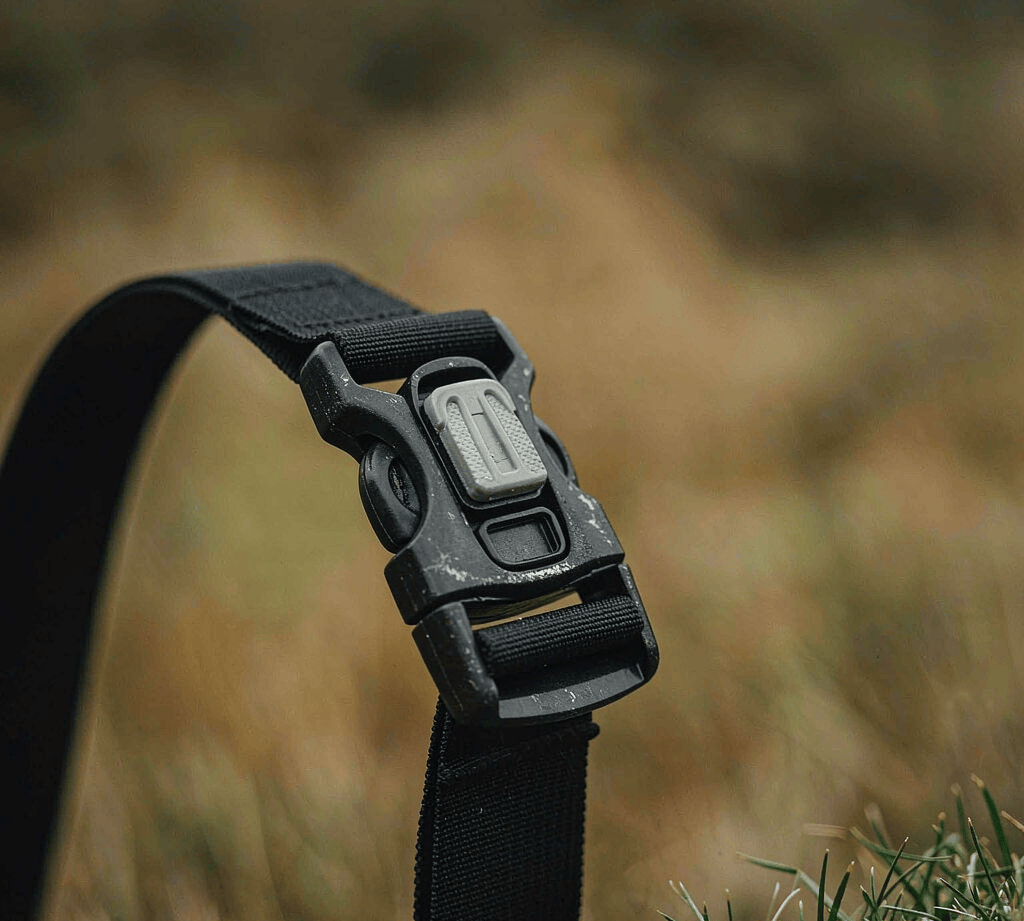
A side release buckle is the two-piece clip you squeeze to open — the fastener on most backpacks, waist belts, pet gear and outdoor straps. When a factory quotes “a buckle” for your custom bag, that single word hides three decisions that decide whether the strap holds, slips, or cracks in the field. The short answer: specify the material, match the buckle to your webbing width, and ask for a breaking-strength number tied to a test method. Get those right and returns drop; skip them and you find out at the complaint stage.
Beyond fixed buckles, gear loops and daisy chains give users movable clip points. Our guide covers the spec. On flaps and fronts a turn-lock closure gives a more secure alternative to a buckle.
POM plastic or metal — pick by load, not by habit
Most everyday buckles are molded from POM (polyacetal, also called acetal). It is light, cheap, and survives tens of thousands of open-close cycles without losing its click. A standard 25 mm (1 inch) POM side release buckle typically breaks somewhere around 70–90 kg (150–200 lb) in supplier pull tests. That covers daypacks, sling straps and most pet collars.
Metal buckles — zinc alloy, aluminum, or steel — start higher and go much further, with zinc versions often rated 140–230 kg and forged aluminum or steel well beyond that. They are the choice for tactical, harness-adjacent, or heavy tie-down use. The trade-off is weight, cost, and corrosion: zinc needs plating or powder coat, while stainless or anodized aluminum shrug off salt spray.
One catch buyers miss: POM goes brittle under long UV exposure and below freezing. If your bag lives outdoors year-round or ships to sub-zero markets, plan for that or move to metal.
Match the buckle to your webbing width
Buckles are sized to webbing, not to bags. Common slots are 20, 25, 38 and 50 mm. The slot should sit about 0.5–1.0 mm wider than your strap’s flat width — a 25 mm webbing wants a 25.5–26.0 mm slot. Oversize the slot by more than ~2 mm and the webbing folds and slips; undersize it and the strap will not thread. Because this depends entirely on your strap spec, lock the two together early — see our notes on webbing and strap specifications before you finalize hardware. The same care applies to a bag’s telescoping handle, where tube material and lock type decide daily reliability.
Breaking strength versus working load
Suppliers quote a single “kg breaking” figure, but that is the point of catastrophic failure in a lab pull, not the safe everyday load. A common rule of thumb is to treat the working load as roughly one-fifth of the breaking strength for dynamic loads. So a 20 kg loaded pack wants a buckle rated well above 100 kg breaking, not one that merely “holds 20 kg.” Always ask which test method produced the number (static pull, repeated cycle, side-load) — a bare figure with no method is a red flag.
Custom molding, tooling and MOQ
If you want a buckle with your logo, a unique shape, or a specific tactile click, that is a custom injection-molded part. Tooling typically runs a few thousand dollars and opens a minimum order in the 5,000–10,000 unit range, with lead times around 25–35 days before mass production. That timing sits on top of your bag’s own tooling, so plan it into the calendar — our breakdown of bag tooling and mold costs shows how hardware tooling stacks against panel and logo molds.
Compliance you may be asked about
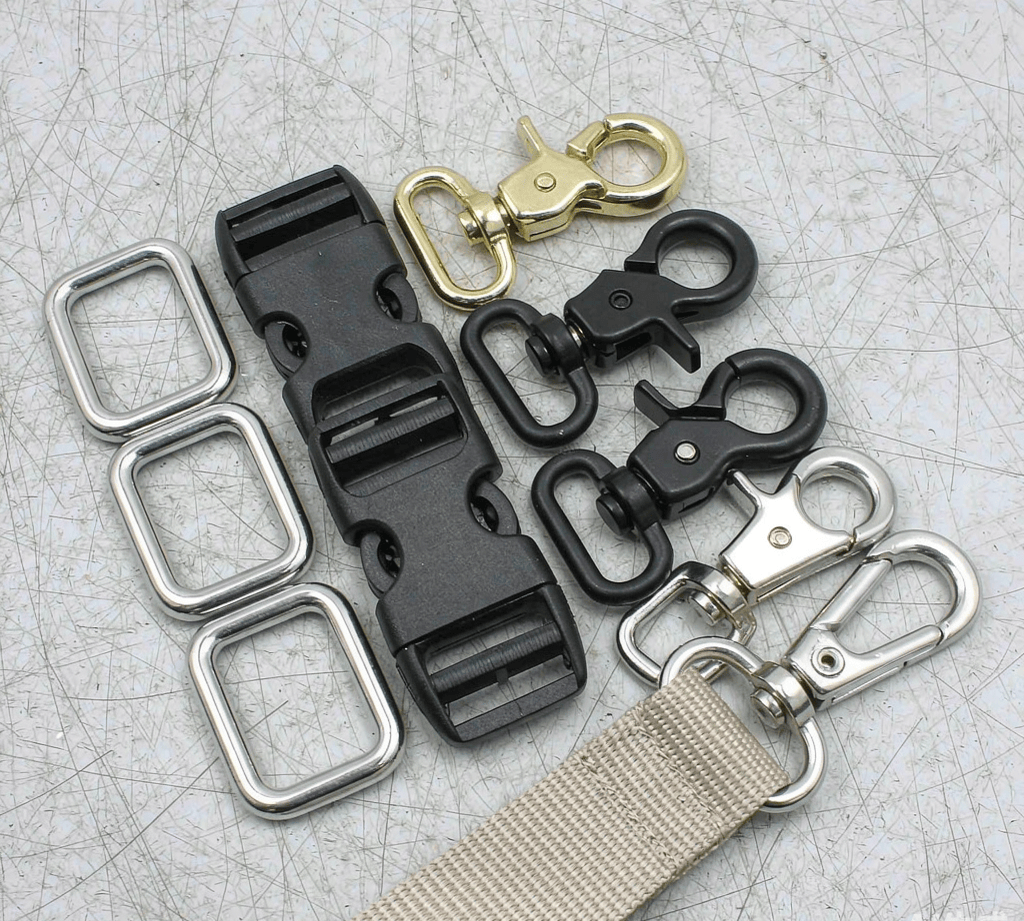
For the EU and North American market, metal buckles draw scrutiny on heavy-metal content: lead and cadmium limits under REACH and RoHS sit at 100 ppm. POM itself is generally clean, but any plating or alloy does not get a free pass. If your distributor requests documentation, ask the factory for test reports at the quotation stage rather than after shipment. The same care applies to strap hardware connectors and finishes and to riveted joints elsewhere on the bag.
FAQ
What is the difference between a side-release buckle and a cam buckle?
A side-release buckle uses a spring clip you squeeze to detach — ideal for straps you open often, like backpack belts. A cam buckle grips webbing with a pivoting bar for continuous tension and is used for load securing, not quick release.
Can I use a plastic buckle for heavy loads?
Sometimes. A 25 mm POM buckle handles typical daypack loads, but for loads near its limit, repeated shock, or cold climates, move to metal. Match the rated breaking strength to about five times your expected working load.
How do I specify a buckle in a tech pack?
List material (POM or alloy), slot width in mm, overall size, color or Pantone, any logo, required breaking strength with test method, and compliance needs (REACH/RoHS). Pair it with the exact webbing width so the two are validated together.
Do buckles need certification?
Not usually for general bags, but safety-adjacent or child-related products may. For standard consumer bags, supplier pull-test reports and material compliance declarations are what buyers and distributors actually ask for.
Wrapping up
Buckles look like a minor part until one fails. Treat them as a spec, not an afterthought: material by load, slot by webbing, strength by test method, and tooling by volume. For the full picture on choosing every piece of hardware on a custom bag, our guide to specifying bag hardware and zippers walks through pulls, sliders and rivets end to end. A trolley sleeve on a travel backpack usually closes with this same style of clip to hold the bag on a rolling case handle.