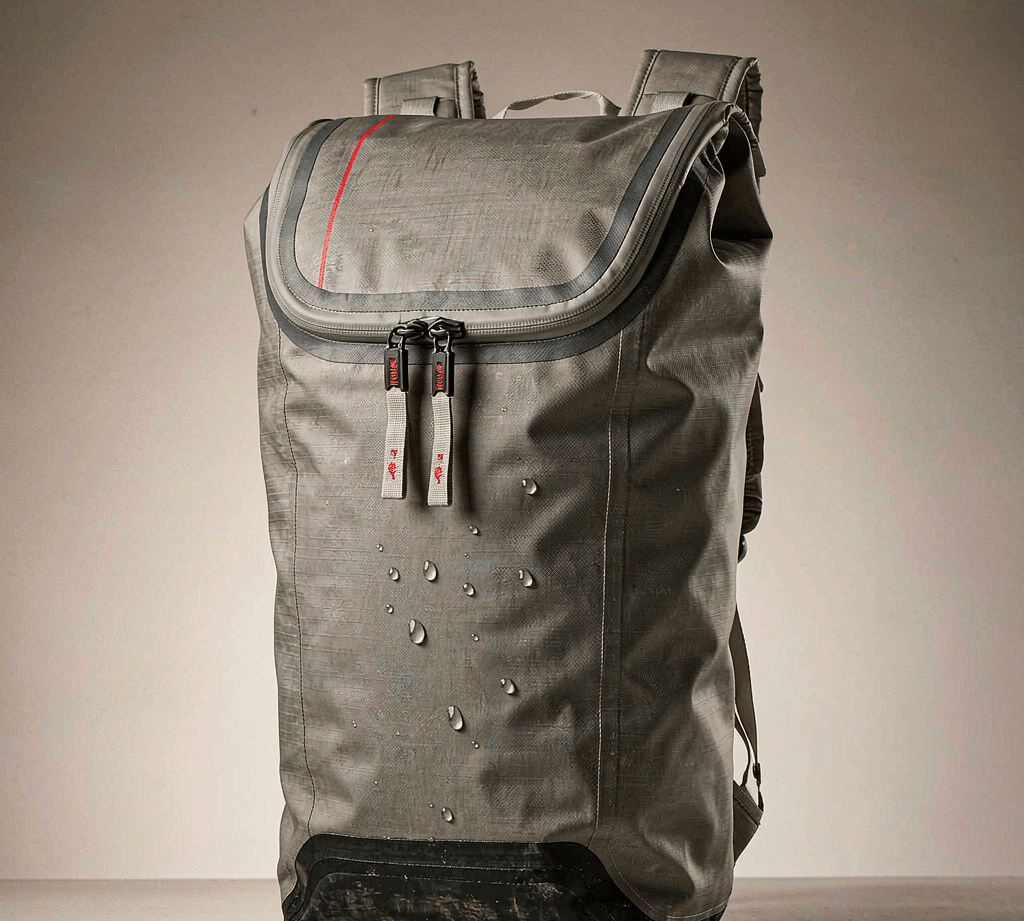
A storm flap is the strip of fabric that folds over a bag’s main zipper so rain runs off instead of into the teeth. In a tech pack it comes down to three numbers — overlap width, drop length and clearance — plus one decision: sewn or welded. Buyers who specify those four items avoid the most common cause of a “waterproof” bag leaking at the zip.
Why the zipper is the weak point
On a coated bag the fabric is sealed. The zipper cannot be, because it has to open. Coil zippers let water sit in the channel, and the slider plus the gap between teeth give it a path inward. A flap works by covering that path and steering water to the sides.
The slider is only half the story. The tab a user grabs thousands of times should be specified too — a custom zipper pull tab sets its material, logo, and finish in the same tech pack.
That is why two bags with the same shell can behave very differently in rain. The fabric passes the test; the closure does not. The coating side is explained in water-repellency ratings, and the zip itself in waterproof zipper spec.
The three numbers to write down
Overlap width. How far the flap extends past the zipper. A common production range is 20–35 mm on the visible face. Narrower and wind-driven rain finds the gap; much wider and the flap curls and snags.
Drop length. The flap should hang low enough that water leaves it below the teeth rather than beside them. For a vertical zip, aim for 15–25 mm of drop past the base of the slider.
Clearance. The gap between flap and zipper must be small enough to shed water but large enough that the slider does not catch. Test with the bag loaded, not empty — a full bag distorts the panel and closes the gap.
State all three with tolerances, not as single values. A flap graded at “25 mm” with no tolerance will pass some lots and fail others.
Fabric and coating
The flap should match the shell for colour and hand-feel, but it does not need the same weight. A 420D PU-coated nylon flap over a 1000D shell stays supple enough to fold. Heavier flaps hold their shape but crease, and a crease line becomes a wear line.
If the shell is laminated, a weldable film lets the flap be joined without stitch holes. If the shell is a coated woven, a sewn flap with a taped underside is often the cheaper route.
Sewn or welded
A sewn flap is faster and cheaper but leaves needle holes, so it needs a seal or tape behind the stitch line to stay dry. A welded flap has no holes and suits bags rated to sit in standing water, but it needs a weldable substrate and a factory with a hot-air or RF welder.
A sewn storm flap still leaks along the stitch line unless the seam is sealed, so most waterproof builds add a heat-taped seam over the rows — see our guide to specifying heat-taped seams for the tape and temperature detail.
The trade-off is the same one covered in welded versus sewn waterproof bags. Pick the method the factory can actually run at your volume, not the one that looks best on a single sample.
For bags where the whole opening is rolled shut, a flap is often replaced by a roll-top closure — a different answer to the same water problem.
Where storm flaps fail
Three failures show up repeatedly in inspections:
- The flap is stitched only at the top and bottom, so the middle lifts and lets water in.
- The overlap is measured flat, then shrinks after coating or washing.
- The flap is treated as decoration, with no tolerance line in the spec.
All three are spec problems, not factory problems. One line in the tech pack — overlap value plus tolerance — removes most of them. To see how details like this get documented, read the tech pack guide.
FAQ
Does a storm flap make a bag waterproof?
No. It manages water at the zipper. A bag is only as dry as its weakest seam, coating and closure together.
Is a wider flap always better?
No. Past roughly 35 mm the flap tends to curl and catch. Match the overlap to the zip size and the bag’s use.
Can a flap be added to an existing design?
Usually yes, if the panel has room for the extra fold and the factory can re-cut the pattern. Expect a revised sample before approval.
Do flaps work on curved zippers?
They can, but the overlap has to be graded along the curve. Straight zips are far easier to hold in production.
Should the flap be lined?
Only if the shell’s back face is rough or the flap needs stiffness. A lining adds weight and one more fold line to control.
Bottom line
Treat the storm flap as a measured feature, not trim. Write the overlap, drop and clearance with tolerances, choose sewn or welded to match the factory, and the zipper stops being the leak point on your next order.