A backpack’s back panel is the one surface that sits against the wearer for hours, and a flat foam slab turns that contact zone into a heat and sweat trap. For buyers sourcing custom backpacks, the difference between a “mesh back” that merely looks breathable and one that actually ventilates comes down to three lines in the tech pack: the mesh type, the channel geometry, and the foam density. Get those right and comfort complaints drop; skip them and you ship a sauna.
Why the panel drives comfort complaints
Most carry-comfort issues are not the straps — they are the back panel. When a pack presses a solid foam slab against the spine, heat and moisture have nowhere to go. A ventilated design reduces that contact area and opens air paths so convection carries heat away as the wearer walks. This matters most for sports, commuting, and travel packs carried in warm conditions, where trapped sweat quickly becomes a return reason.
Two ventilation architectures
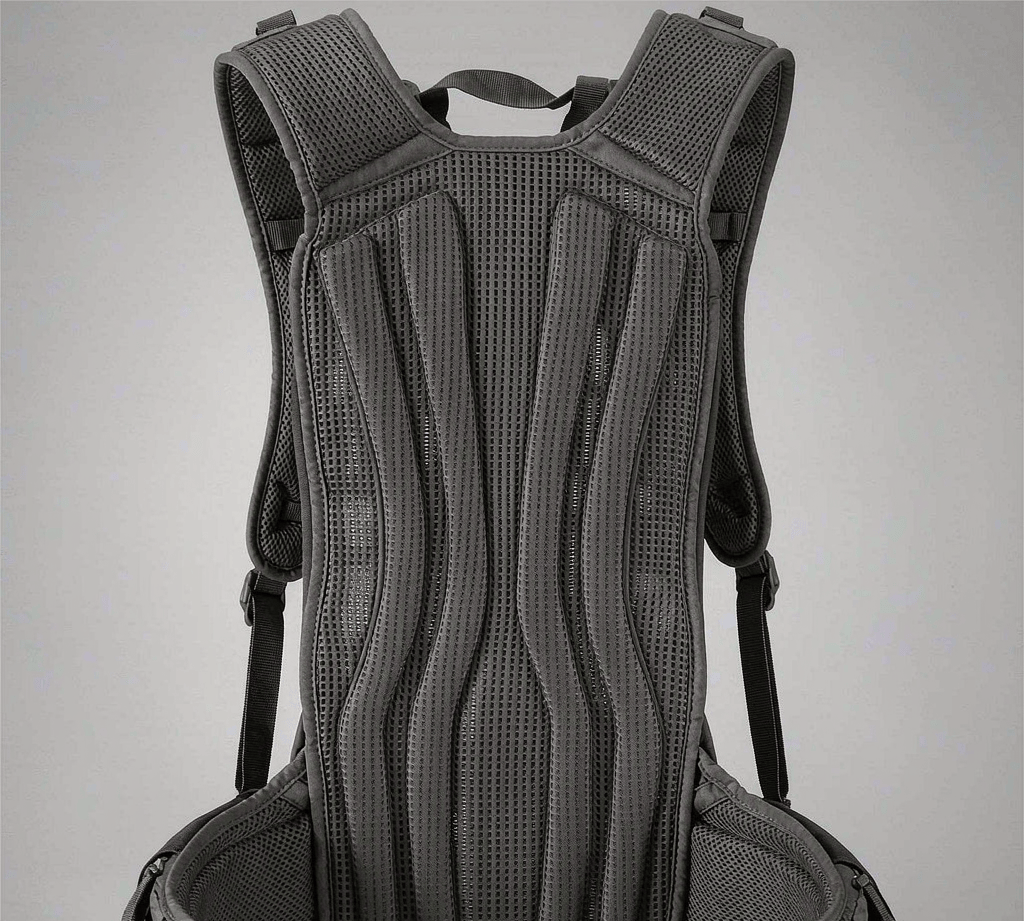
Channel systems carve grooves into a foam back panel. Air moves vertically through the valleys between raised foam ribs. This is cost-effective and stable under load, which is why it dominates gym and urban daypacks.
Suspended mesh stretches a tensioned 3D spacer mesh across a frame, opening a real cavity behind the back. It ventilates better than channels but can feel less planted with heavy, awkward loads. Premium hiking and running packs use this approach.
What to put in the tech pack
- Mesh specification. Specify 3D spacer mesh, not flat single-layer mesh. Ask for a compression-resistance range of about 2–4 kPa so the mesh holds loft under the bag’s weight. Note the GSM; medium spacer mesh around 350–500 gsm suits most travel and everyday packs.
- Channel depth. Functional grooves need real depth: roughly 5–8 mm for light daypacks and 8–12 mm for travel or outdoor packs. Shallow 2–3 mm grooves collapse under an 8–12 kg load and stop ventilating.
- Foam density. Keep the lumbar region firm (around 35–40 kg/m³) where load concentrates, and softer near the shoulder blades for conformability.
- Durability rating. Require a minimum compression-cycle rating (commonly around 50,000 cycles) so the mesh does not flatten within a season of daily use.
For the structural frame that holds a suspended mesh away from the body, see bag-frame-sheet-stiffeners, and for the breathable strap face that pairs with it, see bag-shoulder-strap-padding.
Cost-cutting shortcuts that kill airflow
Two shortcuts show up constantly in low-cost samples. The first is swapping 3D spacer mesh for flat mesh — it reads as breathable in a showroom but performs like a solid panel in use. The second is replacing channeled foam with one solid slab. Both look fine in product photos and only fail after 30 minutes of real wear. Tight shoulder straps also pull the panel flat against the back and close the air gap, so fit and ventilation have to be specified together.
FAQ
What is the difference between 3D spacer mesh and flat mesh?
3D spacer mesh has two fabric faces joined by spacer yarns that hold the outer layer off the foam, maintaining air channels under load. Flat single-layer mesh does not hold loft when compressed, so it ventilates poorly in actual use despite looking similar on the shelf.
How deep should airflow channels be?
Plan for about 5–8 mm in light daypacks and 8–12 mm in travel and outdoor packs. Anything under roughly 3 mm flattens under an 8–12 kg load and stops moving air.
Does a ventilated design reduce load stability?
Suspended mesh can feel less stable with very heavy or irregular loads because it holds the pack slightly off the body. Channel systems keep the pack closer and steadier. Match the architecture to the expected load and usage duration.
How do I verify ventilation in a sample?
Load the sample with roughly 8–12 kg, wear it for 30 minutes in a warm room, then compare the contact surface moisture against a flat-panel reference. Also confirm channel depth retention and foam rebound after a 24-hour hang test.
Related reading
A ventilated panel is one part of a comfort system. For the mesh material itself, see bag-air-mesh-fabric, and for load transfer that keeps the gap consistent, see bag-hip-belt-spec. For a full buyer-side breakdown across pack types, see backpack-buying-guide-for-brands.
When the interior needs structured sections, our guide to [Internal Dividers for Custom Bags](https://imarobag.com/bag-internal-divider-spec/) covers the panel specs worth specifying. For the padded build itself, our guide to [Quilted Bag Construction](https://imarobag.com/bag-quilted-construction-spec/) explains the stitch and loft specs that matter.