A small metal ring looks insignificant until a cooler bag sits in the sun with nowhere for melted ice to drain, or a gym bag traps last week’s sweat with no airflow. That ring is a grommet or eyelet, and on a custom bag line it deserves a line in the spec sheet, not an afterthought. Metal grommets sit outside the recycled-fabric claim, but if a buyer wants the whole build certified, the supplier certificate chain has to reach the trims too — see how recycled bag fabric specs handle claim scope.
What the two terms actually mean
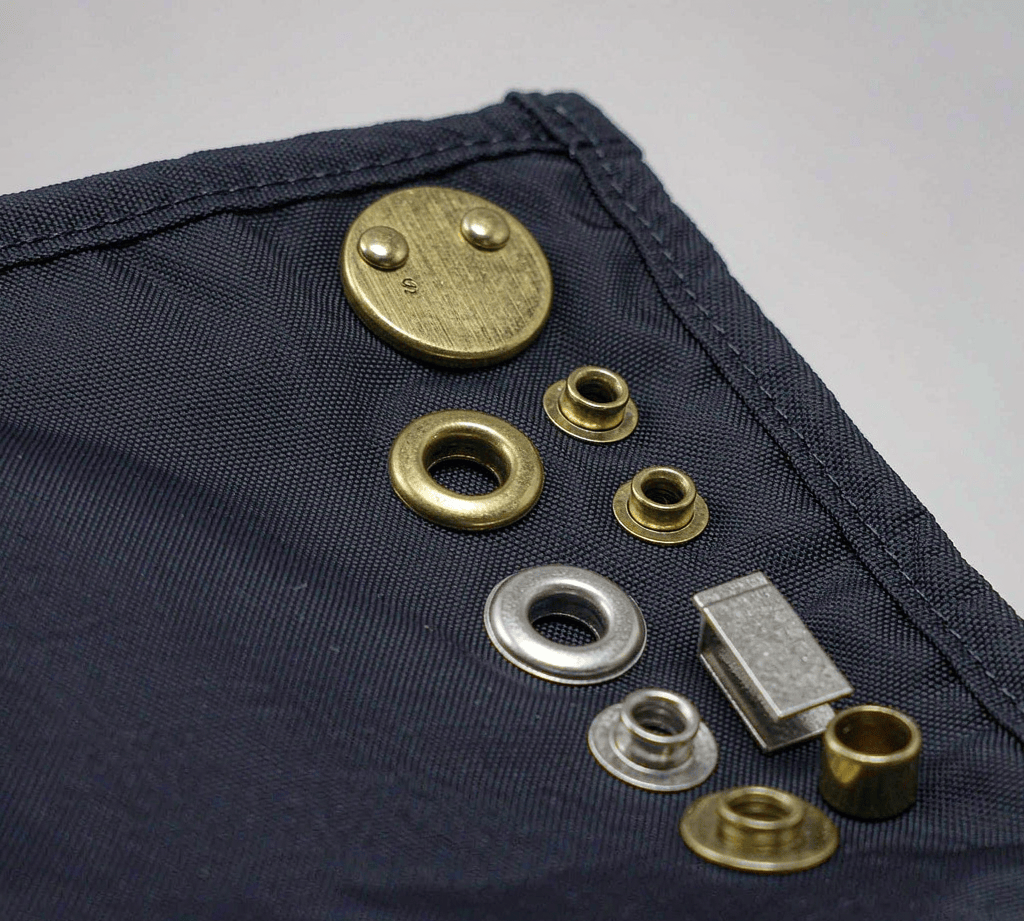
“Eyelet” usually refers to a reinforced hole with a thin metal ring, while a “grommet” is a heavier two-piece component: a male spur and a female washer that lock the fabric between them. Both protect the hole from tearing, but grommets handle far more pull. If a strap, carabiner, or compression cord will load the point, spec a grommet rather than a simple eyelet. The guide to metal hardware plating and corrosion resistance explains why the surrounding finish matters as much as the ring itself.
Material and plating choices
Most bag grommets are brass, stainless steel, or zinc alloy. Brass takes plating well and resists corrosion in humid use; stainless is the safe pick for beach, dive, and cooler bags that see constant moisture; zinc alloy is the budget option for light-load decorative points. The plating — nickel, black oxide, antique brass — is cosmetic until it wears through, so match the plating grade to the bag’s environment rather than its catalog shot.
Sizing and how they are set
The number buyers care about is inner diameter: 6 mm suits a lash cord, 10–12 mm fits a finger pull or drain spout. A grommet is set with a washer (most common) or a socket (lower profile, used on thin fabric). Ask the factory to confirm the setting tool matches the brand you specify — a mismatch leaves a loose ring that spins and eventually rips out.
Where to place them, and why
Placement is a function conversation, not decoration:
- Drainage — cooler, wet-pack, and wash bags get one or two grommets at the lowest point so liquid escapes instead of breeding odor.
- Ventilation — shoe and dirty-clothes bags use eyelets in breathable panels to cut mildew.
- Lash points — outdoor and travel bags get reinforced grommets for compression cords or carabiners.
- Reinforcement — handle and base pivot points sometimes get a grommet as a wear-resistant anchor, a topic covered in stress-point reinforcement for bags.
If the bag claims water resistance, coordinate the drainage holes with the water-repellency rating and test method so a drain does not become the leak.
Drainage is also the cheapest odor control available: letting water out of a wet compartment does more for long-term smell than any finish, and the rest of the approach is set out in our note on odor-control linings for bags.
Reinforcing the fabric around the hole
A grommet is only as strong as the cloth it grips. Spec a woven reinforcement patch (often the same high-denier body fabric) behind the point, and request bar-tacks or an X-box stitch so load spreads across the panel. The fabric denier and coating choice drives how thick that patch needs to be.
What to write in the tech pack
Buyers who hand the factory a one-line “add grommets” note get inconsistent results. A usable spec lists material, plating grade, inner diameter, setter type, exact placement coordinates, and the reinforcement behind each point. For the full structure, see the tech pack guide for custom bag production.
Hole position is a dimensional callout too, so it belongs in the same tolerance discussion as the rest of the build.
On retail programs the ring often carries the hangtag string, so settle the retail labeling spec at the same time.
Once the tech pack is final, the same document should name acceptance tests — a bag drop test is the most common way to prove the base and seams survive shipping.
FAQ
Are brass grommets safe for bags that get wet?
Brass resists corrosion well, but in constant saltwater or chlorinated environments stainless steel is the safer long-term choice. Match the metal to where the bag will actually be used, not just to the showroom.
How many grommets does a cooler bag need?
Usually one or two at the lowest point is enough for drainage. More holes mean more leak paths, so add them only where a function (drain spout, lash point) justifies the cut.
Can eyelets replace grommets on a load-bearing point?
Not reliably. An eyelet is a thin ring meant for low-stress ventilation or decoration. Any point that a strap or cord will pull on should use a two-piece grommet with a washer.
Does plating affect ring strength?
Plating is a surface finish and does not change the base metal’s strength, but a worn or flaking finish exposes the substrate to corrosion, which eventually weakens the ring. Spec the plating grade for the bag’s environment.