A gym bag that smells after three weeks is one of the most common complaints in the sports bag category, and also one of the easiest to prevent. The fix is rarely a stronger chemical. It is usually a combination of liner choice, airflow, and something as unglamorous as where the drain hole sits.
Where bag odor actually comes from
Fresh perspiration is close to odorless. The smell develops when bacteria and fungi on the fabric break down sweat residue and skin oils. That needs four things at once: moisture, warmth, organic residue, and time. Remove any one and the odor largely stops developing. The lining fabric also has to clear the same tensile and tear strength gate as the shell, or it rips at the seams once it is loaded with damp kit.
A bag supplies all four by default: it is closed, carried against a warm body, and usually holds damp kit. Materials decide how long the moisture stays. Open-cell foam, non-woven interlinings, brushed tricot and canvas hold water and dry slowly. Coated polyester sheds water fast, but if the compartment is sealed the water just sits at the lowest seam.
Two construction details make it worse: a wet compartment that opens into the main body, so odor migrates into everything else, and a pocket with no drainage at all.
What an antimicrobial finish does — and doesn’t
Most odor-control finishes inhibit microbial growth on the treated surface rather than absorbing smell. Silver-based systems, quaternary ammonium compounds and zinc pyrithione are the common chemistries, applied at the fabric finishing stage or as part of a liner coating.
What matters in sourcing is how the finish is held on the fibre. A leachable finish migrates to the surface but depletes with washing and abrasion. A bonded finish stays put and lasts longer, acting only on contact. Neither cleans a dirty bag, neither stops mould on soil, and neither dries a sealed compartment.
Activated-carbon interlinings work differently, adsorbing odor molecules instead of inhibiting growth. They saturate and then stop working, which suits a small shoe pocket better than a whole bag body.
Design moves that do more than any finish
Airflow needs an inlet and an outlet. A single mesh panel barely moves air; a 3D spacer mesh panel opposite a vent lets damp air leave. Vents placed high and low on the same wall work better than two side by side, because warm air rises and pulls replacement air in behind it.
Drainage matters just as much. A grommet at the lowest point of a wet compartment lets water out instead of pooling in the seam, which is why eyelet and grommet placement belongs in the same conversation as odor control.
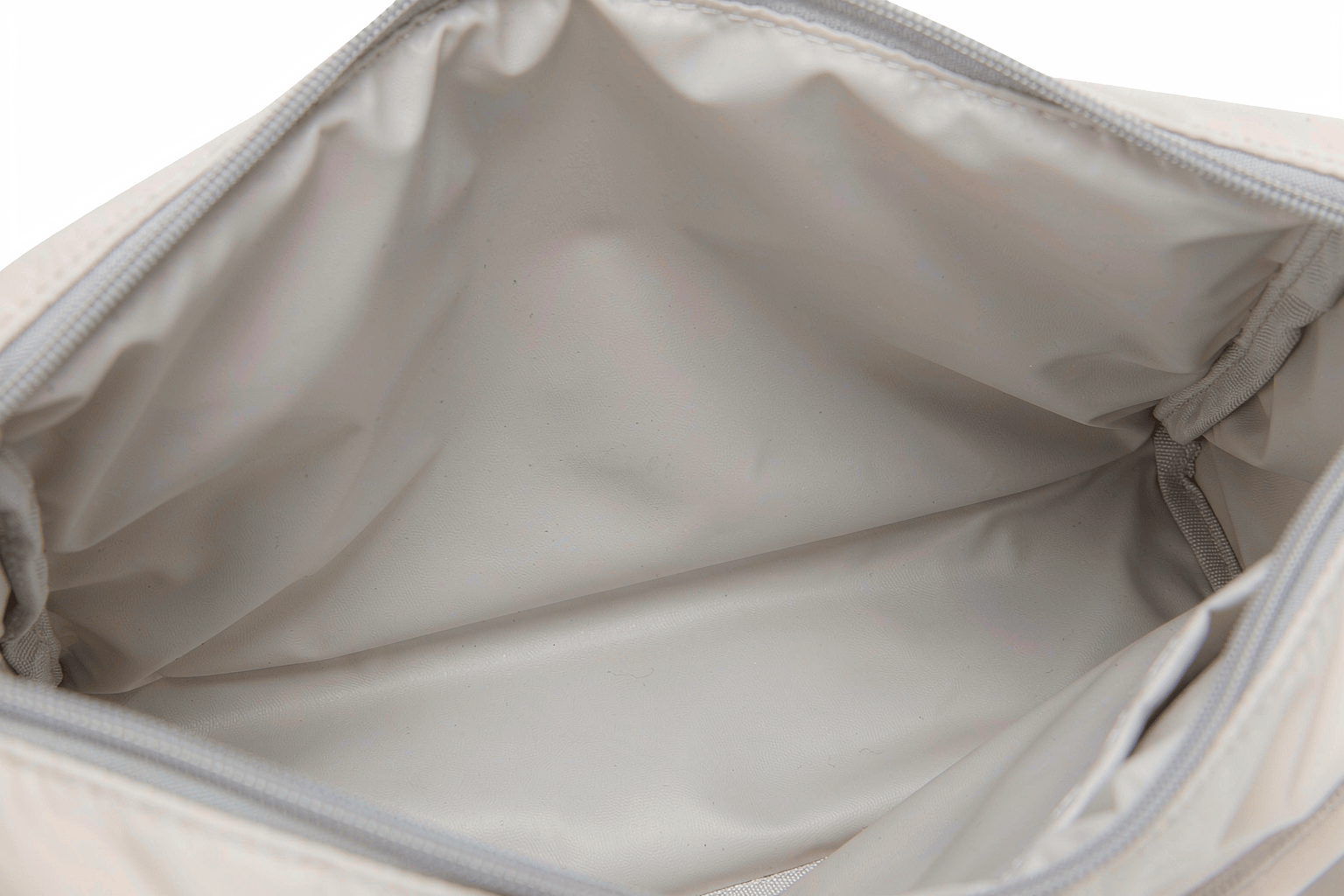
Liner selection is the third lever. A smooth, wipe-clean liner with few seams can be wiped down, which removes the residue microbes feed on; a brushed or foam-backed lining cannot. Where padding is unavoidable, closed-cell foam holds far less water than open-cell — the trade-offs are in foam padding specifications. Coating and construction options are covered in the lining fabric guide.
Specifying odor control in a tech pack
“Anti-odor” is not a specification. A quotable line names the liner substrate, the finish, the test method, the target and the durability requirement, plus which panels are treated — treating the whole body costs more than treating the shoe pocket where the problem starts.
For testing, ask for antibacterial activity by AATCC 100 or ISO 20743, and mould resistance by AATCC 30 for humid markets. Ask for the report on the actual production liner rather than a generic lab fabric, and state how many wash or abrasion cycles the finish must survive.
Compliance belongs in the same conversation. In the US antimicrobial treatments are regulated as pesticides; in the EU treated articles fall under the Biocidal Products Regulation. Confirm the active substance is approved for your market, and keep copy conservative — “reduces odor-causing bacteria on the treated surface” is defensible, health claims generally are not.
What to verify before bulk
Ask for the finish datasheet and a test report dated within the year. Then smell-test a production sample: load the wet compartment with damp fabric, close it, leave it two days, open it. If odor is already strong in the sample, no finish on the spec sheet will rescue bulk.
Confirm bulk uses the same liner roll and finish lot as the approved sample, and put it on the inspection sheet so it gets checked rather than assumed.
FAQ
Do antimicrobial linings last the life of the bag?
No. Every finish depletes with abrasion and washing. A bonded finish usually outlasts a leachable one, so treat odor control as a durability spec, not a permanent property.
Is a ventilated compartment enough on its own?
Rarely. Ventilation slows the problem, but a wet towel pressed against foam padding will still smell. Pair airflow with drainage and a liner that can be wiped dry.
Should the whole bag be treated or just the wet compartment?
Start with the compartment where moisture collects. Treating the entire body adds cost for panels that never get damp.
Which test report should I ask the factory for?
Antibacterial activity by AATCC 100 or ISO 20743 on the production liner, plus AATCC 30 if mould matters. Insist it names your substrate, not a generic swatch.
Related reading
Odor control only delays the first wash. For what happens after, see the long-form guide on how to clean a sports bag.