Ballistic nylon is one of the most requested fabrics for rugged bags, but “ballistic” describes a weave, not a fiber. If a tech pack only says “1680D ballistic,” the most failure-prone details are still undefined. A workable spec pairs denier with the bag’s job, names the coating and hydrostatic head, and quotes a verified abrasion test—then reinforces the attachment points, where most bags actually fail. For panels where snag resistance matters more than puncture strength, a ripstop weave over a lighter base cloth is usually the better trade.
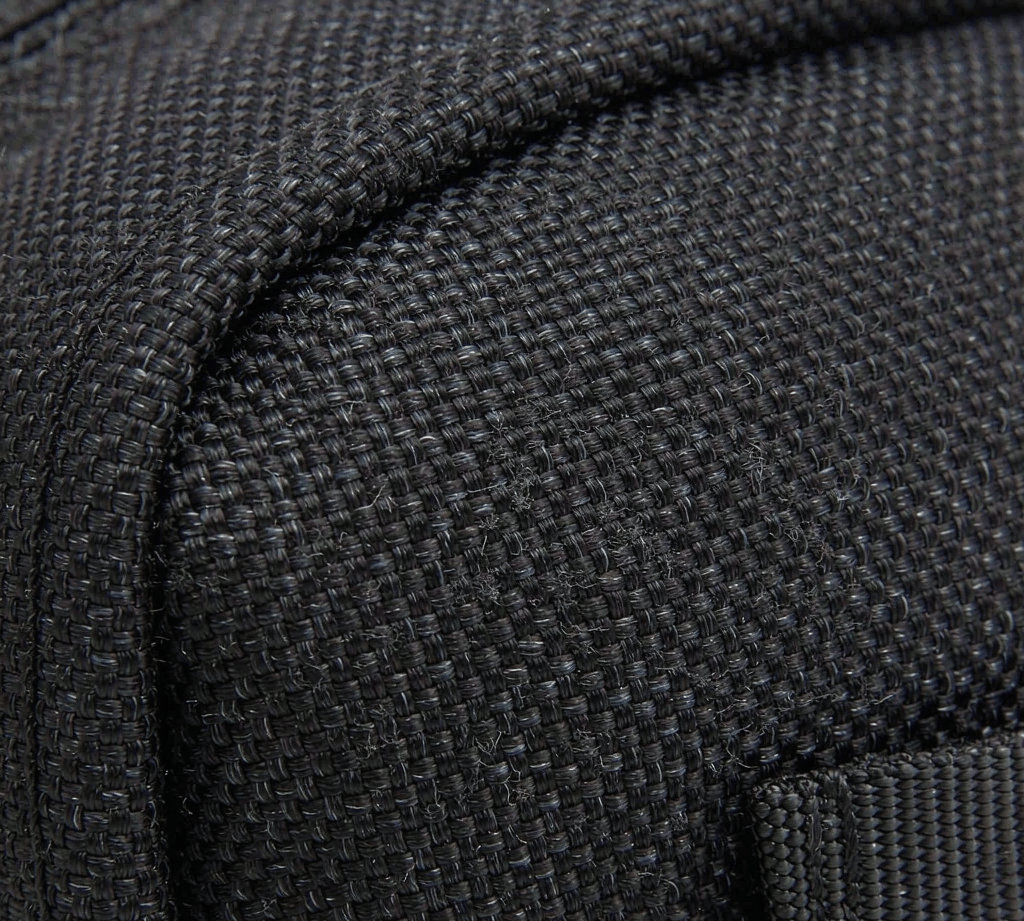
What “ballistic” actually means
Ballistic nylon uses a basket weave: two or more yarns are interlaced as one, which gives a coarse, rigid surface that resists abrasion far better than a plain weave of the same yarn. The fiber behind it matters. Nylon 6,6 holds strength and color better than nylon 6, and both outperform polyester. A “polyester ballistic” panel exists and is cheaper, but it is noticeably weaker—buyers who assume “ballistic” alone means toughness often get caught out. For the underlying denier and coating basics, see our guide to denier and coating on bag fabrics.
Match the denier to the bag’s job
Denier is yarn thickness, not a quality score. Common buyer tiers run roughly 525D–840D for light commuter bags and laptop sleeves, around 1050D for everyday backpacks and travel bags, and 1680D for checked luggage and expedition duffels that take daily abuse. These are starting points buyers use to brief a factory, not a single industry standard—define the number against the use case and expected handling. Heavier denier is stiffer, costlier, and slower to sew, so over-specifying a commuter bag just adds weight and price.
The coating decides waterproofing, not the denier
A nylon face fabric is not waterproof on its own. Protection comes from the coating and the seams. PU coating typically lands around 1,500–10,000 mm hydrostatic head and stays flexible; PVC pushes past 10,000 mm but feels stiff and heavy. DWR sheds surface water, and taped or welded seams stop the leaks that uncoated stitch lines let through. When you compare options, read the water-resistance ratings buyers should ask for rather than trusting the denier number. Most coatings also degrade over a few years, so put the expected performance window in the contract.
Verify before you commit to bulk
Request the test data, not the marketing line. Martindale or Taber abrasion cycles show how long the surface lasts; ASTM D5034 grab strength and tear tests show how it behaves under load. Ask each supplier for coating thickness, adhesion rating, and batch-to-batch color tolerance before bulk. Our breakdown of grab and tear strength tests covers the methods and what a pass looks like. If the bag will sit in sun, factor in the UV breakdown of bag fabrics so the shell does not chalk or weaken ahead of schedule.
Reinforce where bags actually break
The fabric is rarely the first thing to fail. Handles, shoulder straps, zipper perimeters, and base corners take the load, and warranty claims cluster there. Specify bar-tacks at every stress point, double-layer webbing at strap anchors, and backing patches on high-wear panels. A correct fabric with weak attachments still returns to the factory; good construction is what keeps the spec honest. The base corners include the gusset folds, where bag gusset construction shows how depth tolerance and edge finishing keep the panel from puckering under load.
FAQ
What denier ballistic nylon should I specify?
Use 525D–840D for light commuter and sleeve applications, about 1050D for everyday backpacks and travel bags, and 1680D for checked or expedition luggage. Set the number against the bag’s handling, not a default.
Is ballistic nylon waterproof?
Not by itself. The weave is abrasion-resistant, but waterproofing comes from the PU or PVC coating, the DWR finish, and taped or welded seams. Always specify hydrostatic head and seam treatment.
How do I verify a supplier’s ballistic nylon?
Ask for Martindale or Taber abrasion cycles, ASTM D5034 grab and tear strength, coating thickness, and adhesion rating. Request a swatch and a test report before committing to bulk yardage.
What is the difference between ballistic nylon and Cordura?
Both are durable nylons, but Cordura is a branded nylon 6,6 construction with its own certification and licensing. Ballistic is a basket weave any mill can make. Confirm whether the factory is authorized to use the Cordura name before paying for it.
For a wider view of material trade-offs across a product line, our guide to choosing the right bag material walks through nylon, polyester, canvas, and recycled options side by side.
If you are specifying the base cloth, also see our guide to fabric bursting strength and how it complements tear testing.