Most buyers obsess over fabric and forget the small metal and plastic pieces that actually hold a strap to the bag. A shoulder strap can use great webbing and still fail at the connector. When you specify strap attachment hardware up front, you remove one of the most common causes of returns on totes, backpacks, duffels and luggage.
The same rule applies to a hip belt buckle and webbing: the hardware has to match the webbing width and the load the belt actually carries.
The connectors you’ll actually spec
A handful of shapes cover almost every bag:
- D-rings sit where a strap meets the body. They let a shoulder strap pivot instead of tearing at a fixed point.
- Triglide sliders adjust webbing length — the flat, three-slot piece you slide to tighten a strap.
- Swivel snap hooks and lobster clasps clip a strap to a fixed point and rotate freely, which stops the strap from twisting.
- G-hooks are the low-profile alternative used on minimalist straps and convertible bags.
Each type carries load differently, so the shape you pick changes how the bag feels and how long it lasts.
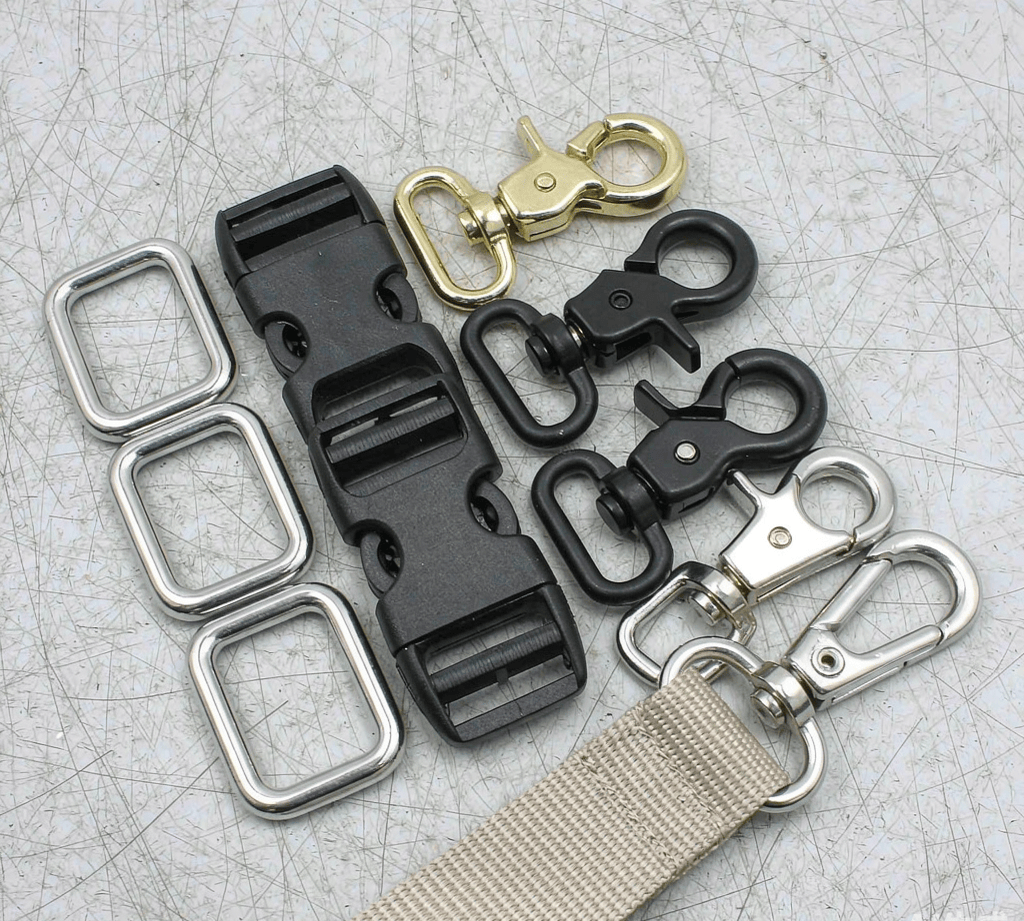 Elastic shock cord on bags usually terminates in cord locks and triglides like the hardware above; the cord behind them is set out in our shock cord spec guide. These same D-rings and triglides also anchor the rows of a modular webbing grid when a bag needs external mounting points.
Ask for a rated break strength
The single most useful number on a hardware spec sheet is break strength, usually given in kilograms or pounds. A swivel hook rated at 20 kg is fine for a light crossbody but wrong for a loaded duffel. Ask the factory for test data rather than a verbal “it’s strong.” For bags meant to carry real weight — gym duffels, tool bags, luggage — request hardware matched to at least the bag’s filled weight plus a safety margin. This is the same logic behind where bag stress points concentrate: the connector is part of that load path.
Match the hardware to the webbing
A triglide or D-ring is sized to a webbing width. A 25 mm slider will not grip 38 mm webbing, and forcing it leaves a sloppy, weak connection. When you write the webbing and strap specification, list the hardware widths in the same document so the two never drift apart during sampling. Factories sometimes substitute a “close enough” size to use stock inventory; naming the exact width keeps that from happening.
Material and finish decide lifespan
Hardware comes in zinc alloy, steel, aluminum and various plastics. Outdoor and sports bags need metal that survives humidity and salt air, which is where corrosion-resistant finishes matter. A cheap plating can flake inside a season and leave black marks on clothing. For bags that ship to coastal or winter-road-salt markets, specify the salt-spray test level you expect.
Connectors are not closures
It’s easy to confuse strap hardware with the parts that actually fasten a bag shut. Buckles and snaps that open and close are a different category — see the guide to bag closures and fasteners for those. Connectors stay fixed; closures move. Keeping the two spec lists separate saves confusion when you review a quotation.
Attachment is part of the spec
A perfect D-ring is useless if it’s sewn on with a single line of stitching. The ring should be bar-tacked or box-stitched into a reinforced patch so the load spreads across the panel. This is why hardware choice and structural reinforcement belong in the same engineering discussion, not two separate emails.
On commuter bags, a short length of retroreflective trim near the strap end does more for night visibility than a larger patch elsewhere.
The same load-spreading thinking carries over to bag bottom feet, where a backing plate behind each foot stops it tearing out of thin base fabric.
Quick buyer checklist
- State break strength per connector, with test data.
- Match every slider and ring to the webbing width in writing.
- Name the material and the finish, especially for outdoor use.
- Confirm the attachment stitch (bar-tack or box-x) in the tech pack.
Frequently Asked Questions
What break strength should I request for bag strap hardware?
There is no single number. Start from the bag’s filled weight and add a margin — many buyers spec connectors at two to three times the expected load. Ask for the factory’s test report so the rating is verified, not assumed.
Are plastic triglides strong enough?
For light bags they are fine and cheaper, but plastic creeps and cracks under sustained load and heat. For heavy or outdoor bags, metal triglides are the safer default.
Why does my D-ring keep twisting the strap?
A fixed D-ring lets the strap pivot and twist. If the strap twists, switch to a swivel snap hook or a swivel D-ring, which rotates at the connection point and keeps the strap flat.
Do I need to specify hardware in the tech pack?
Yes. Leave it out and the factory picks from stock, which often means a slightly wrong width or a weaker finish. A one-line note per connector prevents most of these substitutions. Trim deserves the same treatment: the tape that closes a strap end or a bound opening is spec´d the same way, which is set out in edge binding and piping.
For a deeper buyer-side view of specifying backpacks, including how straps and hardware fit the whole build, see the backpack buying guide for brands.
Buyers comparing suppliers can review our full bag catalog for OEM/ODM specs, materials, and MOQ.